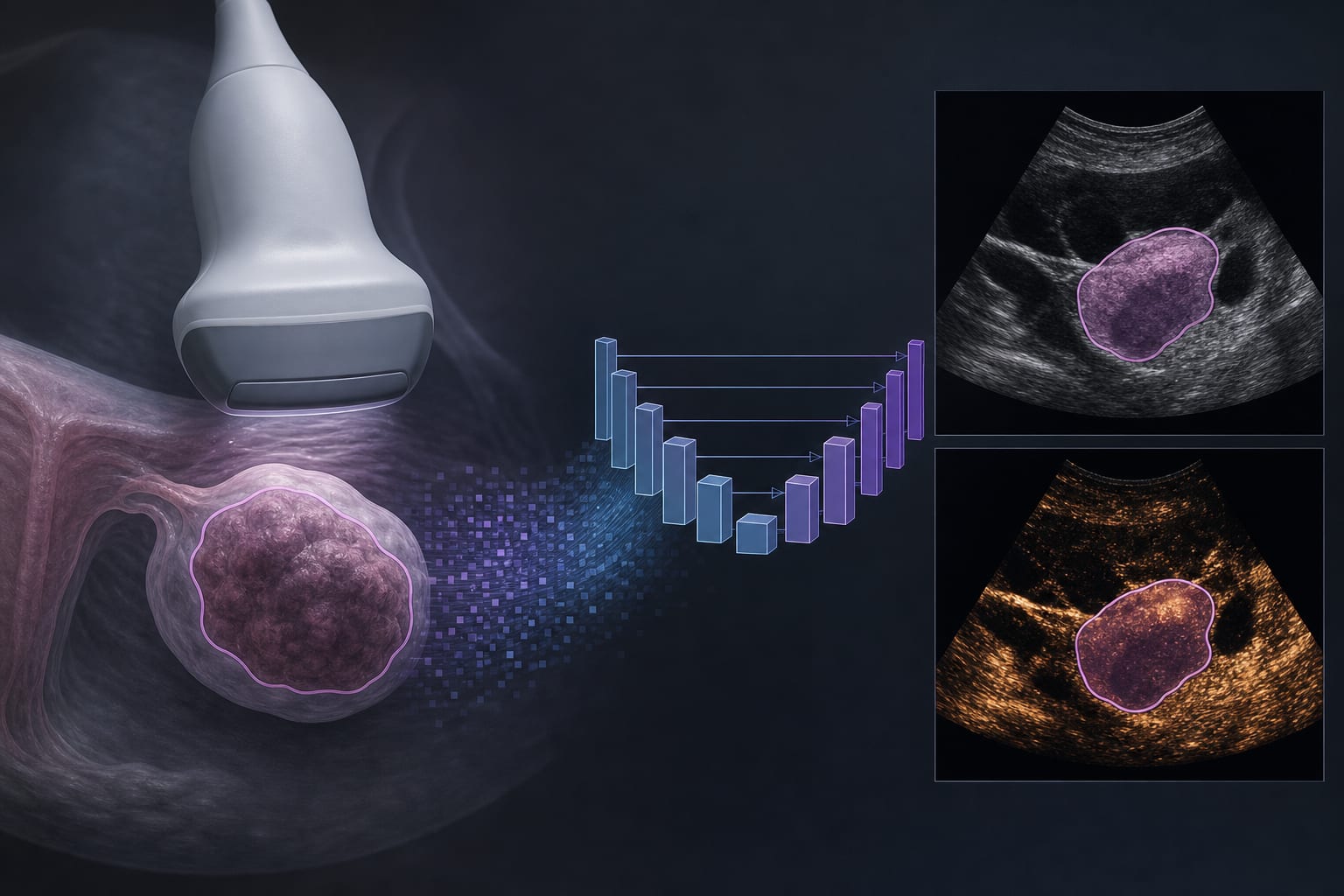
To evaluate whether training-only combined ultrasound-specific augmentation can improve robustness of ovarian tumor segmentation models without adding inference-time complexity.
Approach:
Data Used: Utilized MMOTU image-mask pairs, including 820 B-mode ultrasound images, 382 internal two-dimensional ultrasound images, and 170 contrast-enhanced ultrasound images.
Model Comparison: Compared a lightweight Residual U-Net with a version trained using photometric, blur, and low-amplitude noise augmentation.
Performance Evaluation: Assessed performance using overlap, boundary, and pixel-calibration metrics; applied Wilcoxon signed-rank tests for paired CEUS differences.
Training-only combined ultrasound-specific augmentation yielded a small but directionally favorable improvement in CEUS segmentation without added inference-time complexity.
Limitations:
CEUS segmentation remained suboptimal despite improvements.
Findings require further validation at the patient level and across multiple centers.
Conclusion:
The study supports training-distribution design as a practical low-cost strategy for modality-shift robustness.