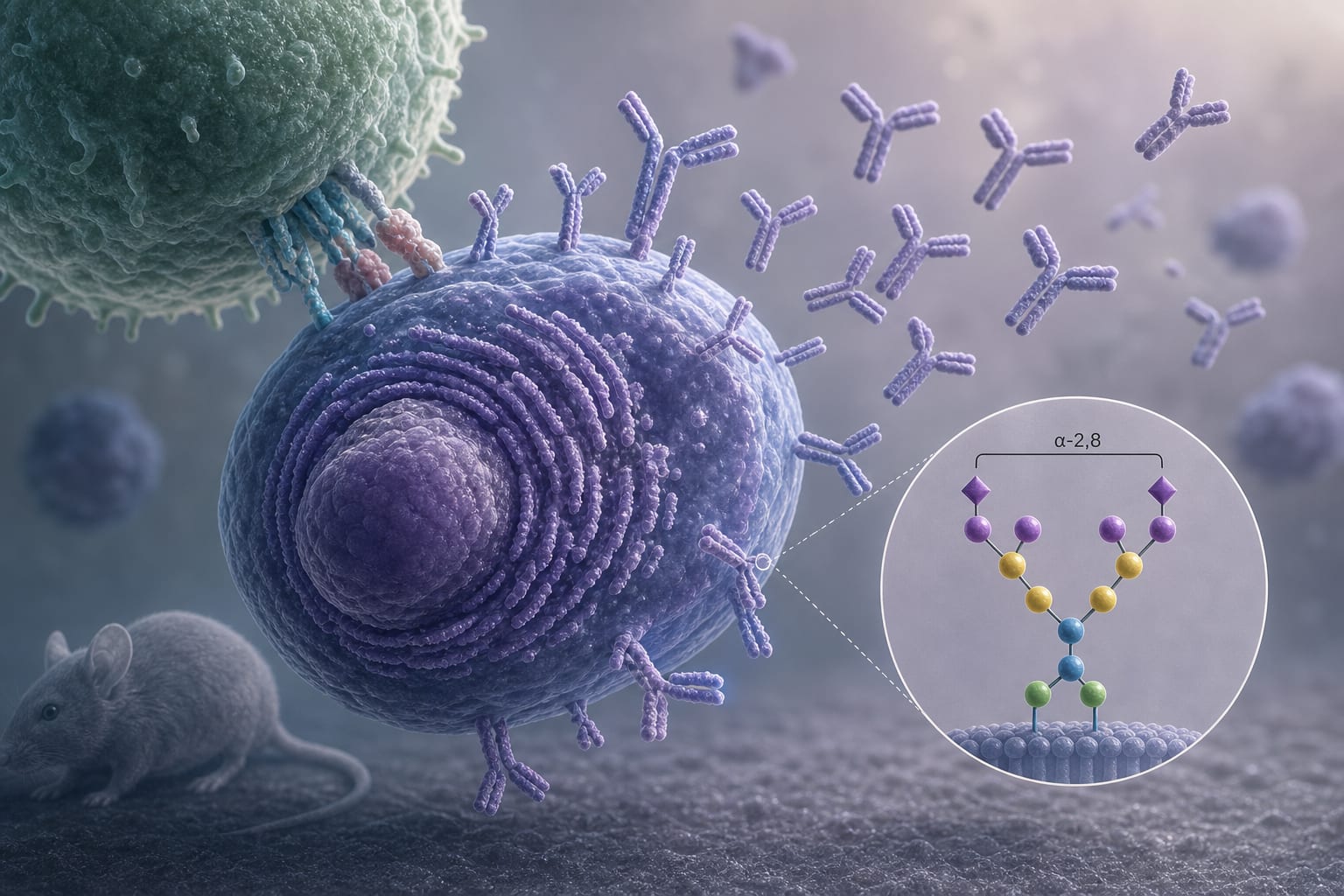
Loss of ST8Sia6 mediated α-2,8-linked di-sialylation enhances T cell-dependent antibody responses and promotes autoimmunity in aged mice - Summary - MDSpire
Advertisement
Loss of ST8Sia6 mediated α-2,8-linked di-sialylation enhances T cell-dependent antibody responses and promotes autoimmunity in aged mice
To investigate the role of ST8Sia6 in the immune system and its impact on T cell-dependent antibody production and autoimmunity in aged murine models.
Approach:
Mouse Model: Utilized St8sia6 knockout mouse model to study immune responses.
Key Findings:
St8sia6-/- mice exhibited normal B cell and plasma cell development.
Enhanced B cell proliferation and increased IgG1 response upon T cell-dependent immunization were observed in St8sia6-/- B cells.
Aged St8sia6-/- mice showed enlarged populations of germinal center B cells and elevated levels of anti-nuclear IgG autoantibodies, indicating autoimmunity.
CD45 was identified as a carrier protein of O-acetylated α2,8-linked di-sialic acids on plasma cells.
Interpretation:
Loss of ST8Sia6-mediated α-2,8-linked di-sialylation enhances T cell-dependent immune responses and promotes an autoimmune-like phenotype in aging.
Limitations:
The study was conducted in a specific mouse model, which may not fully represent human autoimmune conditions.
Further research is needed to explore the mechanisms underlying the observed immune responses.
Conclusion:
The findings indicate a role of ST8Sia6 in regulating immune responses and autoimmunity in aged mice.
by Ronja Brüchert, Michael Hinzpeter-Schmidt, Bettina Röder, Mareike Krause, Stefanie Brey, Thomas H. Winkler, Falk F. R. Buettner, Martina Mühlenhoff, Lars Nitschke