Integrative and interpretable machine learning framework for early non-invasive detection of clinically significant liver fibrosis - Summary - MDSpire

Integrative and interpretable machine learning framework for early non-invasive detection of clinically significant liver fibrosis

  • By

  • Dong Cao

  • Junjie Wang

  • Chenxi Hou

  • Jingyu Zeng

  • Baiyue Tian

  • Yuan Liu

  • Xing Luo

  • Jiaxin Tian

  • Mingbo Zhou

  • Pan Li

  • Huilong Fang

  • Ze Liu

  • Zheng Gong

  • June 23, 2026

  • 0 min

Share

Objective:

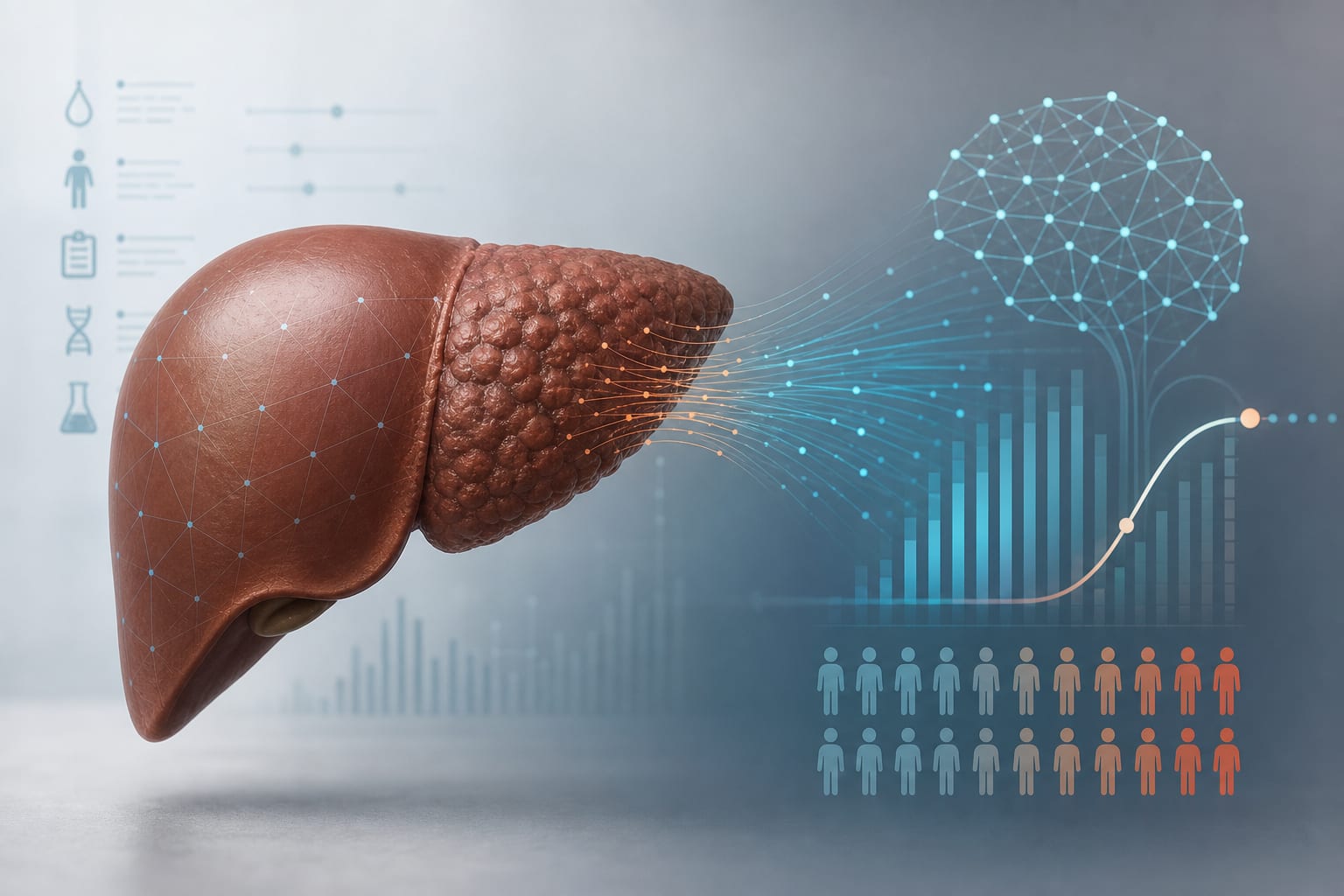
To develop a predictive model for the early identification of clinically relevant liver fibrosis and determine its principal risk factors using clinical data from NHANES 2017–2020.

Approach:
    Key Findings:
    • Primary predictors of liver fibrosis included body mass index (BMI), aspartate aminotransferase (AST), and waist circumference (WC).
    • The model achieved an AUC of 0.824 in the training cohort and 0.872 in the testing cohort.
    • External validation maintained strong performance with an AUC of 0.848.
    Interpretation:

    Increased AST and WC were identified as factors that heighten the estimated risk of liver fibrosis.

    Limitations:
    • The study relies on clinical data which may not capture all relevant factors influencing liver fibrosis.
    • Potential biases in the NHANES dataset could affect the generalizability of the findings.
    Conclusion:

    The interpretable machine learning model provides a non-invasive method for the prompt detection of clinically relevant liver fibrosis, suitable for primary care settings.

Original Source(s)

Related Content