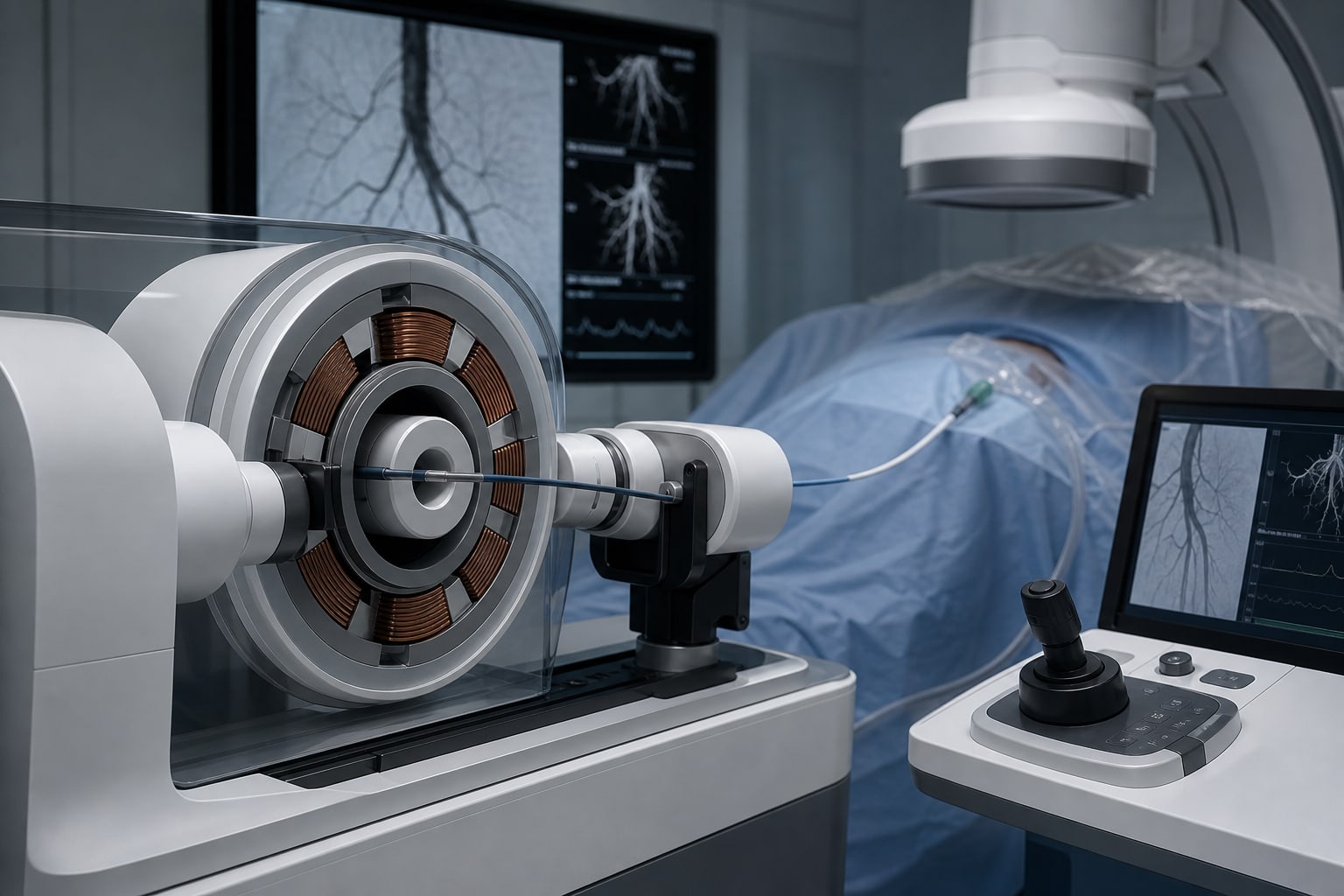
To develop and evaluate a catheter-driving architecture that utilizes magnetic actuation to enhance catheter navigation while maintaining sterility and compatibility with commercial catheters.
Approach:
System Overview: The FlyCaD prototype consists of a reusable static base module and a dynamic upper module with a disposable cartridge for catheter manipulation.
Magnetic Actuation Module: The system employs magnetic coupling between internal and external magnets to transmit torque across a sterile barrier without mechanical contact.
Linear Advancement Method: Catheter advancement is achieved through a sequence of gripping, translating, and releasing, allowing for incremental movement.
Sterile Interface: The design separates reusable components from the catheter, with only the disposable cartridge in direct contact, though sterility validation was not performed.
Control Software and Hardware: Control is managed by an Arduino microcontroller and MATLAB interface, with an estimated latency of 5–20 ms.
Experimental Setup: The system was tested in vascular phantoms to evaluate its performance in catheter navigation under various conditions.
Key Findings:
The FlyCaD system successfully demonstrated the ability to grip, advance, and reposition catheters in simulated environments.
The magnetic actuation allows for contactless operation, preserving sterility and reducing the risk of contamination.
Initial tests showed successful completion of programmed cycles without loss of grip.
Interpretation:
Limitations:
No microbiological sterility or contamination testing was performed.
The sterility claim is based on design rather than empirical validation.