Risk factors for thrombosis in tuberculosis patients admitted to a tuberculosis-dedicated intensive care unit: a retrospective cohort study - Summary - MDSpire
Advertisement
Risk factors for thrombosis in tuberculosis patients admitted to a tuberculosis-dedicated intensive care unit: a retrospective cohort study
To identify independent risk factors for thrombus formation, evaluate the predictive value of inflammatory biomarkers, and explore determinants of IL-6 levels in critically ill tuberculosis patients.
Approach:
Study Design: Retrospective cohort study of 168 tuberculosis patients admitted to the ICU, with data collected on demographics, clinical features, and laboratory results.
Data Analysis: Univariate and multivariable binary logistic regression analyses were performed to identify risk factors, and multivariable linear regression was used to assess factors associated with IL-6 levels.
Key Findings:
Advanced age (OR = 1.057, p = 0.001) and prolonged APTT (OR = 1.053, p = 0.041) were independent predictors of thrombus formation.
Fungal co-infection (OR = 3.185, p = 0.006) and non-TB bacterial co-infection (OR = 0.336, p = 0.038) also reached statistical significance.
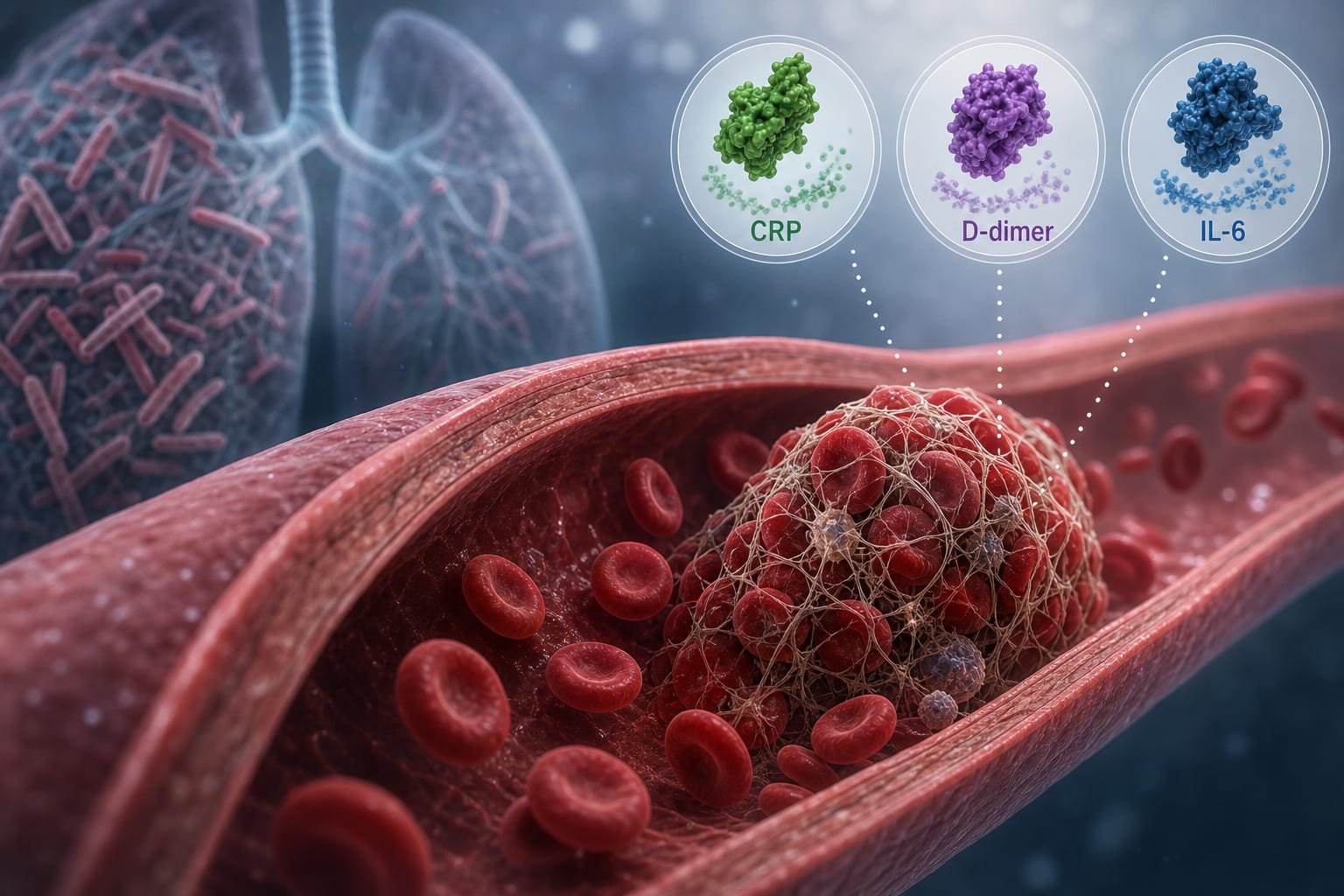
The base model yielded an AUC of 0.753; the addition of CRP, DDR, or IL-6 did not produce a statistically significant improvement in discriminatory performance (all p > 0.05).
Only CRP was independently associated with IL-6 levels (β = 0.423, p < 0.001).
Interpretation:
Age and APTT are significant risk factors for thrombosis in tuberculosis patients, with co-infection status influencing thrombotic risk.
Limitations:
The study is retrospective, which may introduce bias.
The sample size may limit the generalizability of the findings.
Conclusion:
Age and APTT are independent risk factors for thrombus formation in patients with tuberculosis. Fungal co-infection confers additional thrombotic risk, whereas non-TB bacterial co-infection exhibits a paradoxical protective effect.