Echocardiography-derived hemodynamic forces in cardiac resynchronization therapy: association with reverse remodeling and long-term outcomes - Summary - MDSpire
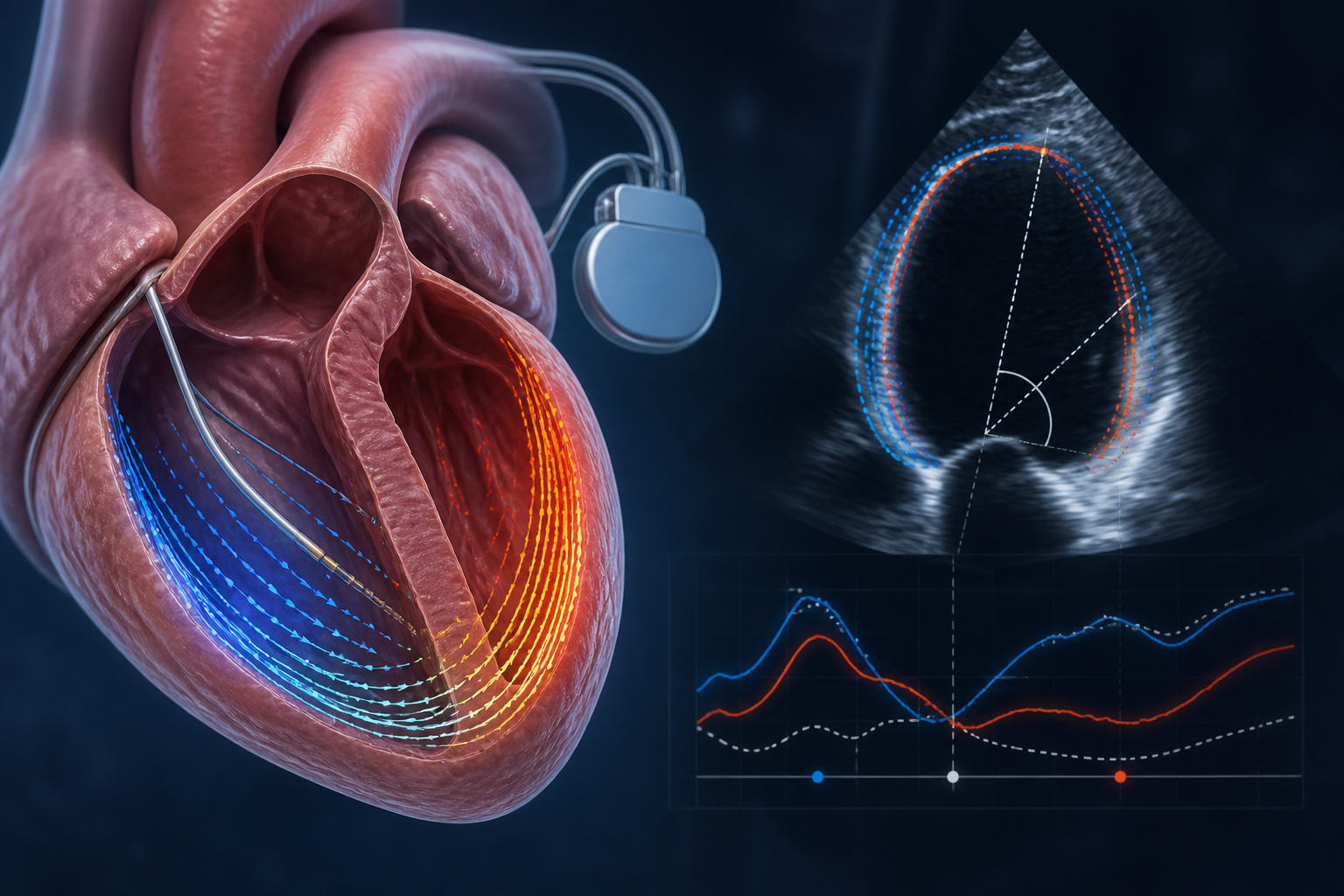
To evaluate the predictive and prognostic significance of hemodynamic force (HDF) parameters in patients undergoing cardiac resynchronization therapy (CRT) and examine changes after CRT implantation.
Approach:
Study Design: A post hoc analysis of 198 patients from the prospective, multicenter, observational MARC study, using archived echocardiographic images.
HDF Parameters Evaluated: Apical-basal force, latero-septal force, their ratio, force vector angle, systolic apical-basal force, and systolic angle.
Response Definition: CRT response is defined as a ≥15% reduction in left ventricular end-systolic volume at 6 months.
Statistical Analysis: Models assess associations with CRT response and the incremental value of HDF parameters. Cox regression evaluates the composite endpoint of all-cause mortality or cardiovascular hospitalization during long-term follow-up.
Key Findings:
At 6 months, 120 patients (60.6%) demonstrate echocardiographic response to CRT.
Adding baseline systolic angle to established clinical, electrocardiographic, and echocardiographic markers significantly improves model fit for CRT response but does not significantly improve discrimination.
Responders show significant improvements in HDF parameters after CRT; nonresponders show no significant changes.
Baseline systolic angle is independently associated with all-cause mortality or cardiovascular hospitalization over a median follow-up of 9.3 years. Its addition improves prognostic model performance but does not significantly improve discrimination.
Interpretation:
HDF parameters provide complementary insight into ventricular mechanics in patients undergoing CRT. Baseline systolic angle is independently associated with reverse remodeling and long-term outcomes, but its incremental clinical predictive value remains uncertain.
Limitations:
This post hoc analysis is not specifically powered for these outcomes and includes a selected population meeting 2012 CRT guideline criteria, limiting generalizability to contemporary patients.
Systolic angle differences are small, approximately 1°–2°, and approach the technique’s measurement precision. Systolic angle has the lowest reproducibility among the HDF parameters.
HDF analysis requires high-quality images and careful measurements. Systematic cardiac magnetic resonance assessment of myocardial scar is unavailable.
The exploratory systolic angle threshold requires external validation. Device programming and biventricular pacing percentage are not incorporated into multivariable models.
Conclusion:
HDF assessment shows potentially relevant associations with CRT response and long-term outcomes, but adding systolic angle does not significantly improve discrimination. Further adequately sized, prospective studies in contemporary populations are needed to establish clinical value.
by Roberto Tarantini, Willem Gerrits, Cheyenne S.L. Chiu, Leonie Smit, Gilbert Heltzel, Luuk H.G.A. Hopman, Philippe C. Wouters, Maarten J. Cramer, Frebus J. van Slochteren, Rene van Es, Alexander H. Maass, Michiel Rienstra, Cornelis P. Allaart, Kevin Vernooy, Antonius M.W. van Stipdonk, Frederik J. de Lange, Dorien Laenens, Philippe van Rosendael, Jeroen J. Bax, Nina Ajmone Marsan