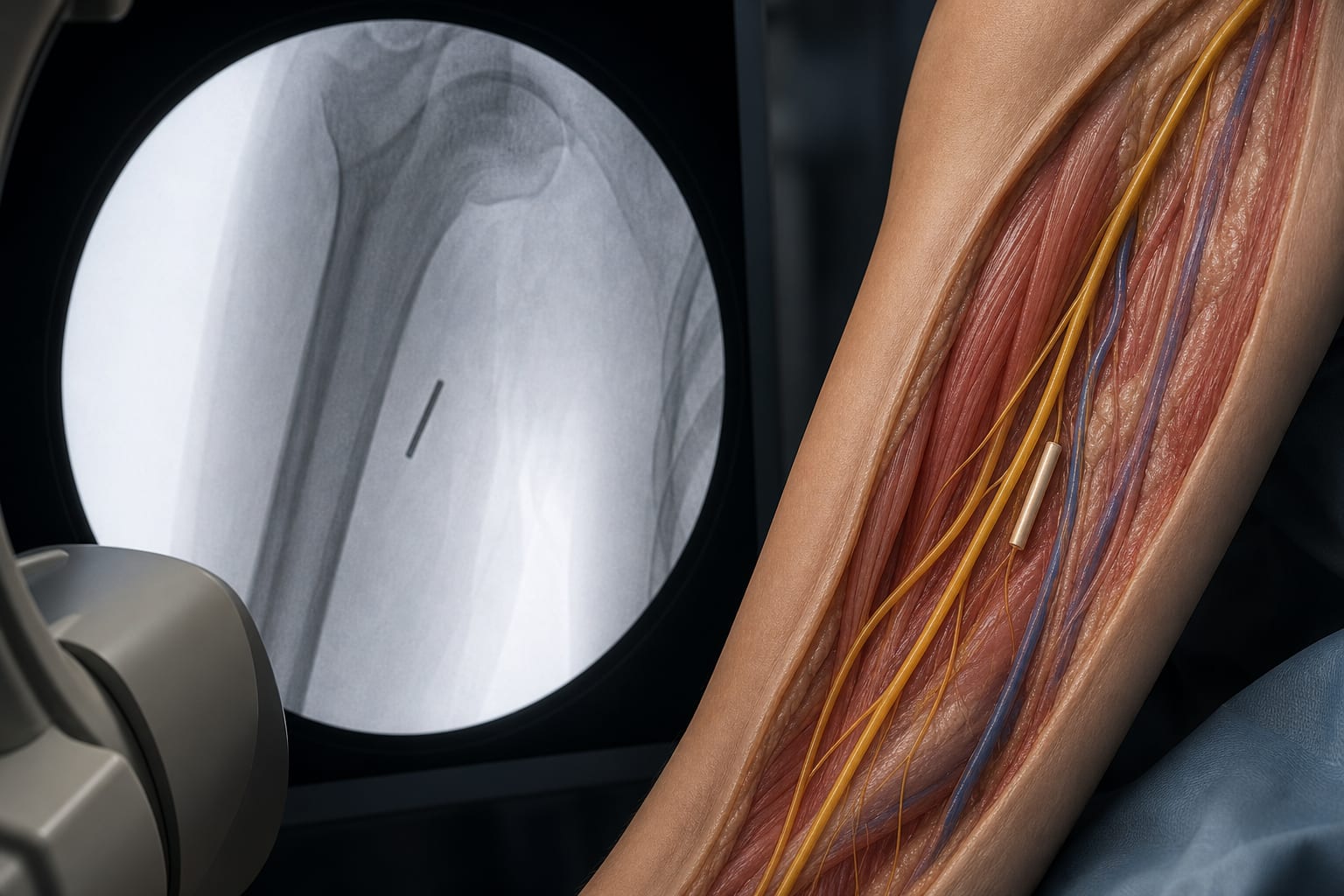
To report a case of a non-palpable etonogestrel implant that migrated and adhered to the ulnar nerve, emphasizing the clinical significance and challenges of its removal.
Key Findings:
The etonogestrel implant was non-palpable and had migrated adjacent to the ulnar nerve, posing significant removal challenges.
Conventional ultrasound guidance and hydrodissection were unsuccessful due to significant artifacts and further migration of the implant, highlighting the need for advanced imaging techniques.
Fluoroscopy-guided removal was effective for the extraction of the deeply placed implant, suggesting a viable alternative in similar cases.
Interpretation:
Fluoroscopy guidance is a viable alternative for the removal of migrated contraceptive implants when conventional methods fail, especially in proximity to neurovascular structures, underscoring the need for accurate localization.
Limitations:
The case is a single instance and may not represent broader outcomes, potentially limiting generalizability.
Fluoroscopy involves radiation exposure, which must be minimized, and the case may introduce biases inherent in single-case studies.
Conclusion:
Accurate localization and referral to specialists are essential for the safe removal of non-palpable contraceptive implants, emphasizing the importance of interdisciplinary collaboration.