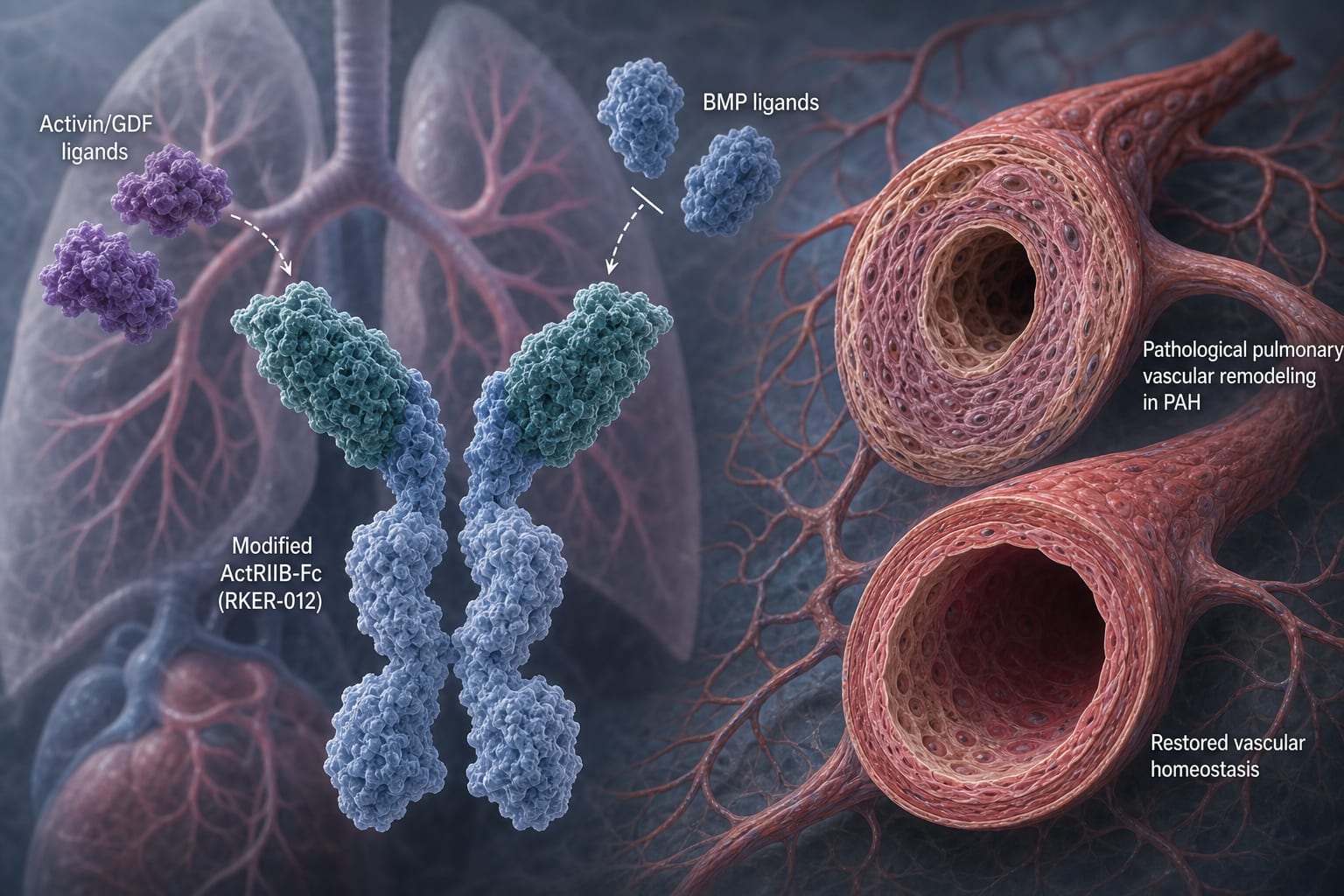
RKER-012, a modified ActRIIB-Fc ligand trap with BMP sparing properties, attenuates pathological features of experimental pulmonary arterial hypertension - Summary - MDSpire

RKER-012, a modified ActRIIB-Fc ligand trap with BMP sparing properties, attenuates pathological features of experimental pulmonary arterial hypertension

  • By

  • R. Keith Babbs

  • Jeanne Ishimwe

  • Chris Materna

  • ffolliott M. Fisher

  • Tandicka Nurse

  • Cynthia Pinkus

  • Pritesh Jain

  • Kevin Dagbay

  • Rosa Grenha

  • Tyler Daman

  • Claire C. Tseng

  • Emily A. Ledoux

  • Evan Lema

  • Alana Gudelsky

  • Francis Wolenski

  • Harveen D. Natarajan

  • Lorena Lerner

  • Jennifer L. Lachey

  • Jasbir Seehra

  • Sachindra R. Joshi

  • June 24, 2026

  • 0 min

Share

Objective:

To evaluate the efficacy and safety of KER-012/RKER-012, a modified ActRIIB-Fc ligand trap, in targeting overactive activin/GDF signaling in pulmonary arterial hypertension (PAH).

Approach:
  • Development of KER-012/RKER-012: Engineered a modified ActRIIB-Fc ligand trap to minimize BMP binding while retaining binding to Activin/GDF ligands.
  • Comparative Analysis: Compared the BMP-sparing properties of RKER-012 with RAP-011 (murine analog of sotatercept) in various models.
  • Efficacy Evaluation: Assessed the effects of RKER-012 on pulmonary vasculopathy, RV dysfunction, and remodeling in a SuHx rat model of PAH.
  • Clinical Trial: Conducted a Phase 1 clinical trial to evaluate the safety and pharmacokinetics of KER-012 in healthy post-menopausal women.
Key Findings:
  • KER-012/RKER-012 did not induce erythrocytosis or thrombocytopenia, unlike sotatercept.
  • The modified ligand trap effectively reduced the risk of hyperviscosity syndrome and bleeding.
  • RKER-012 attenuated experimental PAH by targeting multiple pathobiological components.
Interpretation:

The study suggests that KER-012/RKER-012 may provide a safer alternative to existing therapies by preserving BMP signaling while effectively targeting overactive activin/GDF pathways in PAH.

Limitations:
  • The study primarily focuses on preclinical models, and clinical efficacy in humans remains to be fully established.
  • Potential long-term effects and safety of KER-012/RKER-012 in diverse populations are not yet known.
Conclusion:

KER-012/RKER-012 represents a novel approach to targeting PAH, focusing on minimizing adverse effects associated with current treatments.

Original Source(s)

Related Content