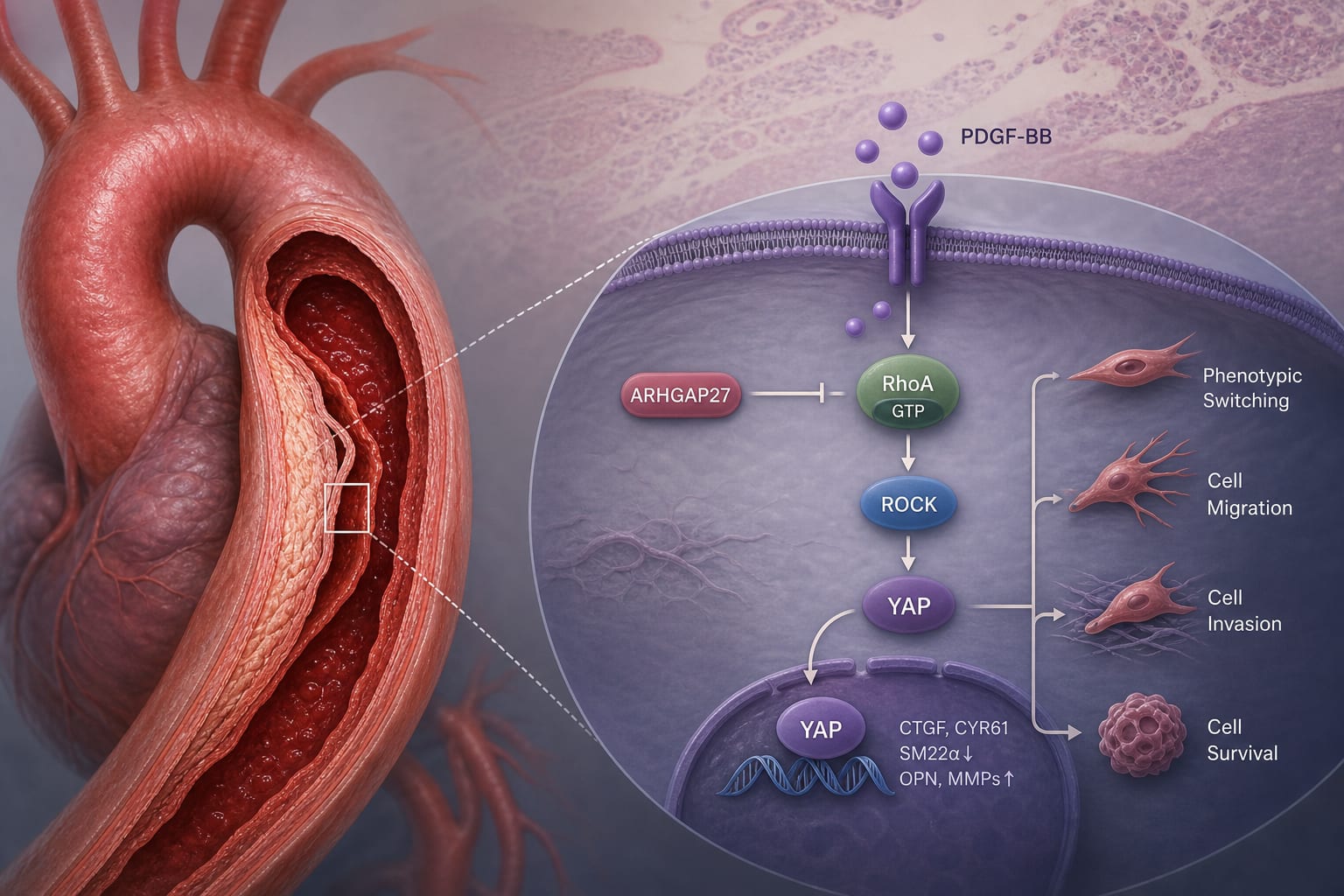
To validate the differential expression of ARHGAP27 in aortic dissection (AD) and explore its molecular pathways influencing AD progression.
Approach:
Data Analysis: AD-related datasets were downloaded from the GEO database to screen differential genes.
Tissue Examination: HE and IHC staining were used to detect pathological changes and ARHGAP27 expression in AD tissue.
In Vitro Experiments: AD cell models were constructed by inducing HAVSMCs with PDGF-BB to evaluate ARHGAP27's effects on cell survival, migration, invasion, and phenotypic switching.
Pathway Specificity Testing: Rescue experiments were performed using the ROCK activator LPA.
Key Findings:
ARHGAP27 was significantly upregulated in AD tissue and datasets.
Overexpression of ARHGAP27 promoted VSMC survival, migration, invasion, and synthetic phenotypic protein expression (MMP2, MMP9), while inhibiting contraction phenotypes (α-SMA, SM22α).
Knockdown of ARHGAP27-2 yielded opposite results.
PDGF-BB downregulated RhoA and ROCK1/2, while upregulating phosphorylated YAP in VSMCs.
Overexpression of ARHGAP27 enhanced PDGF-BB effects, and knockdown inhibited them.
Interpretation:
ARHGAP27 is involved in the progression of aortic dissection through its regulatory role in the RhoA/ROCK/YAP signaling pathway.
Limitations:
The study primarily focused on in vitro models, which may not fully replicate in vivo conditions.
Sample size for tissue collection was limited.
Conclusion:
ARHGAP27 is implicated in the progression of aortic dissection through its regulatory role in the RhoA/ROCK/YAP pathway.