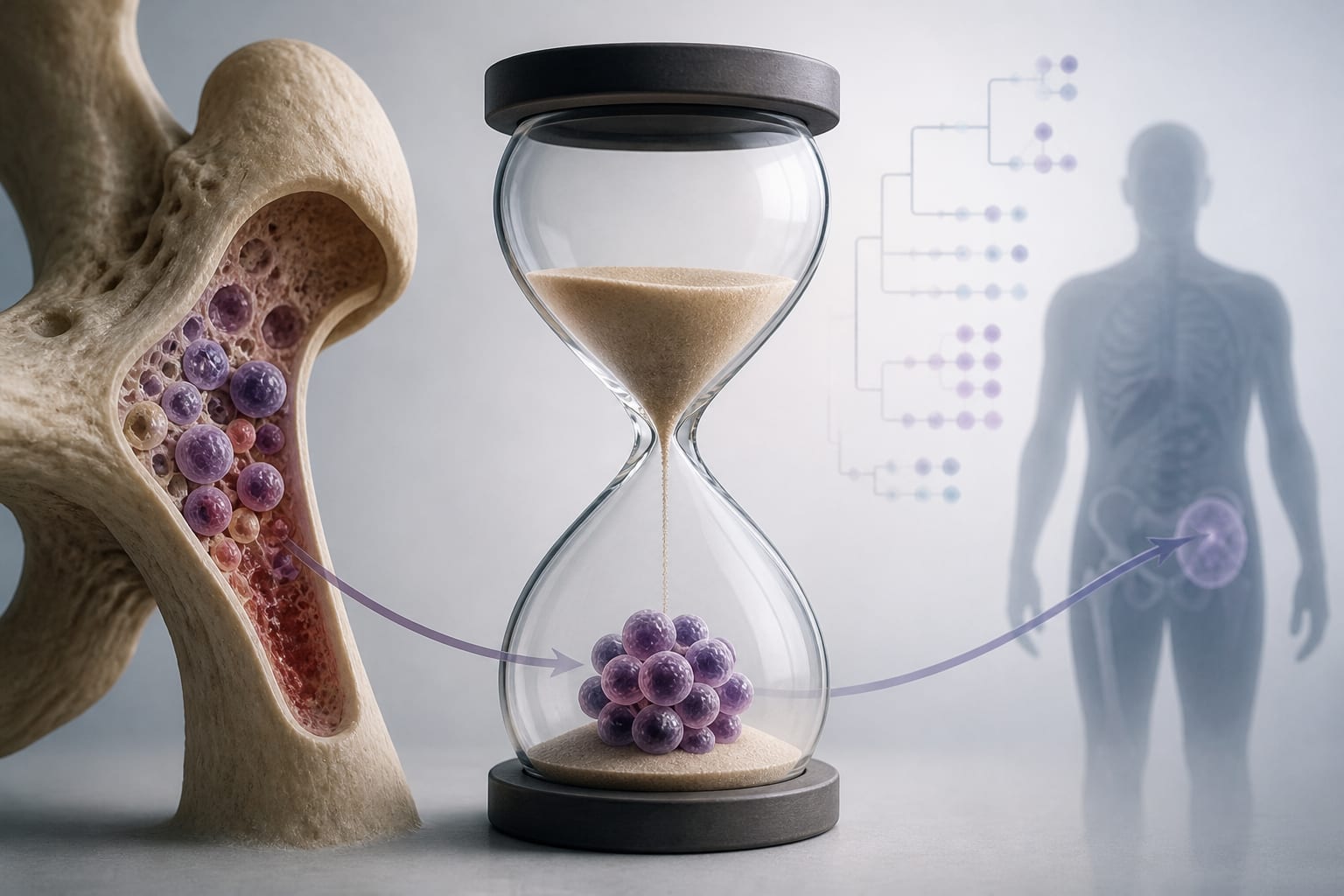
To identify a practical diagnosis-to-transplant interval associated with outcomes after allogeneic hematopoietic stem cell transplantation in patients with IPSS-M higher-risk MDS with increased blasts (MDS-IB).
Approach:
Cohort: Retrospective analysis of 325 patients with IPSS-M higher-risk MDS-IB who underwent transplantation at one hospital.
Timing threshold: Maximally selected rank statistics identified a diagnosis-to-transplant interval (DTI) threshold rounded to 3 months; spline analysis showed the lowest mortality hazard at approximately 2–3 months.
Comparison and analyses: Compared transplantation within 3 months (n=128) with transplantation after 3 months (n=197). Outcomes were assessed using survival models, multivariable adjustment, inverse probability weighting, and time-dependent Cox analysis.
Key Findings:
At 3 years, overall survival was 76.5% with transplantation within 3 months versus 68.7% after 3 months (HR 0.62, 95% CI 0.39–0.98; P=0.039).
Three-year disease-free survival was 76.6% versus 65.8%, respectively (HR 0.63, 95% CI 0.41–0.97; P=0.037).
The overall-survival association remained significant with inverse probability weighting (HR 0.64, 95% CI 0.41–0.99; P=0.046). In adjusted models, associations with overall and disease-free survival were trends (both P=0.06).
Late transplantation remained associated with higher mortality after adjustment for bridging therapy (HR 1.84, 95% CI 1.12–3.00; P=0.012).
The apparent survival advantage was attributed predominantly to lower non-relapse mortality rather than reduced relapse.
The time-dependent Cox estimate was directionally consistent but imprecise and not statistically significant (HR 0.49, 95% CI 0.14–1.64; P=0.24).
Interpretation:
In this single-hospital cohort, transplantation within 3 months of diagnosis was associated with better survival outcomes than later transplantation. The authors report that the apparent advantage was driven mainly by reduced non-relapse mortality.
Limitations:
The analysis was observational and conducted at a single hospital.
The time-dependent Cox estimate was imprecise, with a wide confidence interval because the pre-transplant risk set contained fewer patients.