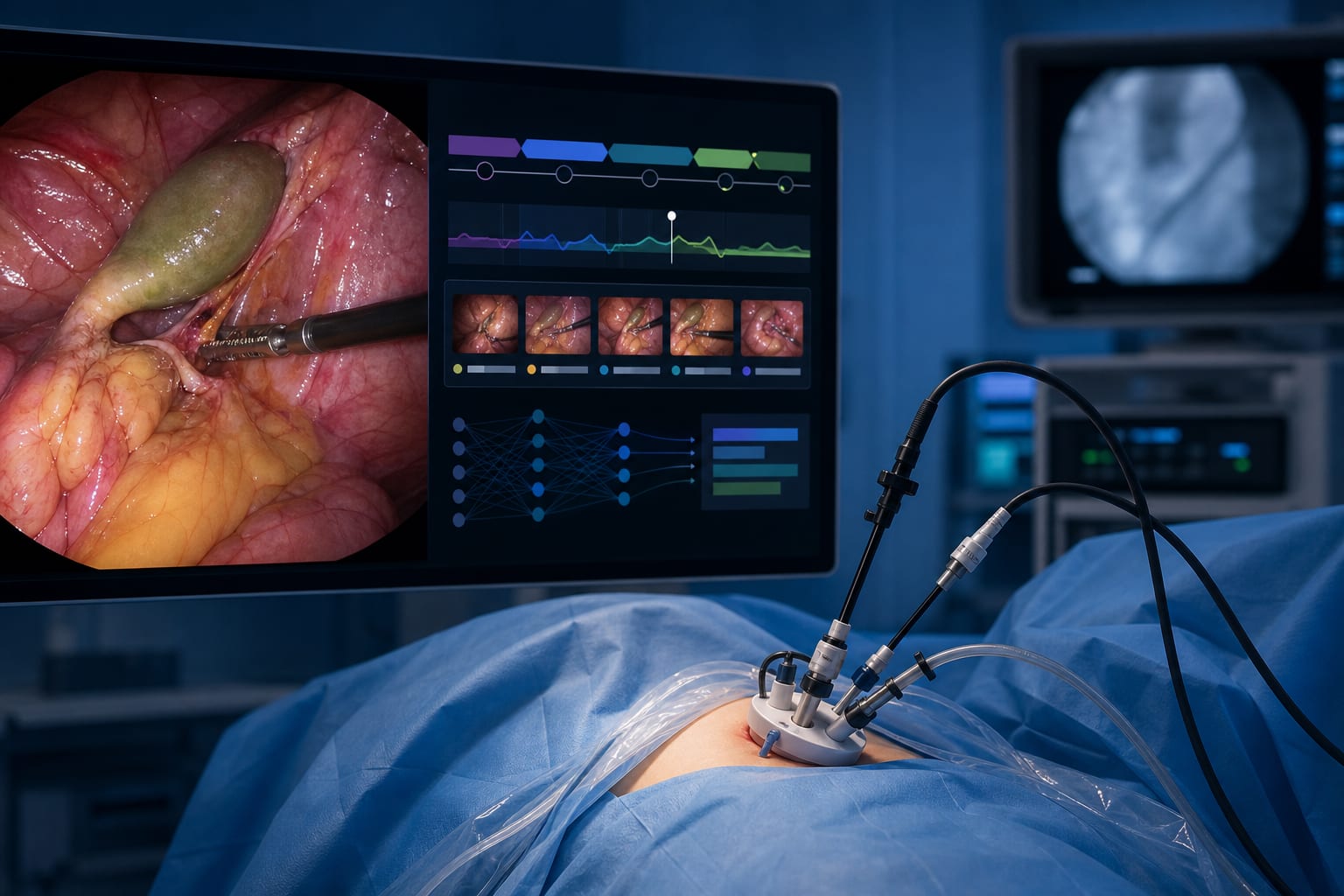
To develop a deep learning model for automatic surgical phase recognition in SILC videos and assess its accuracy.
Approach:
Dataset Collection: SILC videos were obtained from two hospitals, totaling 148 videos, including 20 non-insufflation videos. Videos were sampled at 1-s intervals, resulting in 127,496 images.
Video Annotation: Two surgeons annotated the videos into six distinct phases, defining start and end points based on surgical actions.
Data Preprocessing: Images were resized to 512 × 512 pixels, and online data augmentation techniques were applied to enhance model robustness.
Model Training: The model was trained using a stage-wise approach with a visual encoder (ResNet50) and a temporal encoder (TCN), followed by a feature fusion network (Transformer).
Key Findings:
The study included a diverse set of surgical videos to train the model effectively.
SILC exhibits distinct procedural sequences compared to traditional laparoscopic techniques, necessitating a tailored approach for phase recognition.
Interpretation:
Limitations:
The study focused solely on SILC, limiting the generalizability of findings to other surgical techniques.
Anonymity of videos precluded demographic analysis.
Conclusion:
The study aims to facilitate automated review and analysis of SILC procedures through accurate surgical phase recognition.