Conexiant’s news site is now MDSpire News. Learn more
Advertisement
Revisiting the Role of B Cells and Humoral Immunity in the Pathophysiology of Inflammatory Bowel Disease: Mechanistic Insights and Immunoregulatory Functions
To systematically integrate current evidence on B cell differentiation, local lymphoid organization, and humoral immune responses in IBD.
Approach:
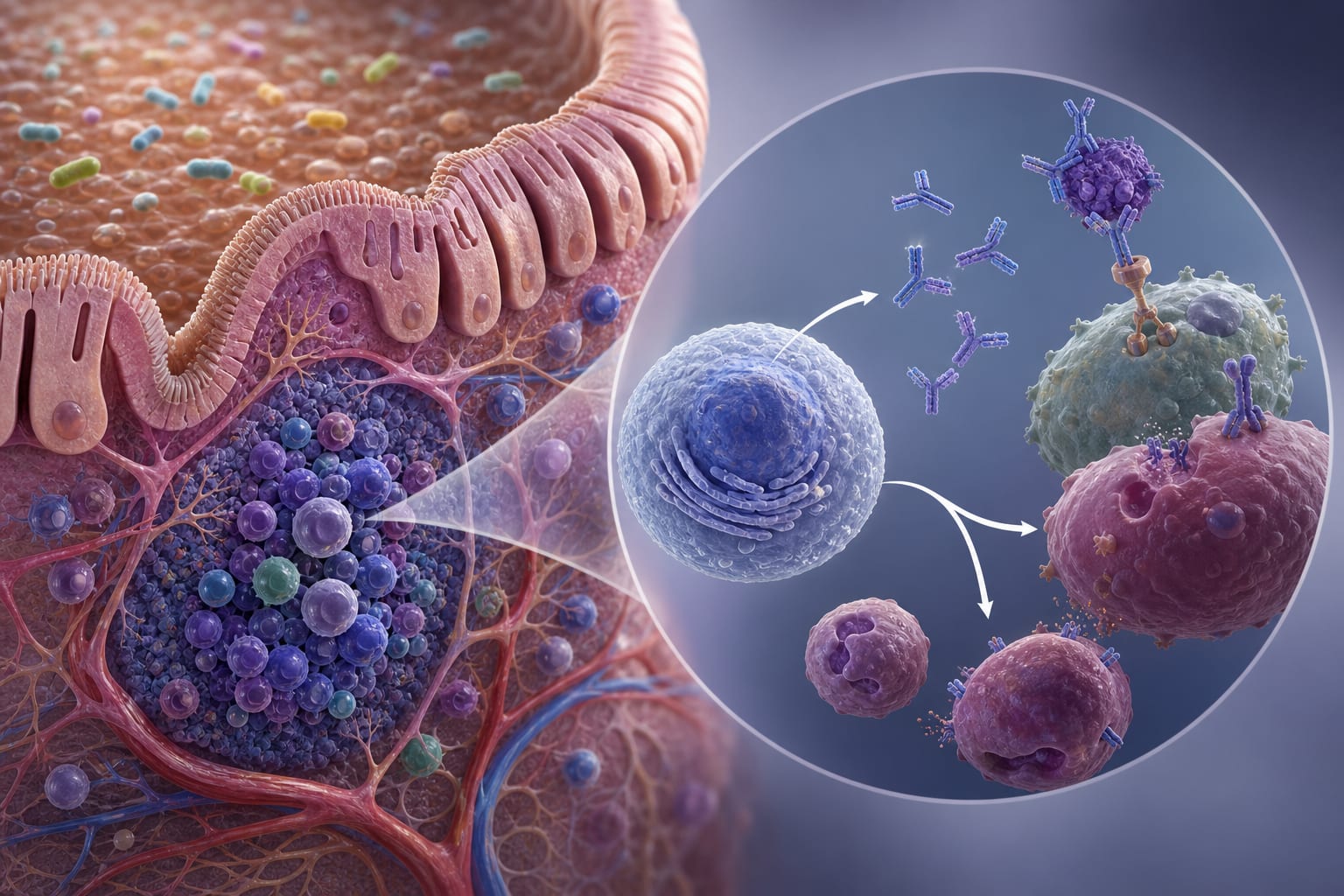
B Cell Differentiation: Examines the remodeling of B cell differentiation in the context of IBD.
Tertiary Lymphoid Structures (TLSs): Explores the spatial disorganization of TLSs and their role in IBD.
Antibody-Mediated Effector Networks: Analyzes alterations in antibody-mediated effector networks and their implications for IBD.
Key Findings:
B cells play a role in mucosal immune regulation through differentiation, clonal expansion, and antibody production.
Intestinal B cells exhibit a stronger tissue dependency compared to peripheral B cells, influenced by local antigen load and cytokine milieu.
In IBD, there is an increase in mucosal B cells and alterations in their spatial localization, subset composition, and activation status.
Interpretation:
The review highlights the need to expand the T cell-centric paradigm of IBD to include B cells and humoral immunity, emphasizing their interconnected roles in disease pathogenesis.
Limitations:
Current therapeutic strategies targeting B cell–humoral immunity vary in efficacy and applicability across different patient populations.
Conclusion:
The proposed 'B cell–humoral immunity regulatory axis' aims to advance mechanistic understanding of IBD.