Evaluation of COVID-19 Mitigation Strategies in South Korea: A Modeling Study Based on Counterfactual Scenarios
-
By
-
Suyoung Jo
-
Kyung-Duk Min
-
Sung-il Cho
-
August 12, 2026
Objective:
To retrospectively evaluate how vaccination, diagnostic testing, contact tracing, and social distancing influenced COVID-19 transmission in South Korea during the pre-Delta and Delta-dominant periods.
Approach:
- Data source: Publicly available, aggregated data from the Korea Disease Control and Prevention Agency and Statistics Korea included confirmed cases, vaccinations, the proportion of confirmed cases already quarantined at diagnosis, Delta variant prevalence, and population data from November 1, 2020, through December 31, 2021.
- Model: Investigators developed a deterministic, age-structured V-SEIQR compartmental model covering 3 age groups and both pre-Delta and Delta variants. Counterfactual scenarios varied vaccine timing and rollout speed, testing capacity, contact-tracing performance, and social-distancing timing or intensity. Cumulative confirmed cases were the primary outcome.
Key Findings:
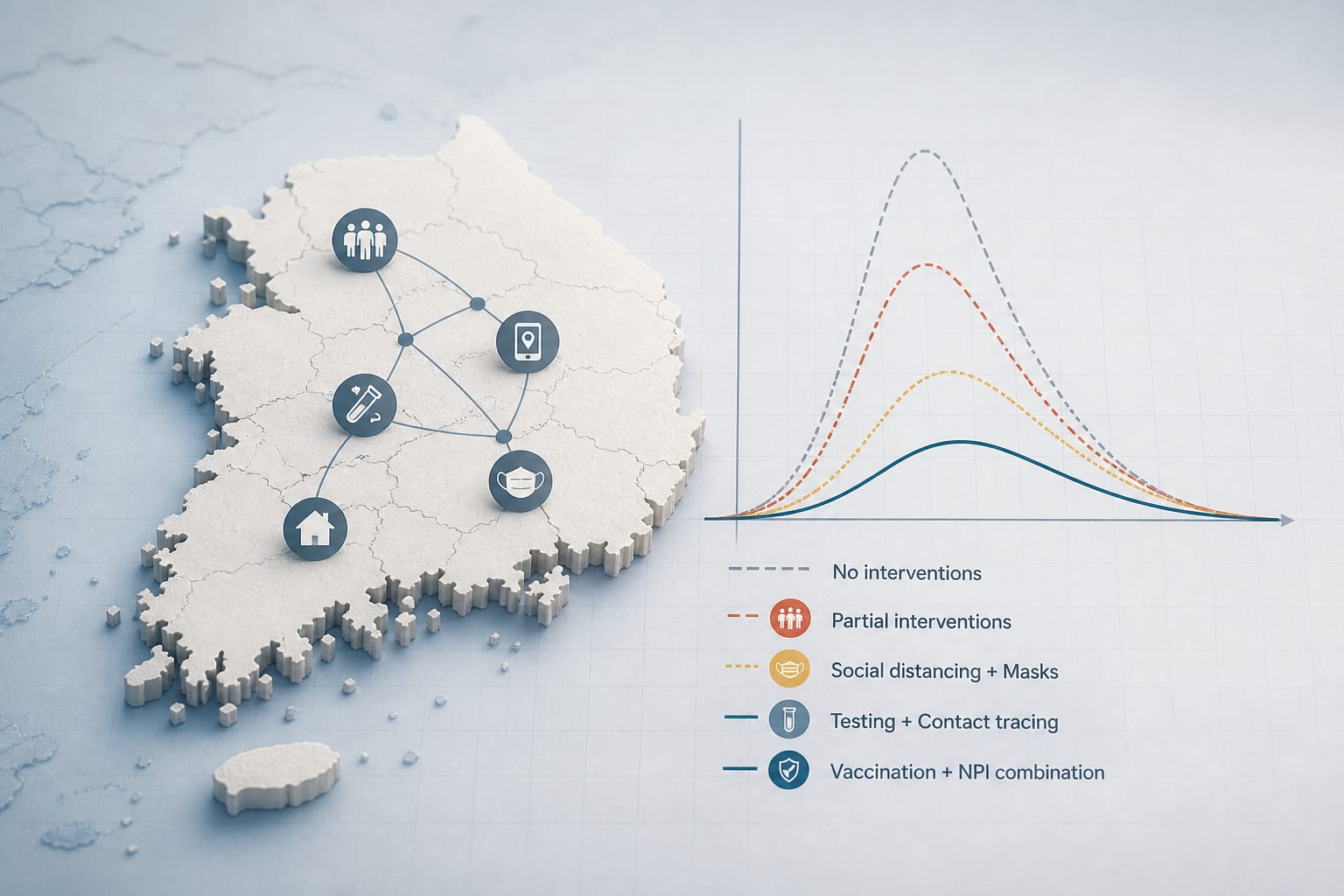
- Advancing vaccine deployment by 2 months during the pre-Delta period reduced modeled cumulative confirmed cases by 48%. Earlier deployment had a greater effect than accelerating rollout after vaccination began.
- Reductions in testing or contact-tracing capacity increased modeled case burdens during both periods. Conversely, stronger contact tracing substantially reduced cases.
- During the Delta period, accelerating vaccination 2.5-fold reduced cumulative confirmed cases by approximately 20%.
- Delaying South Korea’s Gradual Recovery to a New Normal policy by 2 months stabilized the modeled epidemic curve. Strengthening distancing shortly after cases began rising reduced cumulative cases by 32%.
- Vaccination was modeled with a 14-day delay between administration and immune protection.
Interpretation:
Under the model’s assumptions, earlier vaccine deployment, sustained testing and contact-tracing capacity, and timely adjustment of social-distancing policies could have meaningfully altered COVID-19 epidemic trajectories in South Korea. These findings represent modeled counterfactual estimates rather than observed causal effects.
Limitations:
- The model assumed uniform contact-tracing performance and variant proportions across age groups and did not explicitly model undiagnosed infections.
- It did not account for variation in compliance with distancing policies or behavioral responses to changing epidemic conditions.
- Weekly adjustment of the effective contact rate may have introduced overfitting.
- Model-parameter changes do not always correspond directly to achievable real-world policy changes. Because other conditions were held constant, the absolute effects may differ from those in a dynamic real-world setting.
Conclusion:
The counterfactual analyses suggest that earlier vaccination, sustained diagnostic and contact-tracing capacity, and timely changes to social-distancing measures each contributed to epidemic control through different pathways. The unified modeling framework may help inform preparedness planning, but its estimates should be interpreted within the assumptions and limitations of the modeled scenarios.
Based on findings from:
Counterfactual evaluation of COVID-19 control policies in South Korea: A scenario-based modeling study
Suyoung Jo, Kyung-Duk Min, Sung-il Cho. International Journal Of Infectious Diseases, 2026.
https://www.sciencedirect.com/science/article/pii/S1201971226006326
This content is an AI-generated, fully rewritten summary based on a published scholarly article. It does not reproduce the original text and is not a substitute for the original publication. Readers are encouraged to consult the source for full context, data, and methodology.