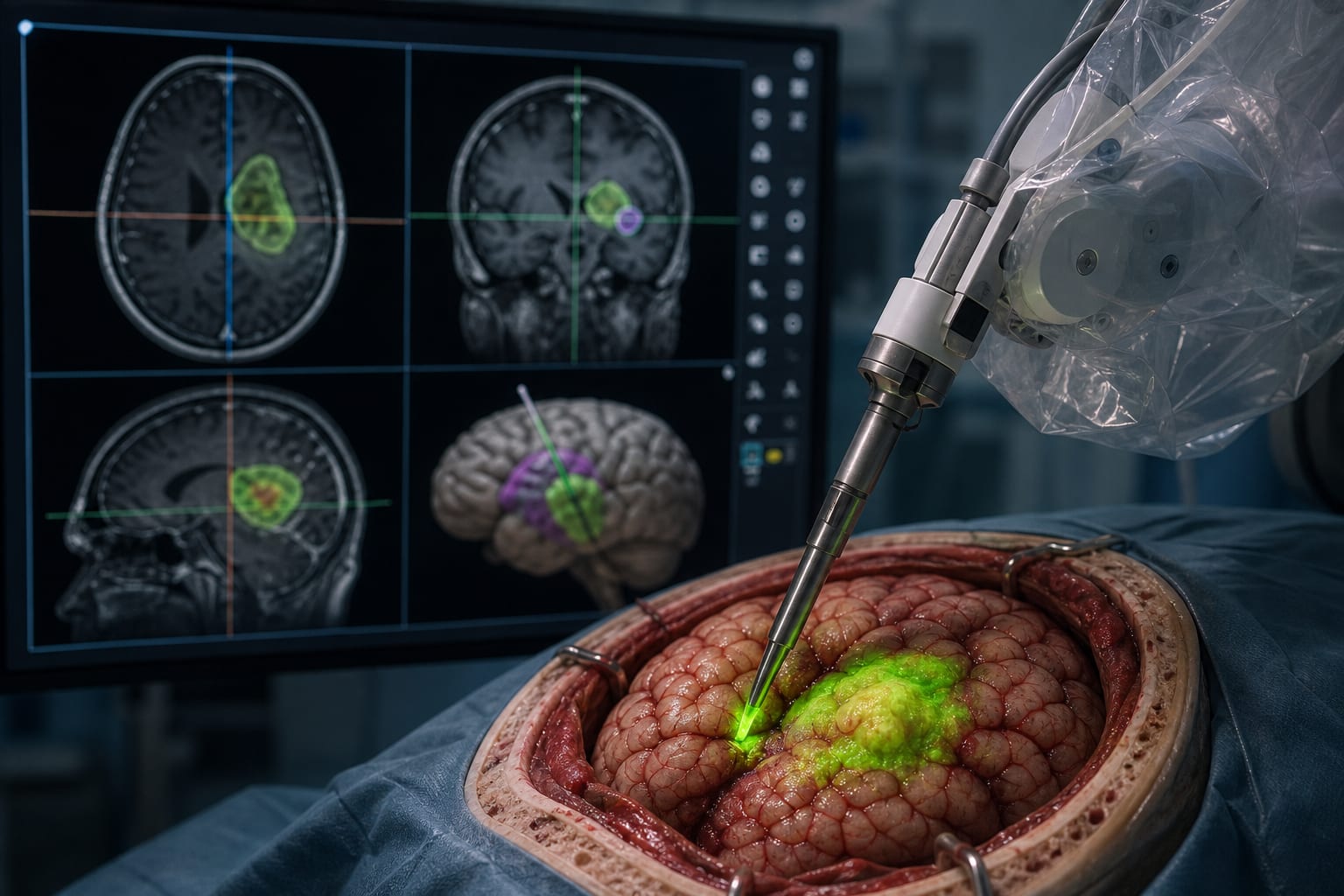
To review recent advancements in intraoperative technologies for glioma surgery that enhance extent of resection (EOR) and improve local drug delivery strategies.
Approach:
Established intraoperative techniques: A decision-making framework for selecting intraoperative mapping and imaging strategies based on preoperative identification of language, motor, or non-eloquent tumor involvement.
Functional mapping: Utilizes preoperative functional neuroimaging, such as functional MRI (fMRI), to localize eloquent brain areas and avoid damage during surgery.
Key Findings:
Maximal safe resection is associated with improved progression-free and overall survival, as supported by multiple studies.
Supramarginal resection beyond the contrast-enhancing tumor can significantly improve overall survival, according to recent findings.
Local drug delivery strategies, such as Gliadel® wafers, can bypass the blood-brain barrier and improve treatment efficacy, demonstrating a modest survival benefit.
Interpretation:
The review highlights the importance of intraoperative technologies in optimizing glioma surgery outcomes while minimizing neurological deficits.
Limitations:
Challenges remain in differentiating infiltrative tumor from functional brain tissue in non-enhancing areas, which complicates surgical decisions.
The risk of postoperative neurological deficits must be carefully managed, as they can impact overall survival.
Conclusion:
Advancements in intraoperative technologies are crucial for enhancing glioma surgery outcomes and improving local drug delivery, as evidenced by recent studies.