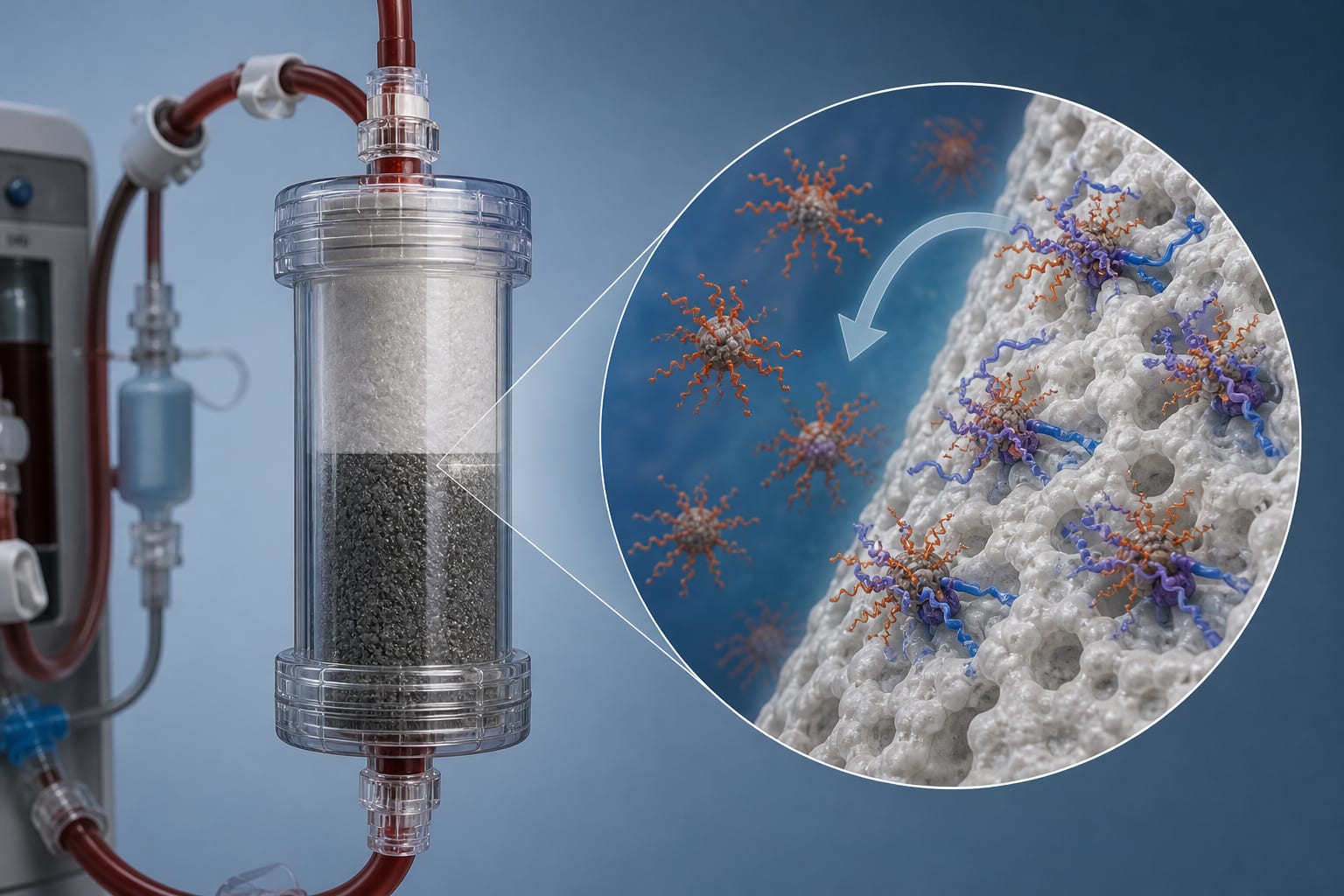
To challenge the claim that a PMX-20R cartridge approaches endotoxin saturation during a 2-hour treatment session.
Approach:
Review of prior experiments: The authors examined cited in vitro LPS adsorption studies and PMX cartridge-development data, distinguishing single-dose closed-loop experiments from evidence of actual cartridge saturation.
Continuous-loading model: They summarize a 24-hour experiment using a neonatal PMX cartridge with continuous LPS infusion, then estimate adult-cartridge adsorption by scaling for fiber mass.
Clinical evidence and labeling: They cite a clinical study of 24-hour PMX-20R treatment and Japanese labeling that permits 6–24 hours of treatment per cartridge for acute exacerbation of idiopathic pulmonary fibrosis.
Key Findings:
The approximately 2-hour plateau in cited closed-loop experiments followed a single 15-µg LPS spike; the authors interpret it as adsorption–desorption equilibrium, not demonstrated saturation.
A separate experiment recovered approximately 20 µg of LPS bound to a cartridge after 2 hours, but the endpoint-only measurement did not establish saturation.
In the continuous-loading model, adsorption efficiency declined after 2 hours, while the adsorption ratio remained approximately 40%; cumulative adsorption reached 4.73 µg at 24 hours without saturation.
Scaling the neonatal-cartridge result by fiber mass gives an estimated 66.2 µg adsorbed by a PMX-20R cartridge over 24 hours.
In a cited clinical study, the median endotoxin removal rate after 24-hour PMX-20R treatment was 74.4% among patients whose pretreatment endotoxin exceeded the assay detection limit.
Interpretation:
The authors argue that available experimental evidence does not establish saturation of PMX-20R cartridges within 2 hours and that continuous endotoxin loading may permit ongoing adsorption. They state that optimal treatment duration and clinical benefits, particularly for patients with endotoxin activity (EA) ≥0.90, remain undetermined.
Limitations:
The continuous-loading experiment used a neonatal cartridge; adult-cartridge adsorption was estimated by scaling according to fiber mass.
The cited 24-hour clinical study measured endotoxin removal but does not establish clinical benefit from prolonged treatment.
The optimal duration of PMX treatment and its clinical effects, including in patients with EA ≥0.90, remain unknown.
Conclusion:
The authors call for reconsideration of the presumed 2-hour saturation rule and further evaluation of treatment duration and clinical outcomes.