Prediction of histological grading in ductal carcinoma in situ based on mammographic signs and clinical information using machine learning models - Summary - MDSpire
Advertisement
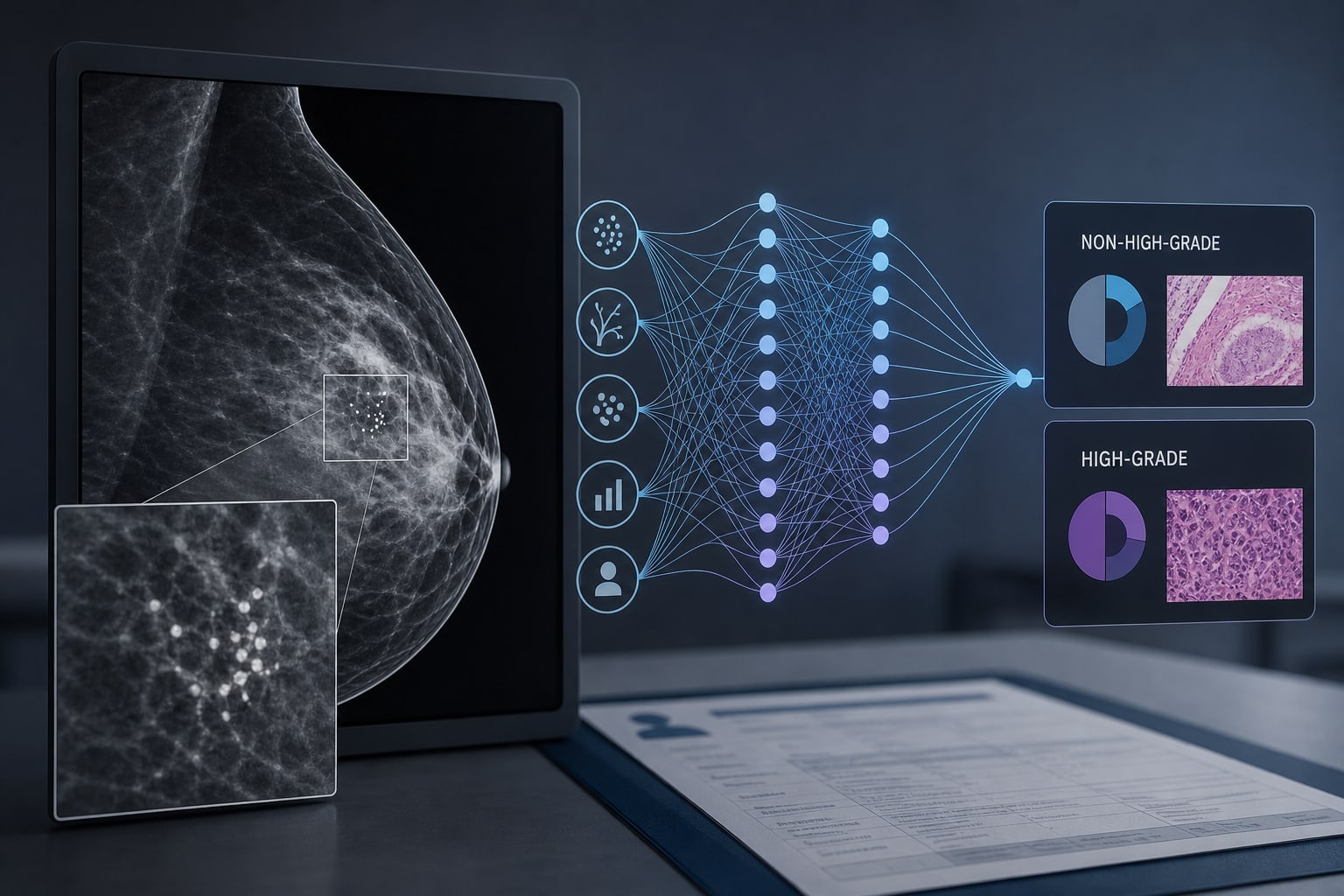
Prediction of histological grading in ductal carcinoma in situ based on mammographic signs and clinical information using machine learning models
To investigate the feasibility of constructing machine learning models based on mammographic signs and clinical information to predict histological grading in ductal carcinoma in situ (DCIS) of the breast.
Approach:
Study Design: A retrospective analysis of mammographic signs and clinical data from 243 patients diagnosed with breast DCIS.
Data Analysis: Statistical analysis on 10 clinical variables and mammographic features to develop three machine learning models: XGBoost, logistic regression, and multinomial Naive Bayes.
Performance Evaluation: Models evaluated using area under the receiver operating characteristic curve (AUC) and pairwise AUC comparisons.
Key Findings:
AUC values for training sets were 0.788 (XGBoost, 95% CI: 0.744–0.832), 0.796 (Logistic Regression, 95% CI: 0.752–0.840), and 0.806 (MNB, 95% CI: 0.761–0.851).
AUC values for test sets were 0.763 (XGBoost, 95% CI: 0.709–0.818), 0.756 (Logistic Regression, 95% CI: 0.705–0.807), and 0.784 (MNB, 95% CI: 0.735–0.833).
Interpretation:
Limitations:
The study is retrospective and conducted at a single institution.
Findings should be regarded as hypothesis-generating pending external multi-center validation.
Conclusion:
The integration of mammographic features and clinical information may improve the prediction of DCIS grading.
Dr. Alicia Morgans of Dana-Farber Cancer Institute reported at #ASCO26 that ARACOG found darolutamide was associated with less decline in cognitive testing than enzalutamide, which may help guide treatment choice.
Dana-Farber Cancer Institute's Dr. Julia Rotow reported on a study looking at silevertinib, with data showing it may offer a new first-line option for hard-to-treat EGFR non-small cell lung cancer variants, with encouraging brain activity and manageable side effects.