Metabolic dysregulation and biological age acceleration in Hashimoto’s thyroiditis: a cross-sectional study based on clinical biomarker aging indices and metabolomics - Summary - MDSpire
Advertisement
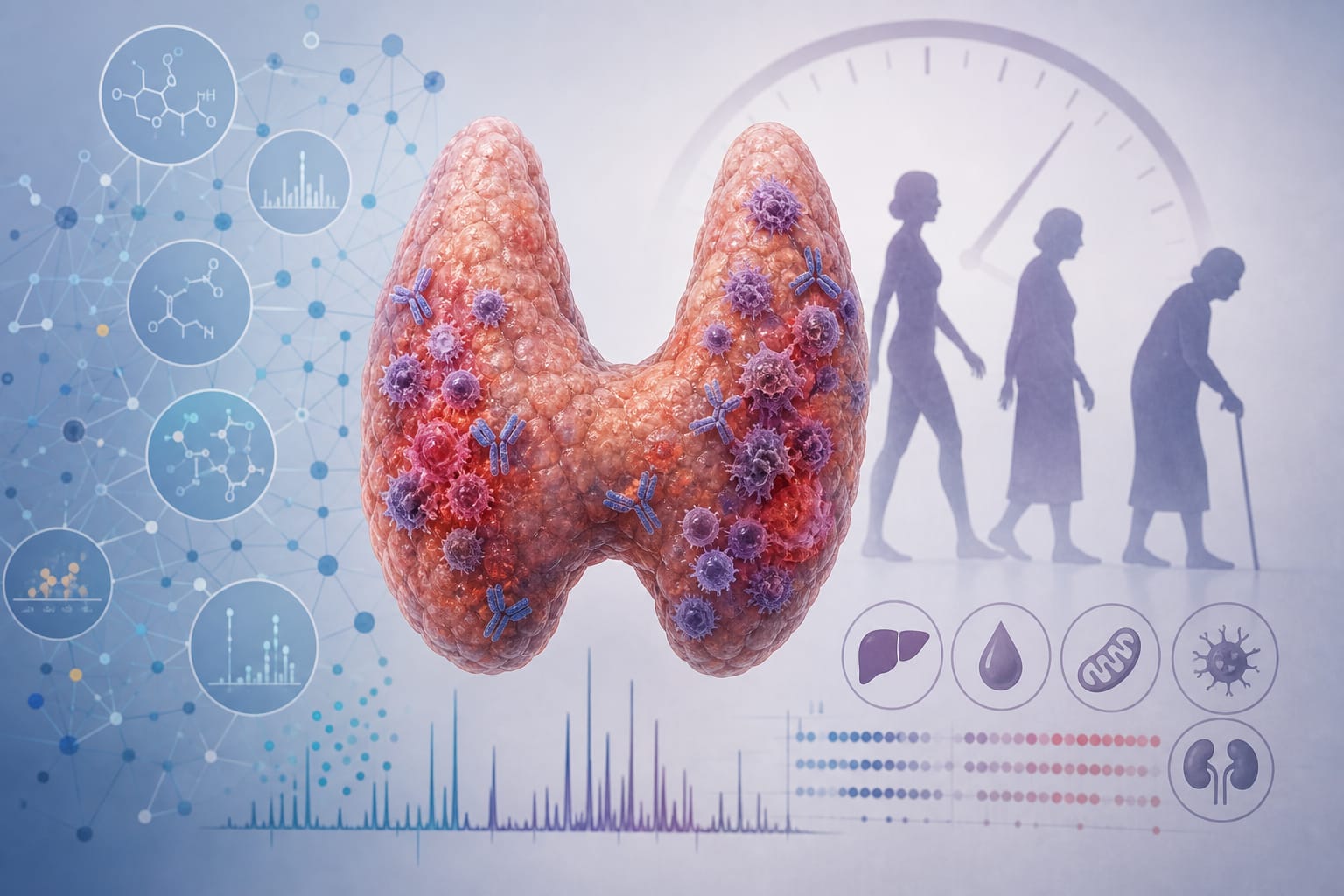
Metabolic dysregulation and biological age acceleration in Hashimoto’s thyroiditis: a cross-sectional study based on clinical biomarker aging indices and metabolomics
To evaluate the association between Hashimoto’s thyroiditis (HT) and biological age acceleration, as well as metabolic age-related remodeling.
Approach:
Study Design: Cross-sectional study including two clinical discovery cohorts, an NHANES validation cohort, and a metabolomics cohort.
Biological Age Assessment: Klemera-Doubal method biological age (KDM biological age) and Phenotypic Age (PhenoAge) were calculated from clinical biomarkers.
Metabolomics Analysis: A random forest metabolic age model was trained and evaluated using metabolomic data from healthy controls and HT patients.
Key Findings:
HT patients exhibited higher KDM biological age and PhenoAge indices compared to healthy controls.
In the NHANES validation cohort, HT was associated with an increase in KDM biological age (beta = 3.16 years, 95% CI 1.77-4.56) and PhenoAge (beta = 1.54 years, 95% CI 1.05-2.03).
Metabolic age acceleration (MAA) was significantly higher in euthyroid HT and subclinical hypothyroid HT groups compared to controls.
Eighteen candidate metabolites were identified, with citric acid, LPC 20:0 sn-1, and SM 34:2 prioritized as core metabolites.
Interpretation:
Limitations:
Small sample size for overt hypothyroid HT may affect the reliability of results.
Cross-sectional design limits causal inferences.
Conclusion:
HT is associated with increased biological age and metabolic age acceleration, indicating potential metabolic features linked to the disease.
Analysis of more than 61,000 patients found higher odds of elevated loneliness scores among those reporting blindness and those with diabetic retinopathy, but not among patients with glaucoma or age-related macular degeneration.