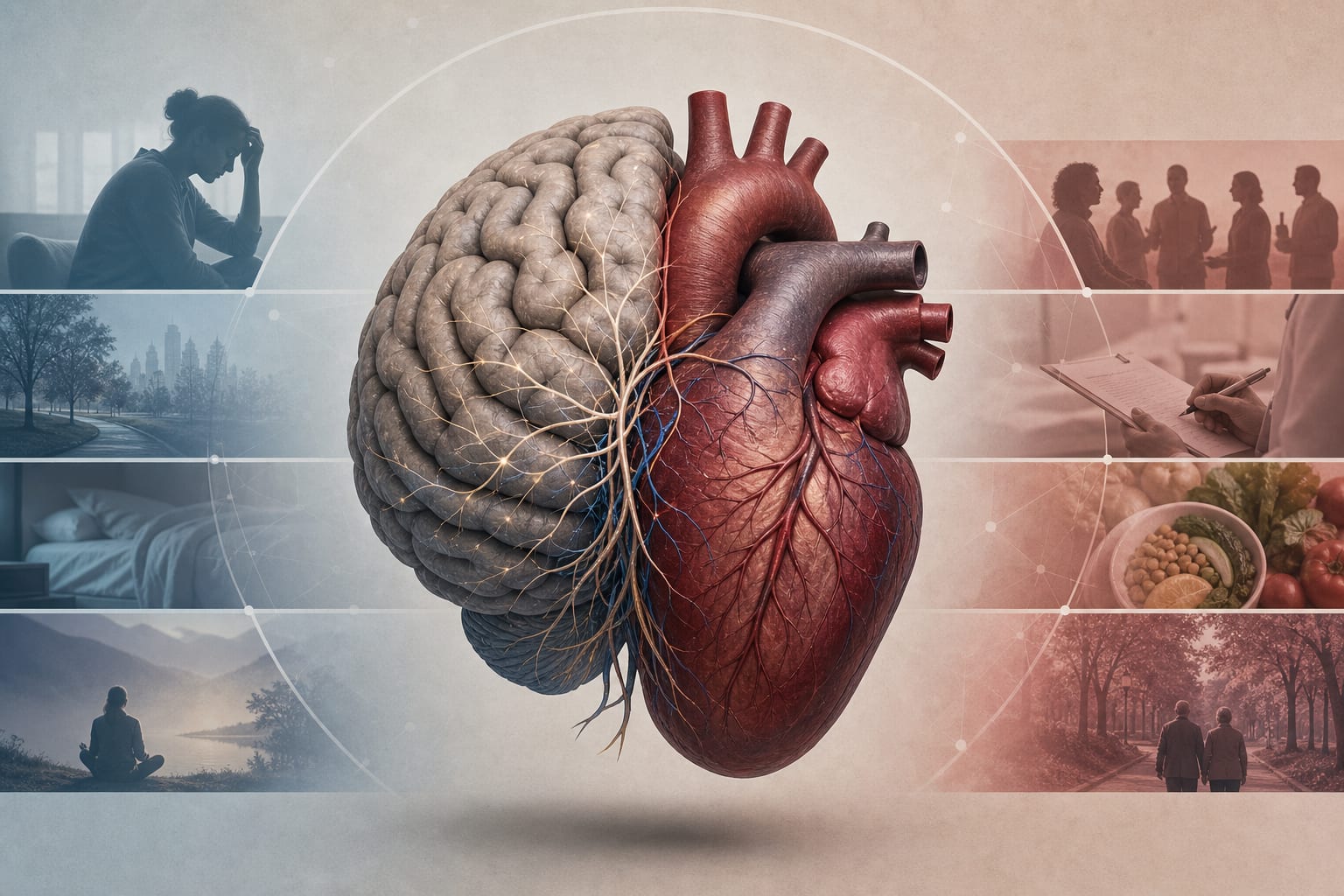
To explore the brain-heart interface and the biopsychosocial context of cardiovascular disease.
Approach:
Yu et al.: Analyzed UK Biobank data to show that childhood maltreatment is associated with adult cardiovascular disease, identifying depressive symptoms as a partial mediator.
Ruan et al.: Used NHANES data to demonstrate that better cardiovascular health is linked to lower odds of depressive symptoms, indicating a reciprocal relationship.
Stapel et al.: Reviewed the prevalence of insomnia in cardiac populations and its association with hospitalization, supporting cognitive behavioral therapy as a first-line treatment.
Lutchman et al.: Investigated the association between anxiety and cardiovascular function, highlighting the importance of physiological variability.
Alhajaji et al.: Conducted a systematic review on healthcare workers, linking organizational stressors to cardiovascular risk.
Herrmann et al.: Presented the TEACH trial, identifying patients with psychological distress and cardiovascular risk factors.
Key Findings:
Cardiovascular risk and recovery are shaped by biopsychosocial mechanisms over time.
Childhood maltreatment contributes to adult cardiovascular disease through depressive symptoms.
Cardiovascular health and mental health are reciprocally linked.
Insomnia is prevalent in cardiac populations and associated with negative outcomes.
Anxiety is more strongly associated with cardiovascular variability than depression.
Organizational factors contribute to cardiovascular risk among healthcare workers.
Interpretation:
The findings suggest a need for an integrated approach in cardiology that considers psychological and social factors alongside biological ones.
Limitations:
The studies may not fully account for all confounding variables in the biopsychosocial model.
Implementation of findings may be constrained by workforce capability and clinical training.
Conclusion:
The editorial emphasizes the importance of integrating psychological and social factors into cardiovascular care.