Overall survival and prognostic factors of oral cavity and oropharyngeal squamous cell carcinomas in Saudi Arabia: a population-based cohort study (2000–2019) - Summary - MDSpire
Advertisement
Overall survival and prognostic factors of oral cavity and oropharyngeal squamous cell carcinomas in Saudi Arabia: a population-based cohort study (2000–2019)
To assess overall survival (OS) and independent prognostic factors for oral cavity and oropharyngeal squamous cell carcinomas in Saudi Arabia, highlighting the significance of these findings in the context of existing literature.
Key Findings:
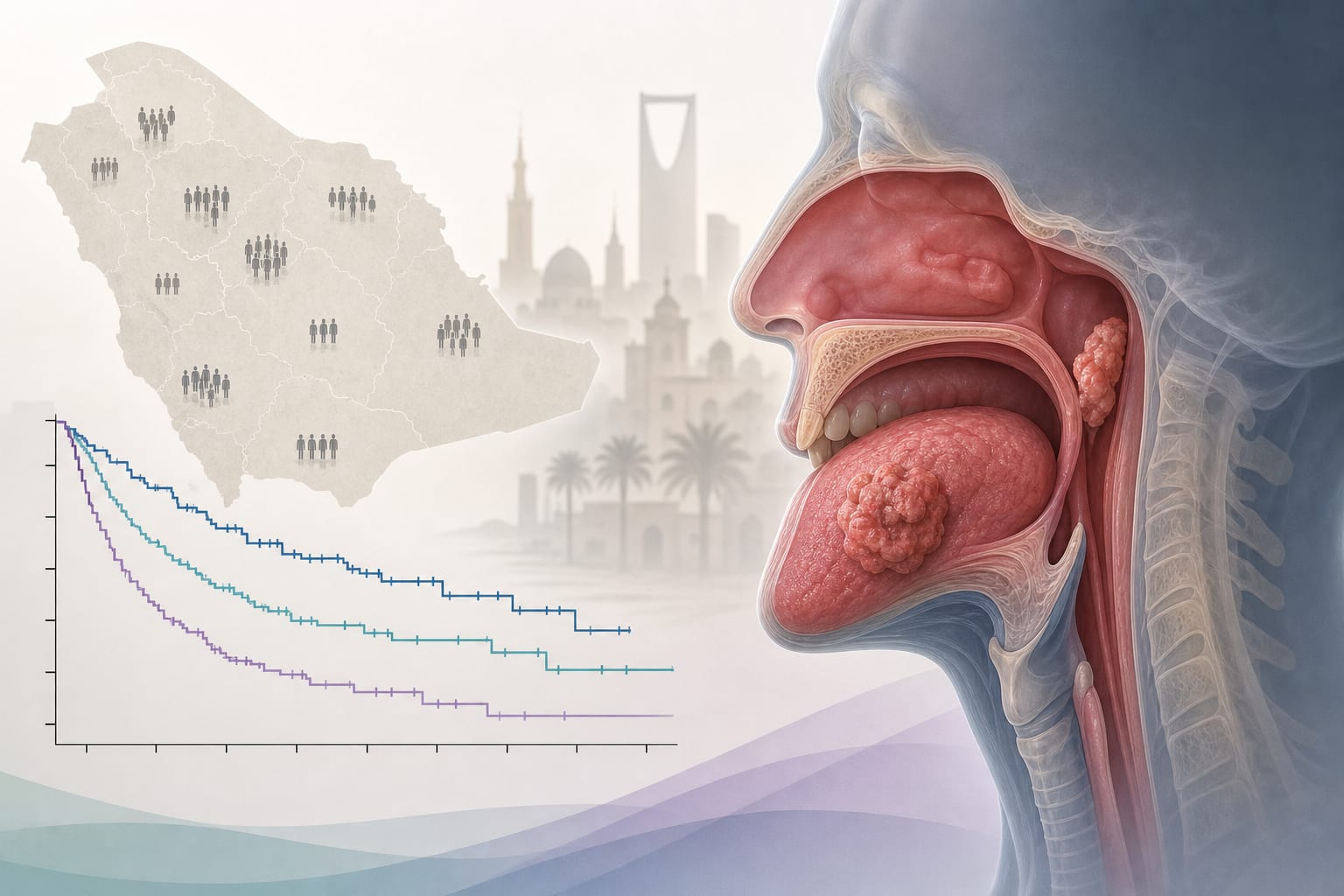
Five-year OS was 55% for OC-SCC and 49% for OP-SCC.
In OC-SCC, 5-year OS decreased from 65% in localized disease to 38% in distant-stage disease.
Patients aged ≥75 years had higher mortality compared to those ≤45 years (aHR 1.70, 95% CI 1.40–2.07).
Males had increased risk of mortality compared to females (aHR 1.49, 95% CI 1.33–1.66).
Diagnosis during 2010–2019 was associated with higher mortality (aHR 1.37, 95% CI 1.22–1.55).
In OP-SCC, regional stage was associated with higher mortality compared to localized disease (aHR 1.64, 95% CI 1.08–2.49).
Residence in the Western region was associated with increased mortality (aHR 1.62, 95% CI 1.08–2.42).
Interpretation:
Survival outcomes for OC-SCC and OP-SCC in Saudi Arabia are modest and vary by subsite and stage at diagnosis, emphasizing the need for earlier detection and equitable access to cancer care, which is crucial for improving public health outcomes.
Limitations:
The study relies on retrospective data from the Saudi Cancer Registry, which may have limitations in completeness and accuracy, including potential biases in data collection methods.
Findings may not be generalizable to populations outside Saudi Arabia.
Conclusion:
The study provides important insights into the survival rates and prognostic factors for OC-SCC and OP-SCC in Saudi Arabia, highlighting the impact of stage at diagnosis on survival outcomes and the need for future research to explore these factors further.