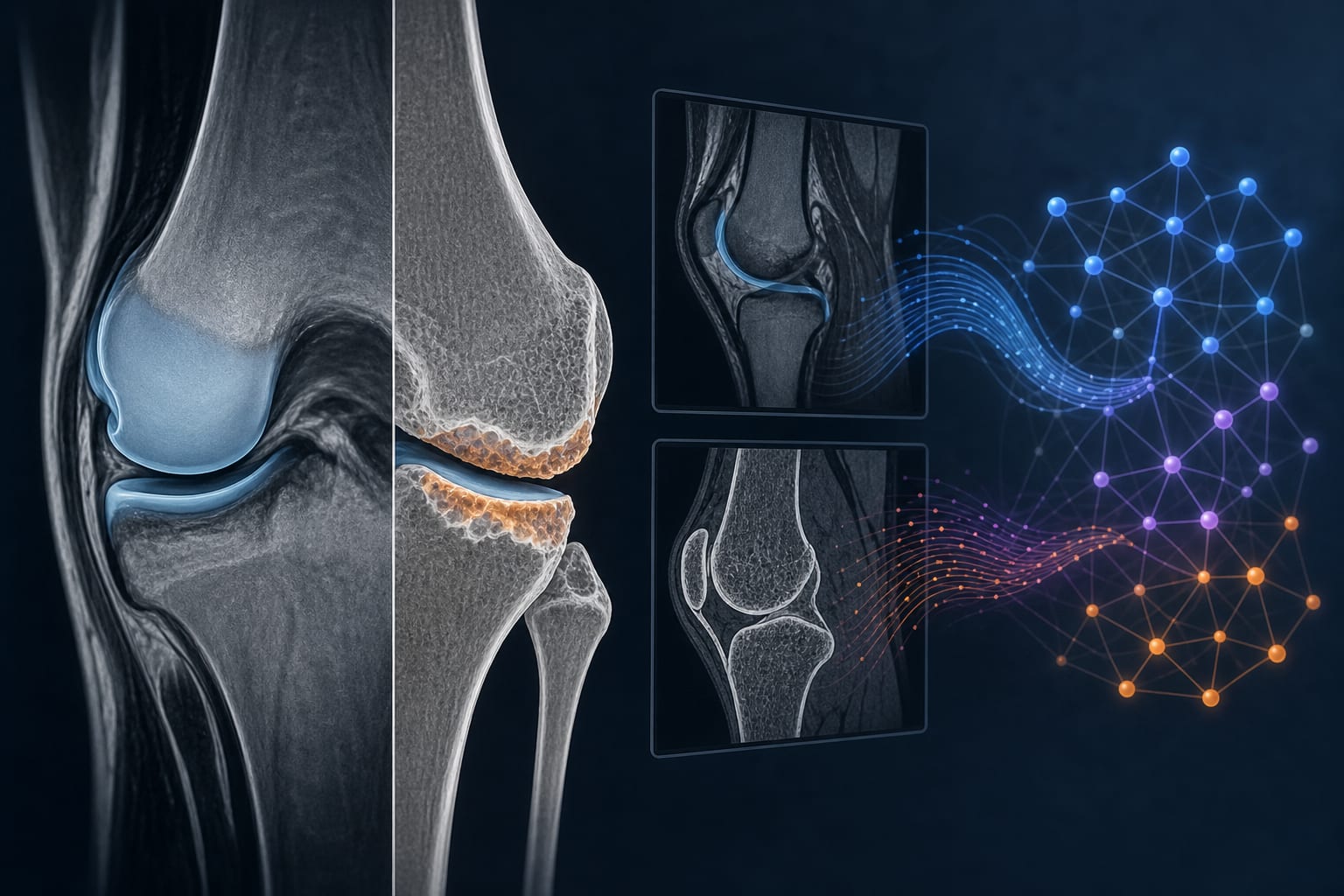
Objective stratification of knee osteoarthritis stages using a semi-supervised learning approach on multimodal MRI-CT cartilage features - Summary - MDSpire
To introduce a semi-supervised learning framework for characterizing knee osteoarthritis (KOA) stages using combined MRI and CT-derived cartilage features, addressing the limitations of current subjective diagnostic methods.
Approach:
Cohort Analysis: Analyzed a cohort of 133 knee scans, including 36 expert-labeled cases categorized as healthy, early degeneration, or advanced degeneration, to establish a baseline for the SSL framework.
Semi-Supervised Learning: Utilized graph-based semi-supervised learning (SSL) methods, specifically Label Propagation and Label Spreading, to produce pseudo-labels for unlabeled samples, enhancing the training dataset.
Performance Evaluation: Evaluated classifiers trained on the SSL-labeled dataset, achieving high weighted F1-scores with Support Vector Machines (0.84) and Logistic Regression (0.81), indicating robust performance.
Key Findings:
Label stability across ten Monte Carlo runs showed high agreement (0.91 ± 0.14) and substantial reliability (Fleiss’ kappa = 0.781), indicating consistency in labeling.
Supervised classifiers achieved robust performance with weighted F1-scores of 0.84 and 0.81 for Support Vector Machines and Logistic Regression, respectively, demonstrating the effectiveness of the SSL approach.
Statistical analysis confirmed significant differences among the three KOA classes for all extracted features, using appropriate statistical tests to validate findings.
Interpretation:
The volume-to-surface ratio and density heterogeneity were identified as having the strongest discriminatory power, reflecting progressive cartilage thinning and structural changes associated with KOA, based on the results obtained.
Limitations:
The study relied on a limited number of expert-labeled cases to seed the SSL framework, which may affect the robustness of the findings.
The generalizability of the findings may be constrained by the specific cohort analyzed, limiting applicability to broader populations.
Conclusion:
Combining expert knowledge with SSL enables reliable KOA stratification, providing insights into cartilage degeneration and laying the groundwork for objective imaging-based biomarkers, as demonstrated by the study's findings.
Preoperative use was associated with fewer revisions and no increase in short-term complications among patients with obesity, although benefits appeared concentrated in select subgroups.