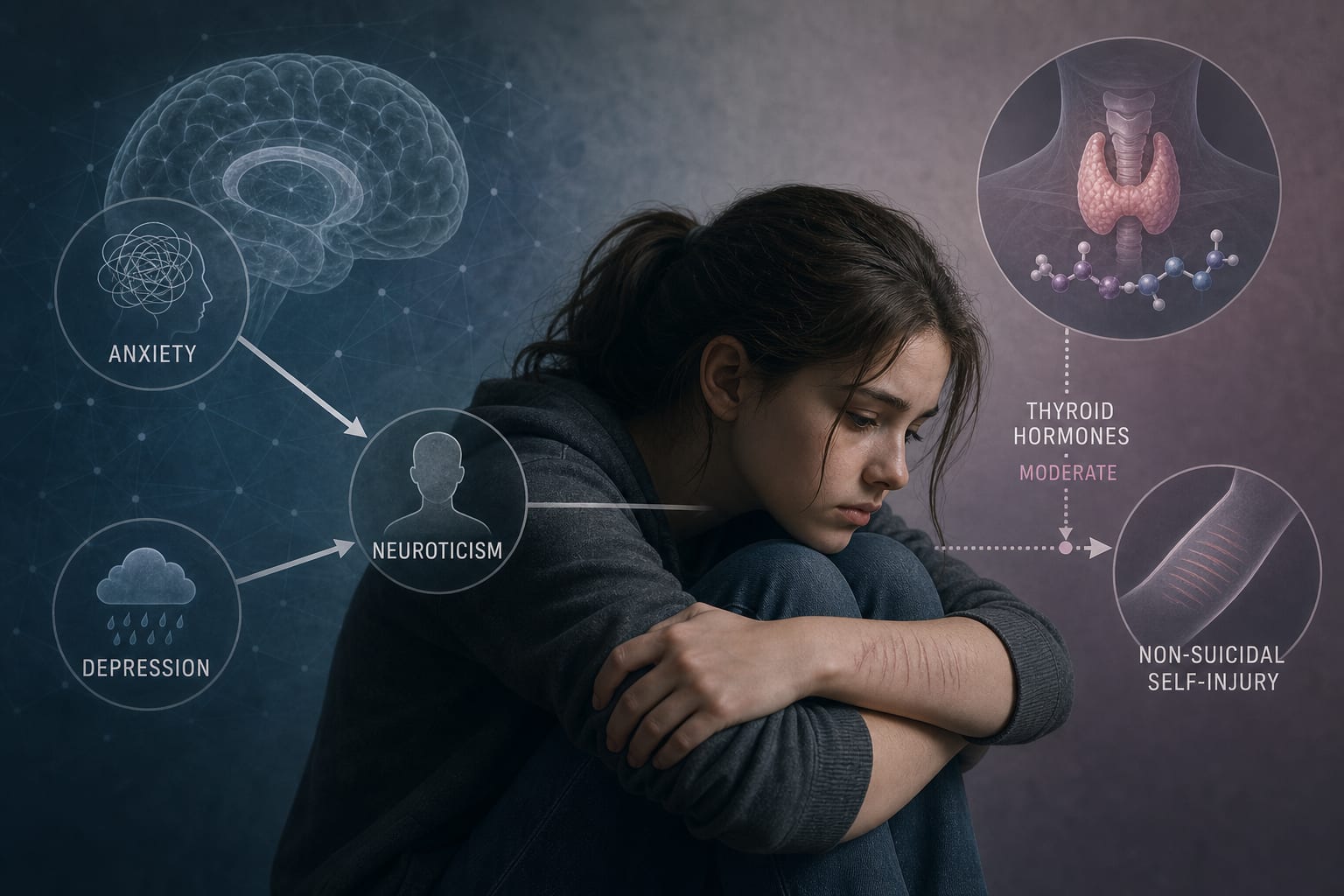
From anxiety and depression to non-suicidal self-injury in youths: the mediating effect of neuroticism and the moderating effect of thyroid hormones - Summary - MDSpire
To investigate whether neuroticism mediates the relationship between negative emotions and non-suicidal self-injury (NSSI), and whether thyroid hormones moderate this pathway.
Approach:
Participants: 104 Han Chinese adolescents and young adults (aged 12–22 years) exhibiting NSSI behaviors.
Assessments: Participants completed questionnaires assessing NSSI severity, depressive symptoms, anxiety symptoms, and personality traits. Blood samples were collected for thyroid function tests.
Analysis: Mediation and moderation analyses were conducted using the PROCESS plug-in for SPSS software.
Key Findings:
Neuroticism fully mediated the association between anxiety symptoms and NSSI (effect = 0.0798, 95% CI [0.0387, 0.1367]).
TT3 (b = 0.3112, p = 0.0147) and FT3 (b = 0.1118, p = 0.0371) positively moderated the relationship between depression and NSSI.
TSH negatively moderated the depression-NSSI relationship (b = -0.0976, p = 0.0011), significant in the high-neuroticism subgroup (β = -1.1116, p = 0.0026).
No significant moderating effects of thyroid hormones were found on the anxiety-NSSI pathway (all p > 0.05).
Interpretation:
Neuroticism mediates the mood-NSSI link, while thyroid hormones have varying moderating effects on the depression-NSSI relationship.
Limitations:
The study's sample size may limit the generalizability of the findings.
The cross-sectional design restricts causal inferences.
Conclusion:
The findings integrate psychological and neuroendocrine mechanisms related to NSSI risk among youths.