Efficacy of Quadruplet Therapy with Daratumumab, Bortezomib, Lenalidomide, and Dexamethasone as Initial Treatment for High-Risk Multiple Myeloma Patients in China: Findings from a Multi-Center Real-World Study - Summary - MDSpire
Advertisement
Efficacy of Quadruplet Therapy with Daratumumab, Bortezomib, Lenalidomide, and Dexamethasone as Initial Treatment for High-Risk Multiple Myeloma Patients in China: Findings from a Multi-Center Real-World Study
To explore the efficacy and safety of D-VRd compared to historical controls receiving VRd as induction regimens in high-risk multiple myeloma patients.
Key Findings:
D-VRd demonstrated superior PFS compared to VRd in high-risk NDMM patients, with a statistically significant hazard ratio.
Patients with high-risk cytogenetic abnormalities showed improved outcomes with D-VRd.
Safety profiles were consistent with known data for the individual agents, with no new safety signals identified.
Interpretation:
The addition of daratumumab to VRd in high-risk NDMM patients may enhance treatment efficacy, suggesting a potential new standard of care that warrants further validation.
Limitations:
The study's observational design may introduce bias, potentially affecting the reliability of the results.
Limited generalizability due to the specific patient population and geographic location, necessitating further studies in diverse settings.
Conclusion:
Quadruplet therapy with D-VRd shows promise as an effective first-line treatment for high-risk multiple myeloma patients, warranting further investigation into its long-term outcomes and applicability in broader populations.
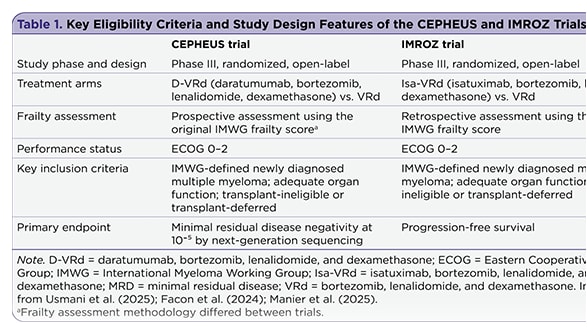
The management of newly diagnosed transplant-ineligible multiple myeloma remains challenging, in part due to the complexity of treatment decisions for frail patients. Recent subgroup analyses provide insight into whether quadruplet therapy may offer advantages over triplet therapy in this population.