CD19, immunoglobulin level, and varied anti-cytokine autoantibodies underline dichotomous susceptibility to types of infection in patients with thymomas - Summary - MDSpire

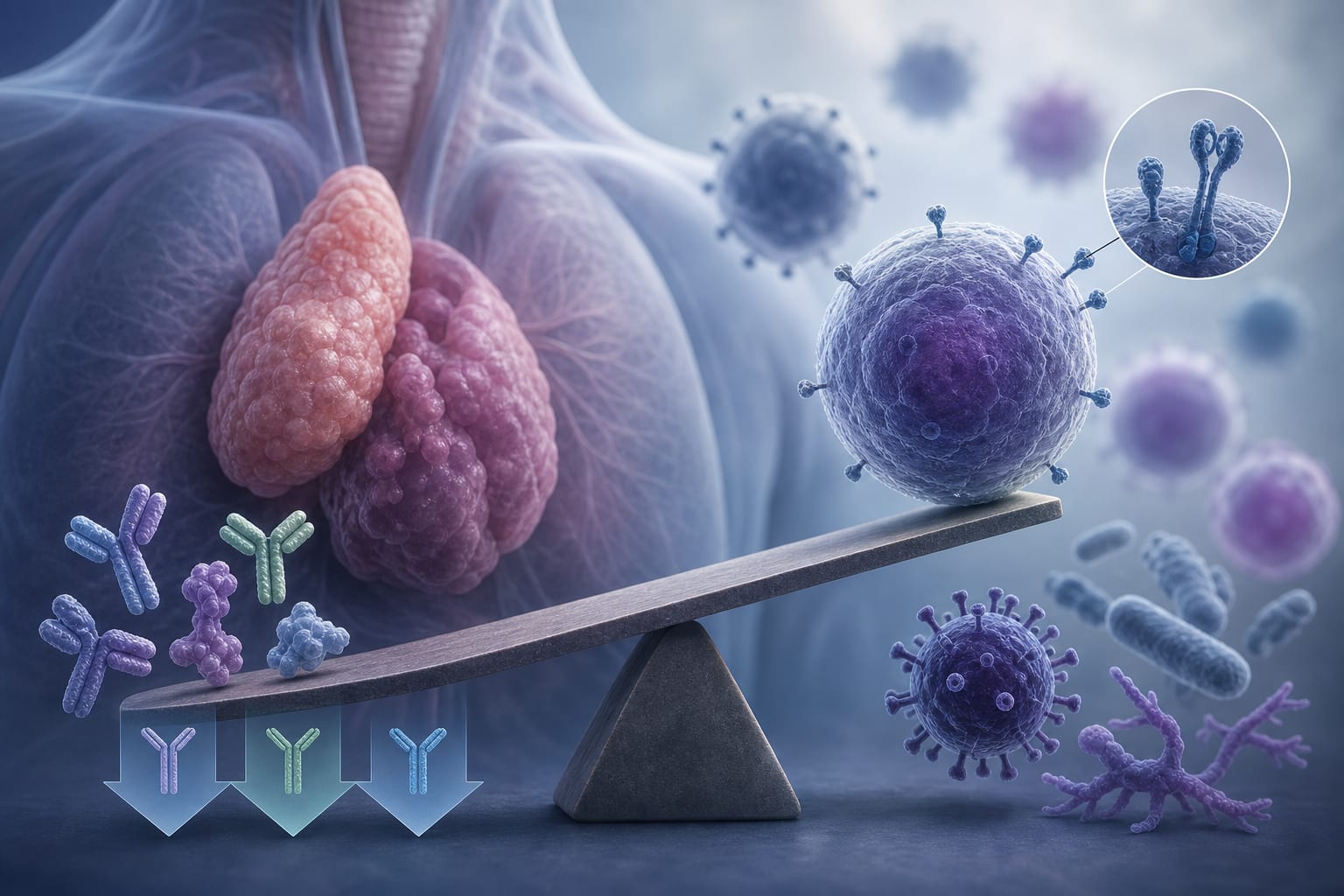
CD19, immunoglobulin level, and varied anti-cytokine autoantibodies underline dichotomous susceptibility to types of infection in patients with thymomas

  • By

  • Zhaohong Tan

  • Areum Shin

  • Rachel Ying Min Tan

  • Dongling Wang

  • Chiung-Hui Huang

  • Sharada Ravikumar

  • Liang En Wee

  • Yvonne Fu Zi Chan

  • Ying Ying Chua

  • Sen Hee Tay

  • Anindita Santosa

  • Gladys Gek Yen Tan

  • Doo Ri Kim

  • Hyun-Il Gil

  • Jae-Hoon Ko

  • Sun Hye Shin

  • Byung Woo Jhun

  • Siew Hoon Sim

  • Yae-Jean Kim

  • Louis Yi Ann Chai

  • July 10, 2026

  • 0 min

Share

Objective:

To characterize the infective susceptibilities in thymoma patients beyond the classic Good syndrome attribution.

Approach:
  • Patient Recruitment: Thymoma patients were recruited from Singapore and South Korea, and their clinical information was reviewed.
  • Immunological Assessment: Immunological parameters including immunoglobulin levels and lymphocyte subsets were correlated with infection types.
  • Autoantibody Detection: Neutralizing autoantibodies against various cytokines were detected using direct ELISA.
  • Immune Signaling Analysis: Serum switch experiments and Western blotting were used to ascertain immune signaling pathway disruptions.
Key Findings:
  • Thymoma patients displayed two distinct groups based on infection types: one with recurrent viral or Pneumocystis jirovecii infections and another with non-tuberculous mycobacterium or invasive infections.
  • The first group had low immunoglobulin levels and CD19+ B cells, while the second group had normal immunoglobulin levels and neutralizing autoantibodies against IL-12, IL-23, and IFN-α.
  • The presence of autoantibodies compromised critical immune signaling pathways.
Interpretation:

The findings indicate that infection vulnerability in thymoma patients is not solely linked to hypogammaglobulinemia.

Limitations:
  • The study involved a small sample size of 15 patients.
  • The findings may not be generalizable to all thymoma patients.
Conclusion:

The study highlights distinct immune profiles in thymoma patients.

Original Source(s)

Related Content