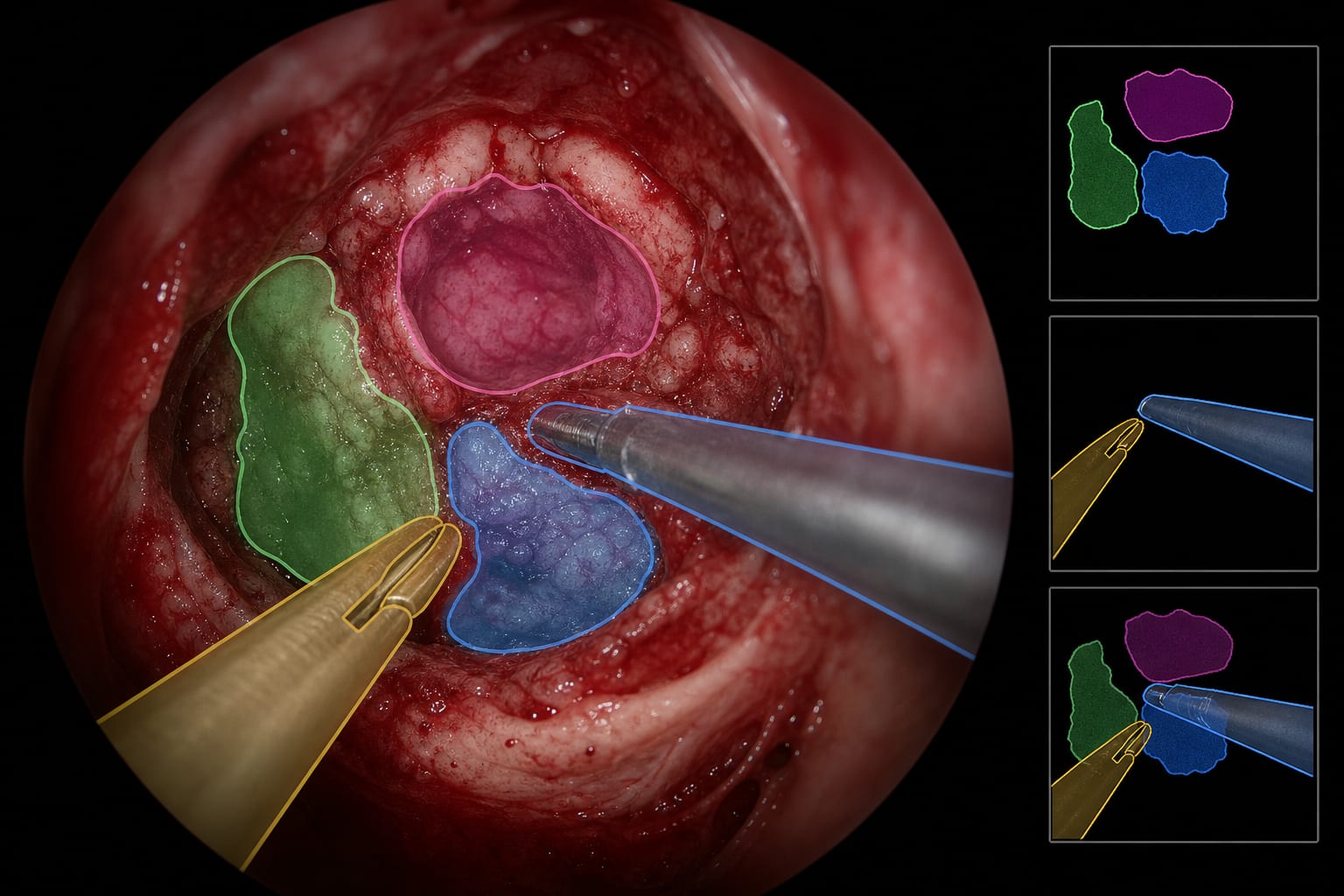
To benchmark established multi-class semantic instrument segmentation models using an in-patient dataset from endoscopic transsphenoidal approach (eTSA) pituitary surgery, highlighting the importance of accurate segmentation in surgical outcomes.
Key Findings:
Class-wise performance varied significantly, with frequent classes performing better, indicating potential areas for targeted training.
Convolutional architectures performed poorly, particularly in classes with fewer occurrences, suggesting a need for improved model designs.
EoMT achieved the highest and most balanced performance among the models, indicating its potential for clinical application.
Interpretation:
Transformer architectures outperformed convolutional ones, emphasizing the critical role of global context and spatial information in enhancing segmentation accuracy.
Limitations:
Performance was reduced for classes with fewer occurrences and less distinct appearances, which may limit the model's applicability in diverse surgical settings.
The dataset may not fully represent the diversity of surgical instruments used, potentially affecting the generalizability of the findings.
Conclusion:
The study benchmarks six models on a new dataset, indicating the need for future work to enhance performance through techniques like temporal modeling, dataset expansion, and exploring hybrid model architectures.
Qualitative interviews identified four themes involving emergency challenges and response, teamwork, psychological stress and coping, and professional growth needs in trauma surgery.