Relationship between family–school–peer risks and problematic Internet use among boarding high school students in China: based on a latent profile analysis - Summary - MDSpire
Advertisement
Relationship between family–school–peer risks and problematic Internet use among boarding high school students in China: based on a latent profile analysis
To examine how configurations of family, school, and peer risks are associated with problematic Internet use among Chinese boarding high school students.
Key Findings:
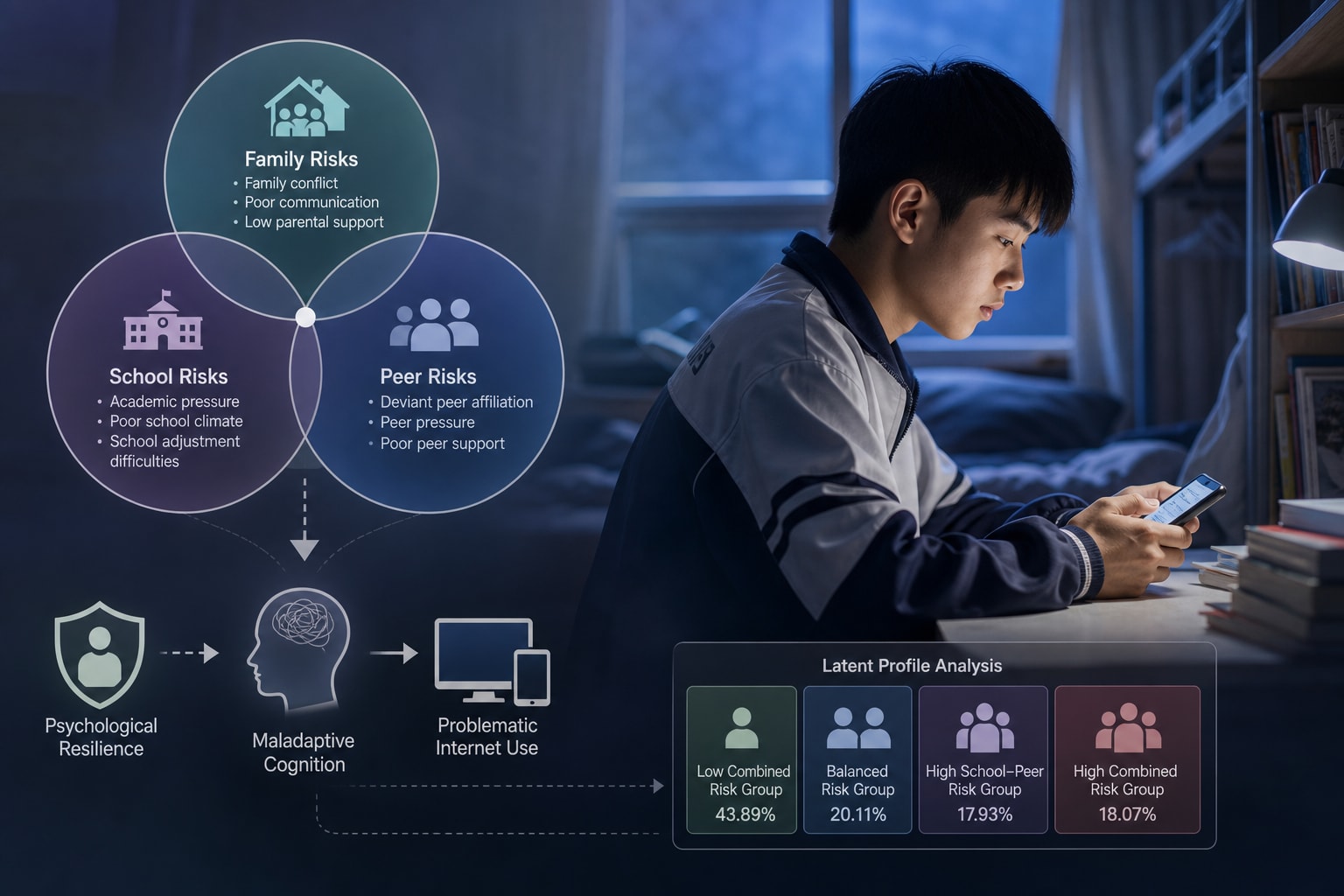
Four profiles identified: Low Combined Risk Group (43.89%), Balanced Risk Group (20.11%), High School–Peer Risk Group (17.93%), and High Combined Risk Group (18.07%).
Problematic Internet use differed significantly across profiles, with the High Combined Risk Group reporting the highest levels.
Maladaptive cognition partially mediated the association between high-risk profiles and problematic Internet use.
Psychological resilience attenuated the direct association between risk profiles and problematic Internet use.
Interpretation:
The study provides a person-centered perspective on family–school–peer risk configurations among boarding high school students and highlights the psychological processes associated with problematic Internet use.
Limitations:
Conclusion:
The findings suggest that configurations of risks from family, school, and peers are significant in understanding problematic Internet use among boarding high school students.