High FCRL5 expression predicts poor treatment response and survival in newly diagnosed multiple myeloma: a retrospective study
By
Cainan Yu
Minghua Zhang
Jie Hui
Mengqing Zhu
Zengtian Sun
Yueyue Sun
Qian Sun
Zhiling Yan
Feng Zhu
Mingshan Niu
Depeng Li
Kunming Qi
June 29, 2026
Objective: To investigate the association of FCRL5 expression with treatment response and survival outcomes in newly diagnosed multiple myeloma (NDMM) patients.
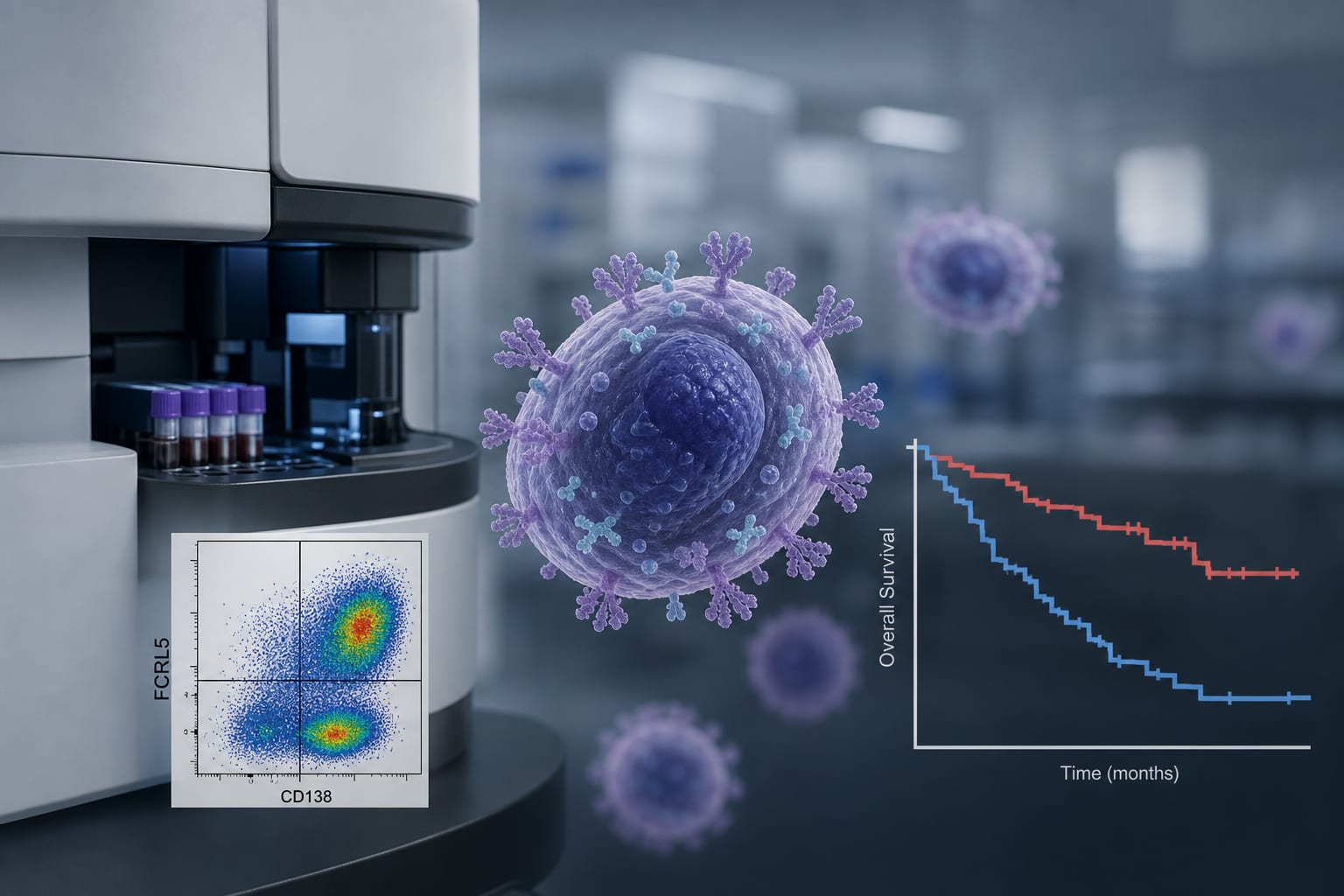
Approach: Study Design: Retrospective analysis of 54 NDMM patients treated at a single center from January 2024 to January 2025.FCRL5 Measurement: Pretreatment FCRL5 expression was quantified by flow cytometry, with a median value of 75.15% used for patient stratification.Outcome Assessment: Comparison of baseline characteristics, treatment response, and survival outcomes between high and low FCRL5 expression groups.Key Findings: High FCRL5 expression correlated with lower rates of complete response (25.93% vs. 51.85%) and ≥very good partial response (33.33% vs. 70.37%). Median progression-free survival (PFS) was significantly shorter in the high FCRL5 group (10.6 months vs. not reached, P = 0.002). Overall survival (OS) was also shorter in the high FCRL5 group (13.2 months vs. not reached, P = 0.02). High FCRL5 expression was confirmed as an independent adverse prognostic factor for both PFS (HR 7.32, P = 0.004) and OS (HR 9.82, P = 0.049). The 1-year PFS rate was significantly lower in the high FCRL5 group (21.43% vs. 76.47%, P = 0.004). Interpretation:
Limitations: The study is retrospective and conducted at a single center, which may limit generalizability. Functional or immune landscape analyses were not included, preventing establishment of a direct causal link between FCRL5 and treatment failure. Conclusion: Further prospective validation of FCRL5 as a prognostic biomarker in NDMM is required.