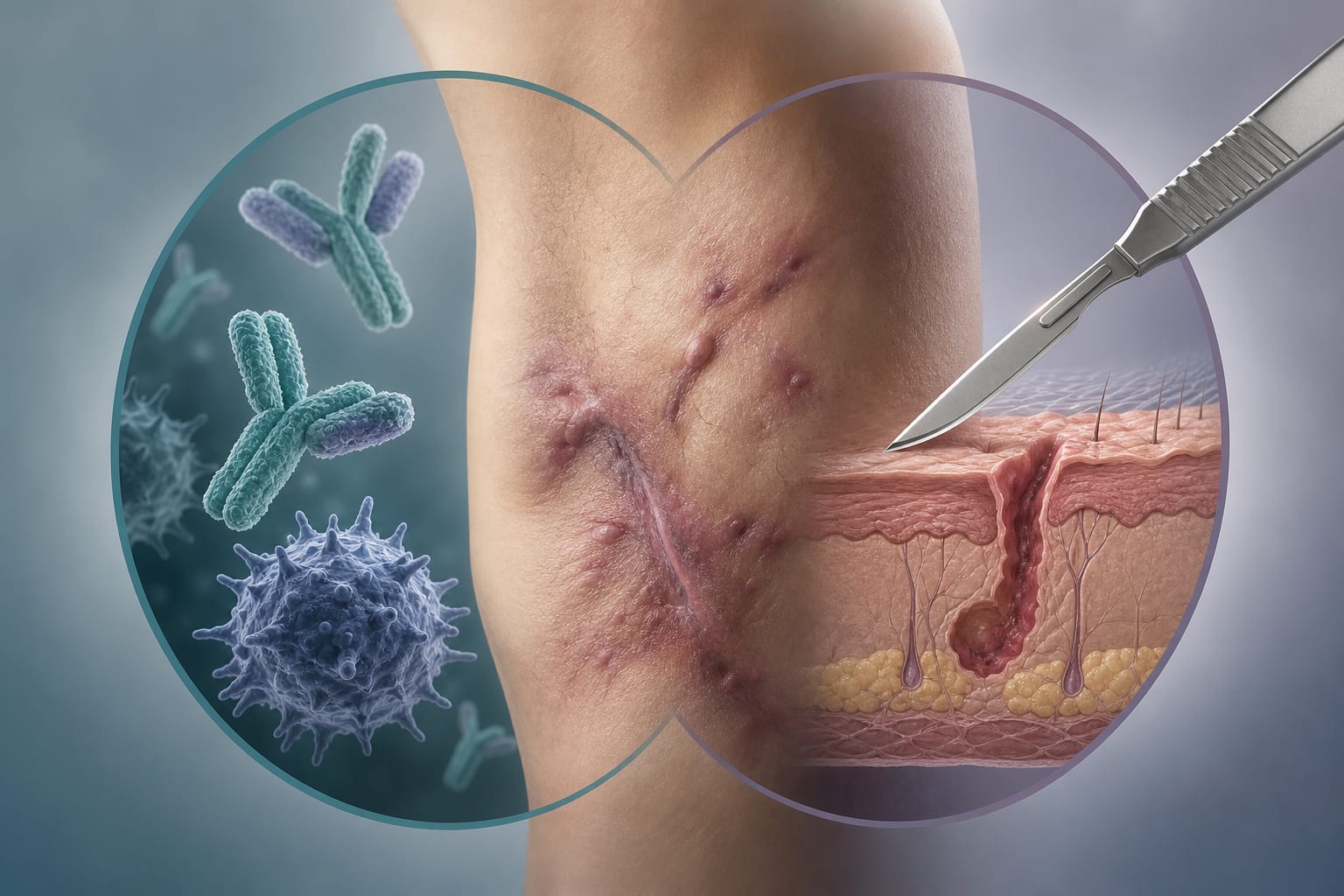
Differentiation defects reposition sebaceous glands as inflammatory instigators in the early pathogenesis of hidradenitis suppurativa - Summary - MDSpire

Differentiation defects reposition sebaceous glands as inflammatory instigators in the early pathogenesis of hidradenitis suppurativa

  • By

  • Xiang Chen

  • Jiaqi Li

  • Yibo Feng

  • Zhanyan Pan

  • Qiong Wu

  • Xinyi Xu

  • Qian Zhao

  • Tingting Hu

  • Guangjie Chen

  • Christos C. Zouboulis

  • Xiaohui Mo

  • Qiang Ju

  • June 8, 2026

  • 0 min

Share

Objective:

To determine whether sebaceous gland (SG) aberrations constitute a primary pathogenic driver in early hidradenitis suppurativa (HS) and elucidate the underlying mechanisms.

Key Findings:
  • SG size was significantly reduced in both NLS (47.26% of HC area, p = 0.04) and LS (30.74%, p = 0.006).
  • Aberrant stem cell commitment and downregulation of tight junction signaling were observed in HS SGs.
  • CLDN1 knockdown in sebocytes induced a pro-inflammatory response and metabolic reprogramming, including overproduction of lysophosphatidylcholine (LPC).
  • Exogenous LPC promoted proliferation and inflammatory cytokine secretion in keratinocytes.
Interpretation:

Remove unsupported conclusions and rephrase to reflect findings.

Limitations:
  • The study focused on a limited number of clinical specimens.
  • Further investigations are needed to validate SG-derived LPC as a biomarker and therapeutic target.
Conclusion:

Rephrase to avoid implications about LPC as a biomarker.

Original Source(s)

Related Content