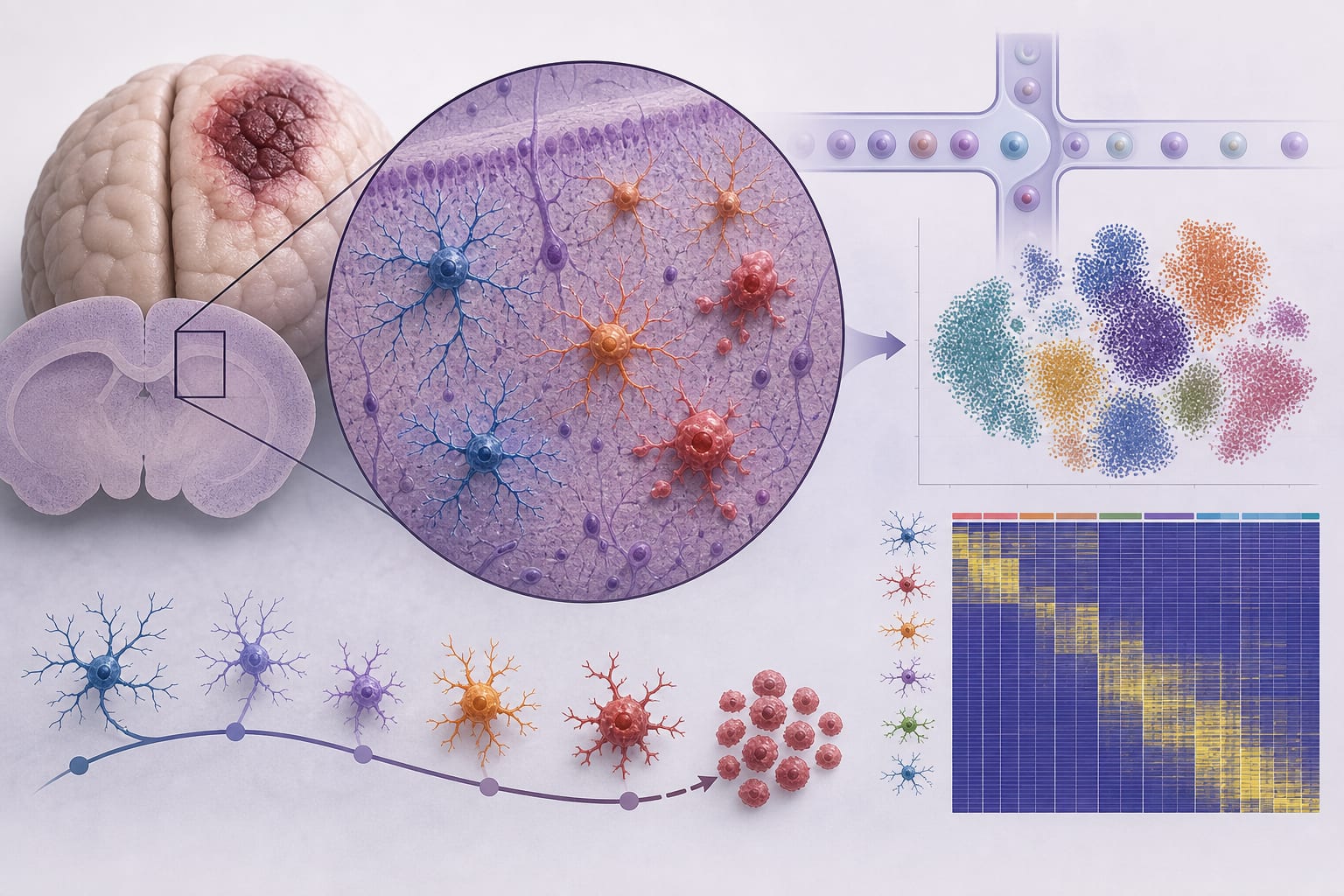
To systematically characterize the transcriptional landscape of cortical cells in a mouse model of moderate controlled cortical impact following traumatic brain injury (TBI).
Approach:
Single-cell RNA sequencing: Utilized to analyze three TBI samples and three sham samples, identifying 14 different cell groups and focusing on microglial subclusters.
Pseudotime trajectory analysis: Conducted to confirm the transition of microglial subclusters from a homeostatic state to a pro-inflammatory state.
Intercellular communication analysis: Performed to assess the reconstruction of cellular interaction networks and signaling pathways.
Key Findings:
Identification of 14 different cell groups, including seven microglial subclusters.
Reduction of homeostatic microglial subclusters (C0 and C2) and increase of disease-associated subclusters (C1, C4, C5) and a proliferation subgroup (MC Cycle) post-TBI.
Microglial transition to a pro-inflammatory state characterized by downregulation of Tmem119 and upregulation of Tnf, Spp1, Il1a, Il1b, and Cxcl2.
Proliferating microglia in the TBI group predominantly exhibited an M1-like phenotype.
Significant reconstruction of cellular interaction networks enhancing M1 polarization and contributing to neuroinflammation.
Interpretation:
The study maps cellular dynamics in TBI, highlighting a shift in microglial behavior towards a pro-inflammatory phenotype and a complex communication network involving microglia.
Limitations:
Study conducted in a mouse model, which may not fully replicate human TBI responses.
Limited sample size with only three TBI and three sham samples analyzed.
Conclusion:
Findings provide insights into microglial behavior and neuroinflammatory signaling post-TBI.