Does bronchoalveolar lavage lymphocytosis predict prognosis in fibrotic hypersensitivity pneumonitis, and is this relationship influenced by low-dose immunomodulatory therapy at the time of BAL? - Summary - MDSpire
Advertisement
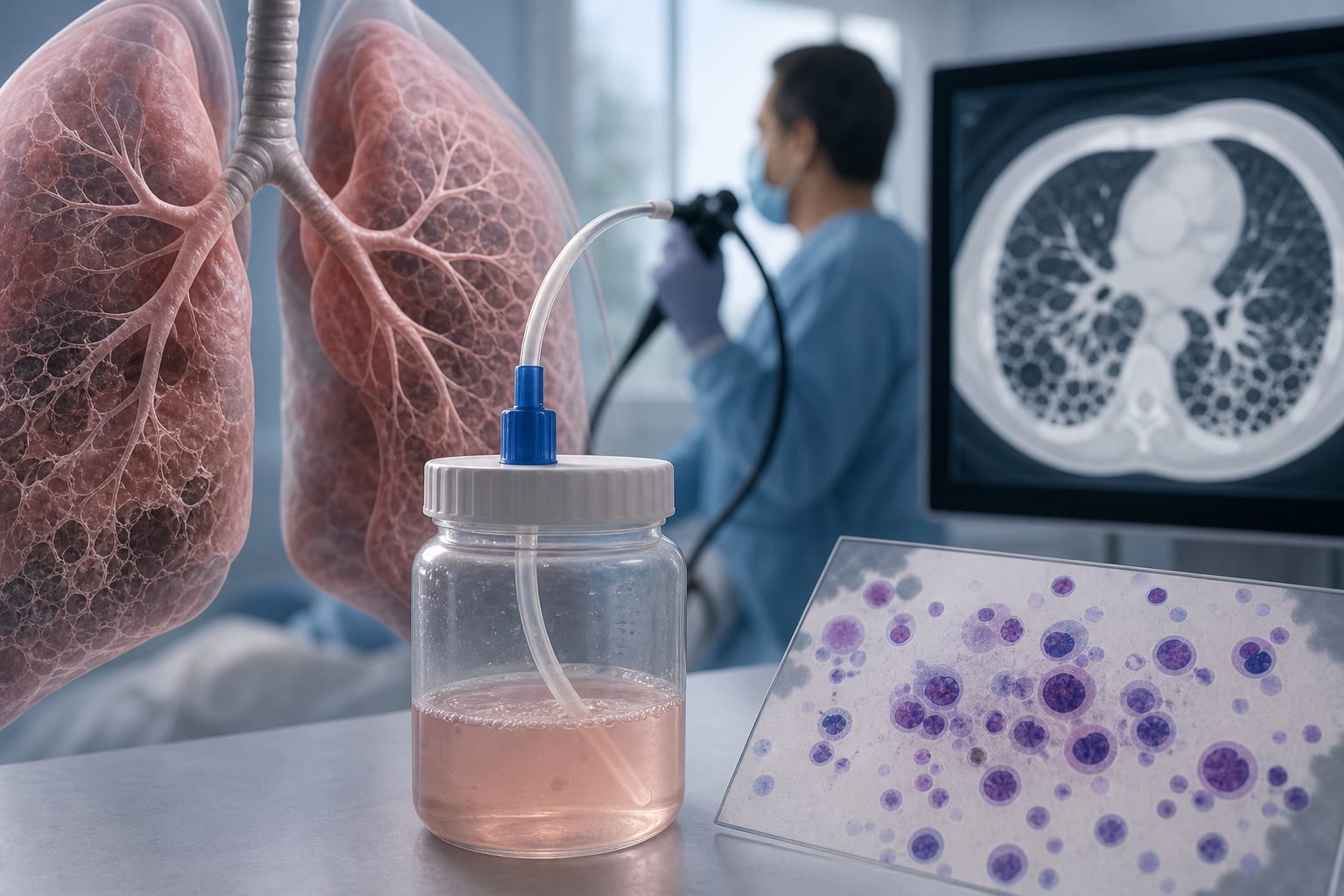
Can Lymphocytosis Detected in Bronchoalveolar Lavage Serve as a Prognostic Indicator in Fibrotic Hypersensitivity Pneumonitis, and Does Low-Dose Immunomodulatory Therapy Affect This Correlation?
To assess whether immunosuppressive treatment reduced to the lowest tolerated level at the time of bronchoalveolar lavage (BAL) modifies the association between BAL lymphocytosis and disease severity, one-year lung function, and transplant-free survival in fibrotic hypersensitivity pneumonitis (fHP).
Approach:
Study Design: Analysis of 247 fHP patients undergoing BAL, including 162 untreated and 85 receiving immunomodulatory therapy, assessing associations between BAL lymphocytosis and clinical outcomes.
Statistical Analysis: Multivariable flexible parametric survival models were used to evaluate the relationship between BAL lymphocyte percentages and clinical outcomes, adjusted for treatment status and covariates.
Key Findings:
Higher BAL lymphocyte percentages were associated with less severe disease and more favorable one-year changes in composite physiologic index (CPI) in both treated and untreated patients.
In untreated patients, higher BAL lymphocyte percentages predicted lower mortality (HR 0.87 per 10% increase, p = 0.036).
In treated patients, higher BAL lymphocyte percentages also predicted lower mortality (HR 0.78, p = 0.025).
No significant interaction was found between treatment status and BAL lymphocyte percentages regarding mortality or CPI changes.
Interpretation:
BAL lymphocytosis is associated with improved clinical outcomes in fHP, regardless of immunomodulatory therapy.
Limitations:
The study is observational and may be subject to confounding factors.
The sample size for histological confirmation of fHP was limited (only 27.5% of patients).
Conclusion:
BAL lymphocytosis is linked to better disease outcomes in fHP, independent of immunomodulatory treatment status.
by Punchalee Kaenmuang, Fiammetta Danzo, Simon Bax, Richard J. Hewitt, Maria Kokosi, Vasileios Kouranos, Felix Chua, Peter M. George, Gisli Jenkins, Athol U. Wells, Carmel J. W. Stock, Piersante Sestini, Elisabetta A. Renzoni