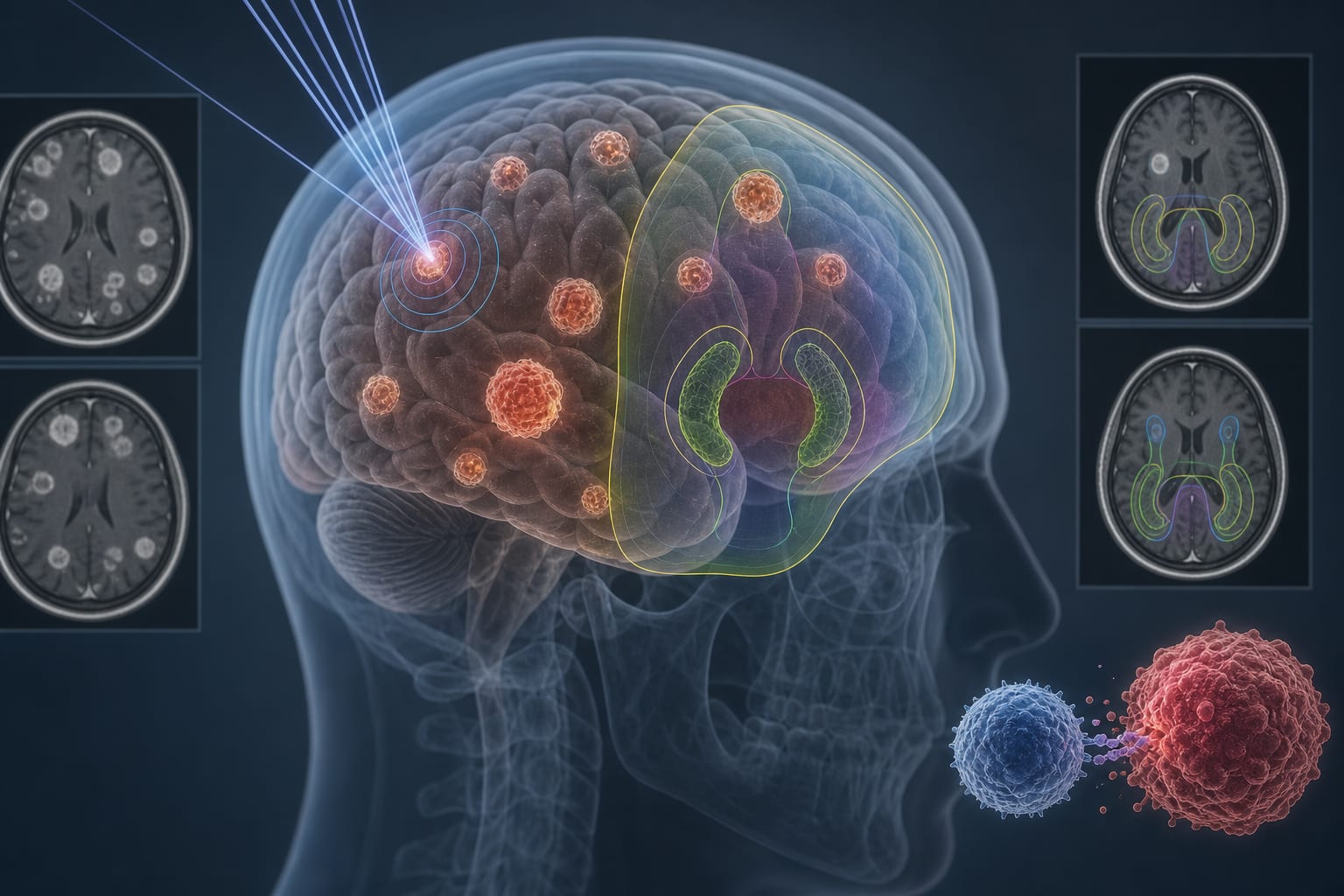
Stereotactic versus hippocampal avoidance whole-brain radiotherapy combined with immune checkpoint inhibitors for multiple brain metastases in non-small cell lung cancer: a multi-center retrospective study - Summary - MDSpire
Advertisement
Comparison of Stereotactic Radiotherapy and Hippocampal Avoidance Whole-Brain Radiotherapy with Immune Checkpoint Inhibitors in Non-Small Cell Lung Cancer Patients with Multiple Brain Metastases: A Multi-Center Retrospective Analysis
To compare the clinical efficacy of stereotactic radiotherapy (SRT) plus immune checkpoint inhibitors (ICIs) versus hippocampal avoidance whole-brain radiotherapy (HA-WBRT) plus ICIs in non-small cell lung cancer (NSCLC) patients with multiple brain metastases.
Approach:
Study Design: Retrospective review of NSCLC patients with multiple brain metastases who underwent RT plus ICIs from 2018 to 2024, with specific exclusion criteria.
Key Findings:
A total of 124 eligible patients were analyzed after matching, with 62 in each cohort.
The SRT+ICIs cohort demonstrated significantly longer median OS (21.4 months vs. 15.5 months; P<0.001) and median iPFS (10.5 months vs. 8.1 months; P<0.001) compared to the HA-WBRT+ICIs cohort.
SRT+ICIs was independently associated with improved OS (HR 0.381, 95% CI 0.241-0.695, P<0.001) and iPFS (HR 0.513, 95% CI 0.297-0.961, P<0.001).
Adverse events were similar between cohorts, with no grade > 3 adverse events reported.
Interpretation:
SRT+ICIs is associated with significantly improved OS and iPFS compared to HA-WBRT+ICIs in NSCLC patients with multiple brain metastases, without an increased risk of adverse events.
Limitations:
The retrospective nature of the study may introduce bias.
Generalizability is limited due to specific inclusion and exclusion criteria.
Conclusion:
SRT+ICIs represents a promising approach for NSCLC patients with multiple brain metastases.