Beyond the dose-volume histogram: a critical appraisal of normal tissue complication probability modelling for osteoradionecrosis of the jaw and a strategic framework for clinical translation - Summary - MDSpire
Conexiant’s news site is now MDSpire News. Learn more
Advertisement
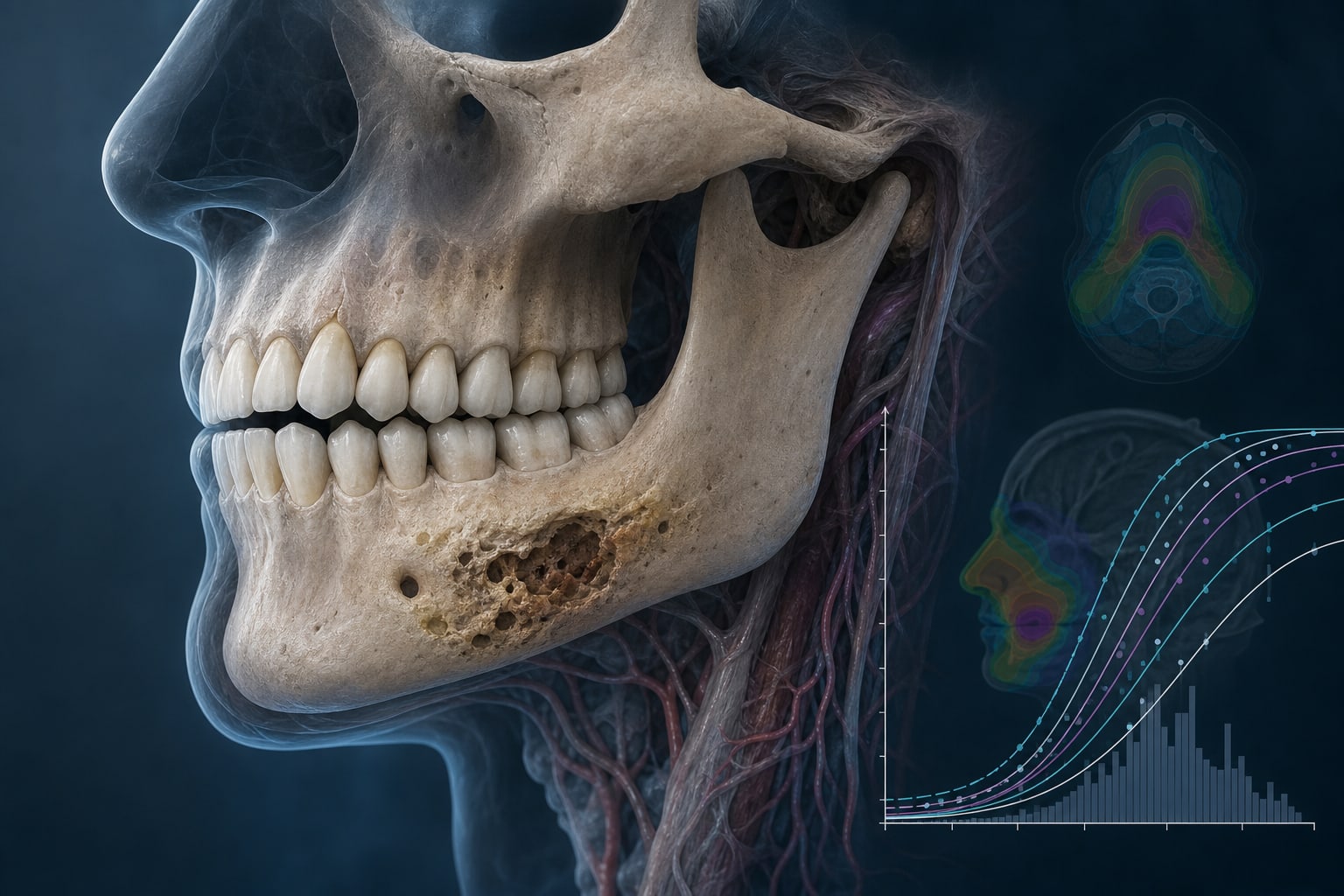
Evaluating Normal Tissue Complication Probability Models for Osteoradionecrosis of the Jaw: A Comprehensive Review and Framework for Clinical Application Beyond Dose-Volume Histograms
To review the current evidence base for NTCP models related to osteoradionecrosis (ORN) in head and neck cancer and propose a framework for clinical application.
Approach:
Narrative Synthesis: A narrative synthesis of published literature on NTCP models for ORN in head and neck cancer was conducted, considering studies that met specific inclusion criteria.
Key Findings:
The landmark NTCP model by van Dijk et al. identified D30% and pre-RT dental extraction as key predictors of ORN, achieving AUCs of 0.78 on the training cohort and 0.75 on the validation set.
The PREDMORN study corroborated these findings, adding V70Gy and smoking status as additional predictors, with AUCs of 0.67–0.69 across various cohorts.
The WAFT model introduced a time-to-event framework for ORN, identifying D25% as a significant predictor with an Adjusted Time Ratio of 0.88 per Gy increment.
Deep learning approaches have shown promise but have not yet demonstrated significant advantages over traditional DVH models.
Interpretation:
The clinical implementation of NTCP models for ORN is limited by insufficient cohort diversity, inadequate characterization of RT protocols, and under-representation of oral health variables.
Limitations:
Insufficient cohort diversity in existing studies.
Inadequate characterization of radiotherapy protocol heterogeneity.
Consistent under-representation of oral health variables.
Conclusion:
A strategic framework is proposed to address the limitations of current NTCP models, aiming for improved clinical translation.
Baptist Health will bring together leading physicians, researchers and healthcare professionals from South Florida and across the country for the 14th Annual Baptist Health Miami Neuroscience Symposium, taking place Nov. 4-6, 2026, at Hilton Miami Dadeland and virtually via Zoom.