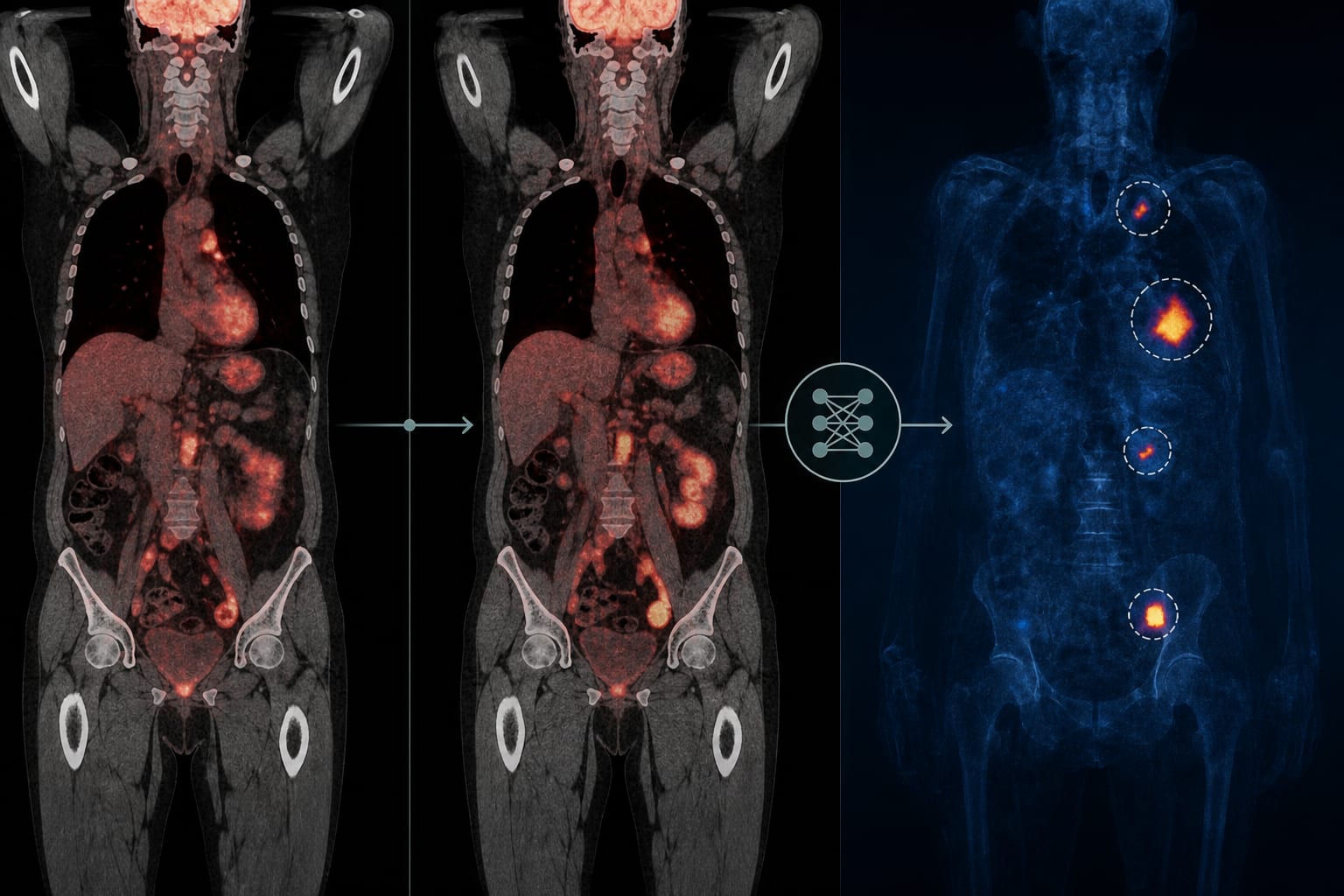
To investigate the utility of unsupervised anomaly detection for longitudinal comparison of whole-body PET/CT imaging, emphasizing its clinical significance.
Approach:
Key Findings:
The unsupervised approach reduces false-positive findings compared to traditional subtraction methods, with a quantifiable percentage.
It allows for the identification of newly appearing lesions across diverse regions of the body without the need for annotated datasets.
Interpretation:
Unsupervised anomaly detection can effectively highlight abnormalities in longitudinal PET/CT imaging, addressing limitations of existing methods by providing a more comprehensive analysis.
Limitations:
The study only included early-phase body PET/CT images, potentially limiting the generalizability of findings to other phases.
The model was developed using a dataset that excluded abnormal images during training, which may affect its performance in real-world scenarios.
Conclusion:
Unsupervised anomaly detection presents a promising alternative for longitudinal analysis in PET/CT imaging, potentially improving the identification of new lesions and suggesting directions for future research.