Conexiant’s news site is now MDSpire News. Learn more
Advertisement
Connecting Structure and Function in GA
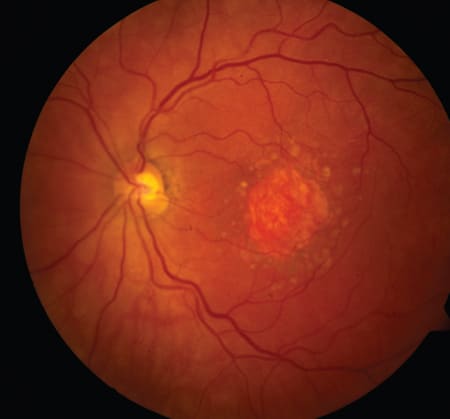
Post hoc GATHER2 analyses presented at ASRS 2026 suggest ellipsoid zone integrity and low-luminance deficit may provide complementary measures of disease progression and treatment response.
To evaluate the relationship between ellipsoid zone integrity and low-luminance deficit as markers of disease progression and treatment response in geographic atrophy.
Approach:
Study Design: Post hoc analysis of the phase 3 GATHER2 trial, focusing on patients treated with avacincaptad pegol.
Patient Evaluation: Patients were assessed based on baseline low-luminance deficit (LLD) and categorized into quartiles.
Measurements: Partial and total ellipsoid zone (EZ) attenuation were measured alongside visual acuity metrics.
Key Findings:
Ellipsoid zone integrity and low-luminance deficit moved in parallel, indicating their potential as complementary markers.
Patients in the lowest LLD quartile had less partial or total EZ attenuation than those in the highest quartile.
Avacincaptad pegol treatment reduced progression of partial EZ attenuation by approximately 62% with monthly dosing and 67% with every-other-month dosing in the highest LLD quartile, and total EZ attenuation by approximately 31% with either dosing schedule.
Interpretation:
Limitations:
The analysis is post hoc and may not establish causation.
Results are specific to the GATHER2 trial population and may not generalize to all geographic atrophy patients.