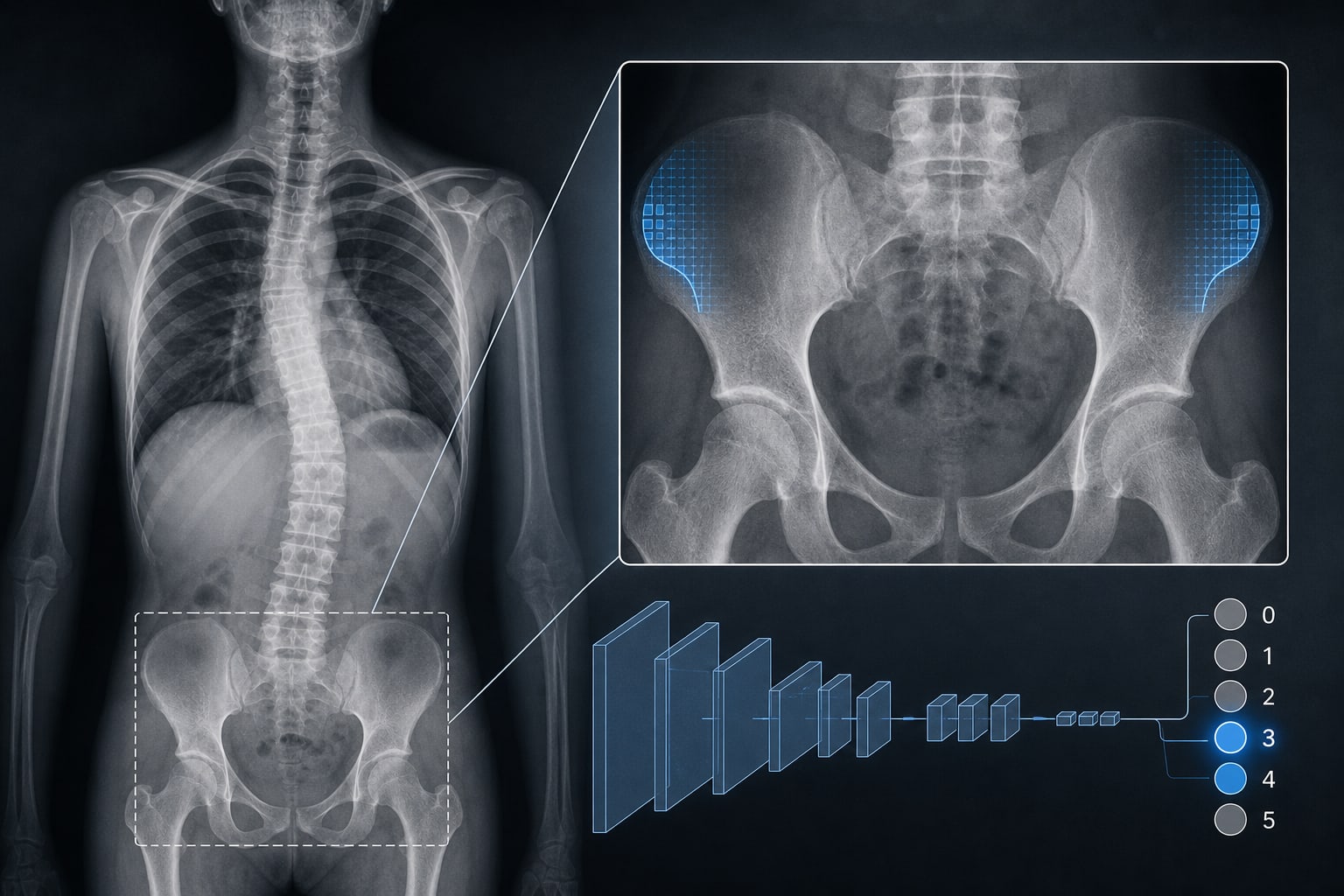
To develop and evaluate an interpretable deep-learning model for automatic stratification of skeletal maturity as Risser 0–2 vs. 3–5 using routine full-spine radiographs, enhancing clinical decision-making.
Key Findings:
The model achieved an AUC of 0.938, accuracy of 0.875, and Cohen's kappa of 0.748 on the independent test set, indicating strong predictive performance relevant for clinical application.
Grad-CAM visualizations indicated model predictions focused on the iliac apophysis and adjacent ossification regions, supporting the model's interpretability.
Model assistance reduced mean reading time by 9.7–11.8 seconds per case and improved agreement with expert reference, highlighting its efficiency in clinical settings.
Interpretation:
The interpretable deep-learning model enabled clinically actionable Risser stratification and improved reading efficiency without additional imaging.
Limitations:
Exploratory six-class Risser staging showed substantially lower performance, particularly for intermediate stages, which may limit its applicability.
The study was conducted at a single center, which may affect generalizability, and potential biases in the reader study should be considered.
Conclusion:
This approach may support standardized assessment of growth potential in routine AIS management, potentially improving patient outcomes.