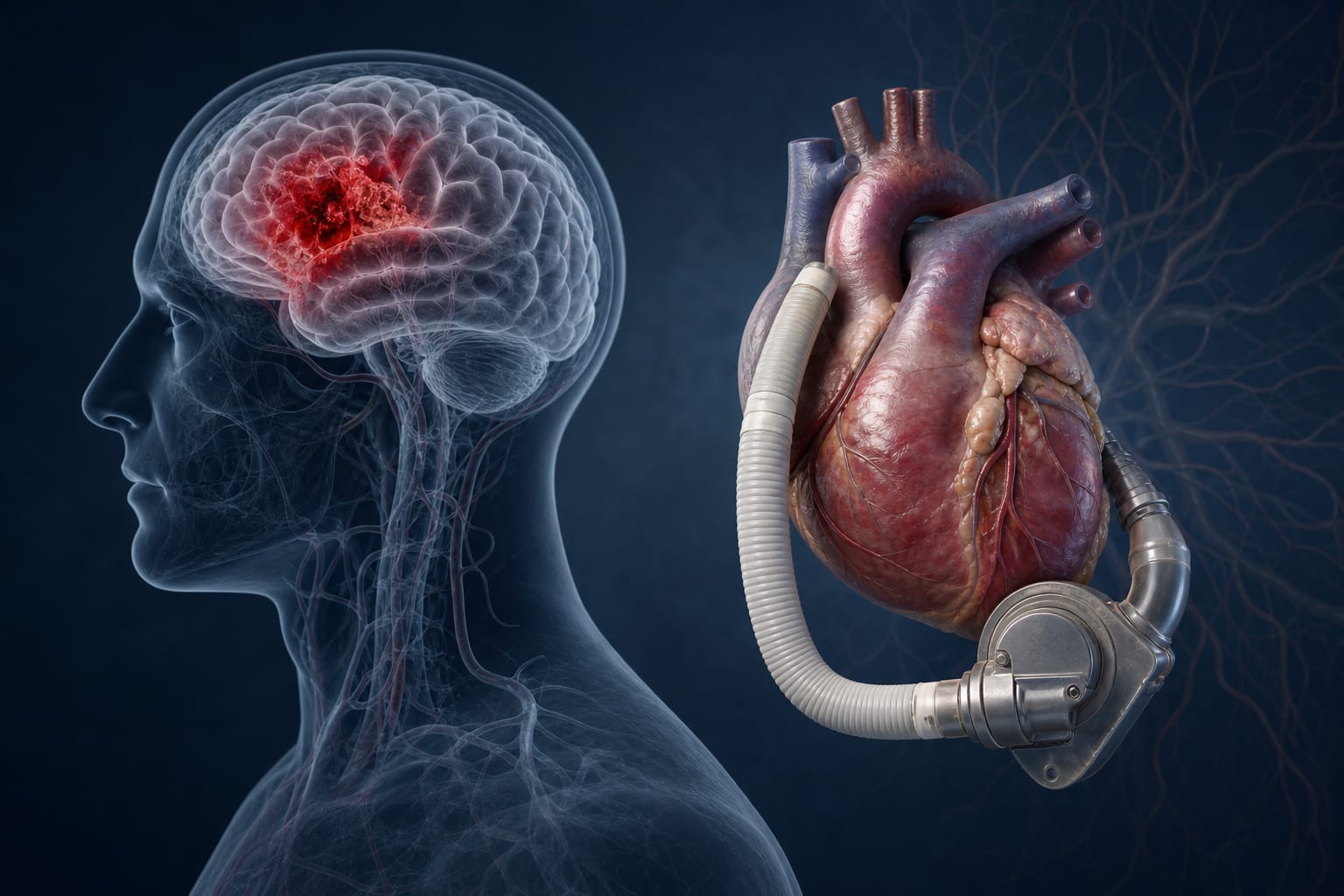
To identify independent predictors of acute heart failure (AHF) after endovascular treatment (EVT) for acute ischemic stroke with large vessel occlusion (AIS-LVO) and to develop and validate a nomogram for individualized risk prediction.
Approach:
Study Design: Retrospective analysis of data from 457 patients with AIS-LVO who underwent EVT, divided into training (n = 320) and validation (n = 137) cohorts.
Statistical Methods: Utilized LASSO regression for feature selection and multivariate logistic regression to identify independent predictors of AHF.
Model Assessment: Evaluated model performance using AUC, calibration plots, decision curve analysis (DCA), and clinical impact curves (CIC).
Key Findings:
Five independent predictors of AHF identified: atrial fibrillation, valvular heart disease, left ventricular ejection fraction, serum creatinine, and troponin T.
Nomogram demonstrated excellent discriminative ability with an AUC of 0.909 in the validation cohort.
Calibration curves showed good agreement between predicted and observed risks.
Interpretation:
The developed nomogram effectively predicts the individualized risk of AHF following EVT in patients with AIS-LVO.
Limitations:
Retrospective nature of the study may introduce bias.
Single-center study limits generalizability of findings.
Conclusion:
A validated five-factor nomogram for predicting AHF risk post-EVT in AIS-LVO patients was developed.