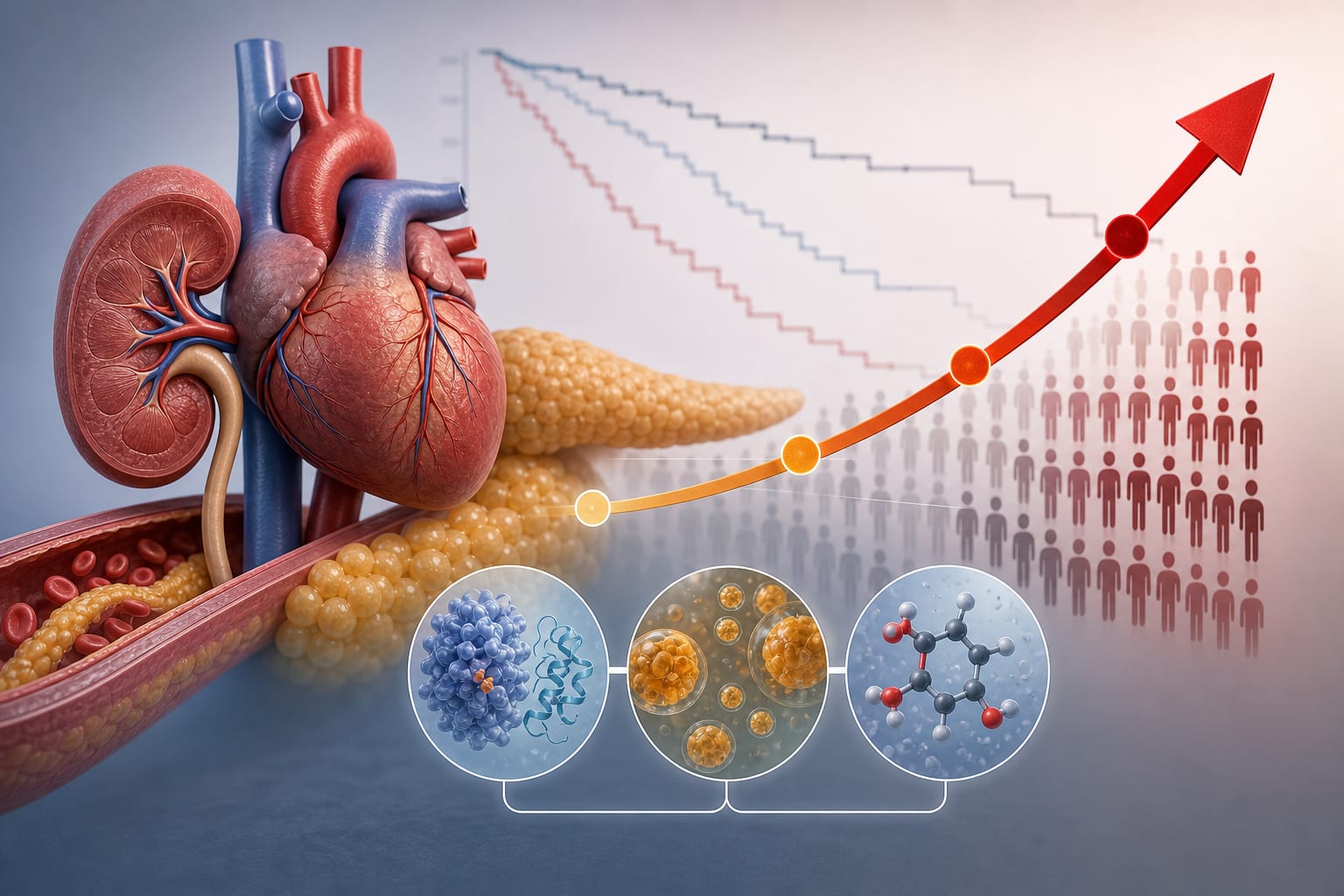
The association between C-reactive protein-triglyceride glucose index and all-cause mortality in patients with cardiovascular-kidney-metabolic syndrome: a single-center retrospective cohort study - Summary - MDSpire
Advertisement
The association between C-reactive protein-triglyceride glucose index and all-cause mortality in patients with cardiovascular-kidney-metabolic syndrome: a single-center retrospective cohort study
To investigate the association between the C-reactive protein-triglyceride glucose index (CTI) and all-cause mortality in patients with cardiovascular-kidney-metabolic (CKM) syndrome, focusing on its predictive value across CKM stages.
Approach:
Study Design: A retrospective cohort study analyzing data from 8,632 CKM patients enrolled between 2020 and 2025, stratified by CTI quartiles.
Mortality Assessment: All-cause mortality was assessed using adjusted Cox models.
CTI Calculation: CTI was calculated as the product of CRP and the TyG index, incorporating natural logarithmic transformations.
Key Findings:
CTI was an independent predictor of mortality in both CKM stages 0–3 (HR 1.68, 95% CI 1.30–2.18) and stage 4 (HR 1.54, 95% CI 1.33–1.77).
Patients in the highest CTI quartile (Q4) had a significantly higher risk of mortality compared to those in the lowest quartile (Q1) (stage 0–3: HR 4.57, 95% CI 2.32–8.99; stage 4: HR 2.26, 95% CI 1.64–3.13).
A linear dose-response relationship was confirmed between CTI and mortality risk (P for nonlinear >0.05).
CTI demonstrated superior predictive performance over the TyG index for 1-year mortality (AUC: stage 0–3, 0.73 vs. 0.62; stage 4, 0.69 vs. 0.51).
Interpretation:
CTI integrates inflammation and insulin resistance, providing a comprehensive assessment of the pathological burden in CKM patients.
Limitations:
The study was conducted at a single center, which may limit generalizability.
Retrospective design may introduce biases in data collection and analysis.
Conclusion:
CTI is a potent, independent predictor of all-cause mortality in CKM, with a linear dose-response relationship.