Trends in urolithiasis mortality in the United States, 1999–2024: a Joinpoint regression analysis of age, sex, race, and regional disparities - Summary - MDSpire
Conexiant’s news site is now MDSpire News. Learn more
Advertisement
Analysis of Mortality Trends Associated with Urolithiasis in the United States from 1999 to 2024: A Joinpoint Regression Study Examining Age, Gender, Ethnicity, and Geographic Variations
To analyze urolithiasis mortality trends in the United States between 1999 and 2024, focusing on demographic and geographic disparities.
Approach:
Data Source: Data on death certificates for individuals aged ≥45 years were retrieved from the CDC WONDER database, using ICD-10 codes N20–N23 to identify urolithiasis-related deaths.
Statistical Analysis: Age-adjusted mortality rates (AAMRs) were computed, and Joinpoint regression was utilized to detect significant changes in mortality trends, stratified by region, sex, race/ethnicity, and age group.
Key Findings:
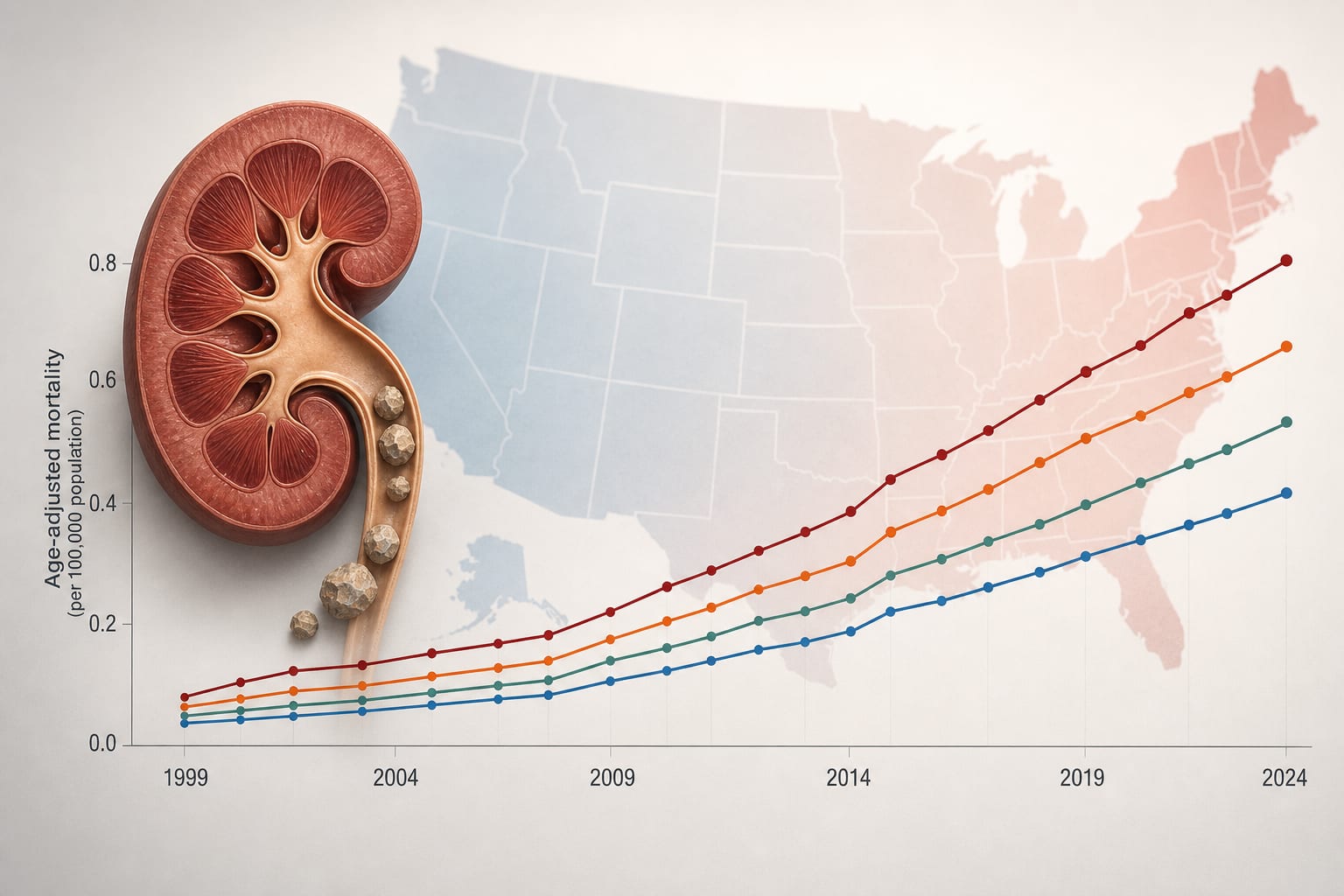
Urolithiasis mortality rose from 0.22 to 0.72 per 100,000 population from 1999 to 2024.
Mortality growth was modest from 1999 to 2014 (1.94% annual change) but accelerated significantly from 2014 to 2024 (8.54% annual change).
The Northeast had the highest age-adjusted mortality rate (0.85 per 100,000), while the Midwest showed the most rapid increase (5.42% annual change).
Females had a higher age-adjusted mortality rate than males by 2024 (0.80 vs 0.68 per 100,000).
Non-Hispanic white individuals had the highest mortality rate (0.86 per 100,000), while non-Hispanic black individuals had the lowest (0.36 per 100,000).
Mortality increased with age, peaking at 5.72 per 100,000 among individuals aged 85 and older.
Interpretation:
The study indicates a significant increase in urolithiasis mortality since 2014, with notable disparities across demographic and geographic groups.
Limitations:
Absolute mortality rates are low, and findings are based on death certificate data, which have inherent limitations.
Observations should be considered hypothesis-generating and require further validation through subsequent research.
Conclusion:
The results highlight the need for targeted interventions among high-risk populations and in high-risk regions.