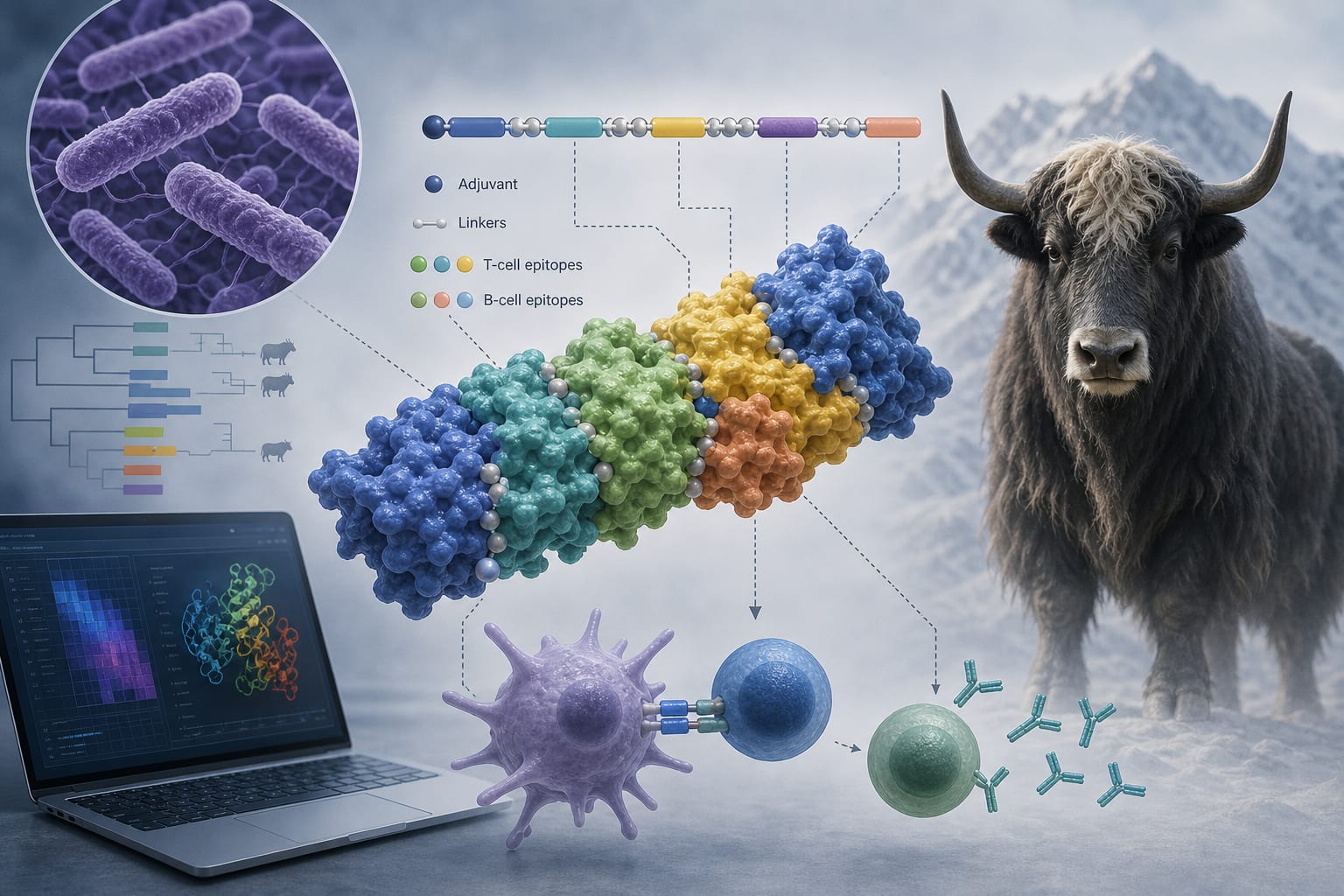
To construct a novel vaccine candidate incorporating epitopes from multiple prevalent toxinotypes of C. perfringens affecting yaks using an immunoinformatics approach.
Approach:
Immunoinformatics Pipeline: Implemented a hierarchical immunoinformatics pipeline including subtractive genomics, epitope prediction, multi-epitope vaccine design, structural modeling, molecular docking, molecular dynamics simulations, and codon optimization.
Key Findings:
Identified five core virulence proteins (Iap, CpsE, NanH, Plc, Pfo) from genomic data.
Predicted and selected ten CTL epitopes, five HTL epitopes, and five B-cell epitopes.
Constructed a 352-amino-acid multi-epitope vaccine incorporating human β-defensin-3 as an adjuvant.
Achieved high antigenicity (VaxiJen score: 0.9092) and confirmed non-allergenic nature.
Demonstrated strong binding affinity with TLR2 and TLR4 through molecular docking.
Molecular dynamics simulations confirmed stability of TLR4 and TLR2 complexes.
Immune simulation profiles predicted the induction of robust humoral and cellular immune responses, including elevated antibody titers, T-cell activation, and cytokine production.
Interpretation:
The study presents a candidate for a multi-epitope vaccine against C. perfringens in yaks, showing high antigenicity and structural stability, which requires further experimental validation.
Limitations:
The findings are based on computational predictions that need rigorous in vitro and in vivo validation.
Conclusion:
This work provides a foundation for the development of effective vaccines against yak C. perfringens infections on the Qinghai-Tibet Plateau.