Development and validation of a uric acid-inflammation-metabolism score for predicting osteoarthritis risk: evidence from NHANES 2007–2018 and an external Chinese cohort - Summary - MDSpire
Conexiant’s news site is now MDSpire News. Learn more
Advertisement
Creation and assessment of a Uric Acid-Inflammation-Metabolism score for predicting the likelihood of osteoarthritis: findings from NHANES 2007–2018 and a validation cohort from China
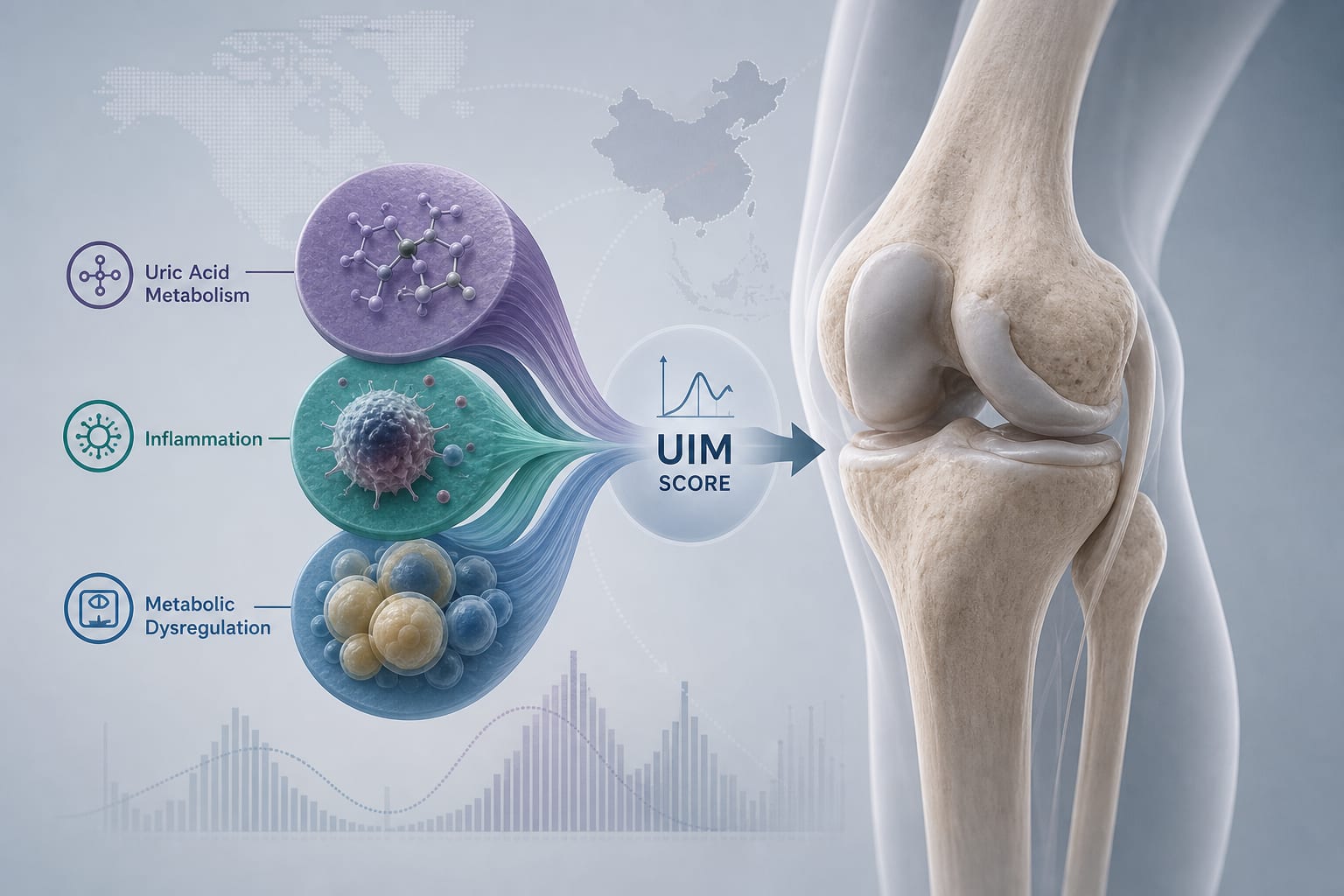
To develop and validate a novel Uric acid-Inflammation-Metabolism (UIM) score for assessing the association with osteoarthritis (OA) prevalence and to explore joint effect mechanisms among three biological dimensions: uric acid metabolism, inflammatory status, and metabolic disturbance, highlighting its potential significance in clinical practice.
Key Findings:
Seven variables (UA, eGFR, serum creatinine, hs-CRP, WC, HDL-C, BMI) were retained in the UIM score, indicating a multifactorial approach to OA risk assessment.
Participants in the highest UIM score quartile (Q4) had a 2.63-fold higher OA risk than those in the lowest quartile (Q1) (OR = 2.63, 95% CI: 1.47–4.72), underscoring the score's predictive power.
The UIM score (AUC = 0.707) outperformed individual biomarkers and the traditional model, suggesting its superior utility in clinical settings.
The uric acid dimension contributed most (70.50%) to the UIM score, followed by metabolic (26.92%) and inflammatory (2.58%) dimensions, reflecting the complex interplay of these factors.
A significant additive antagonistic interaction was observed between high inflammation and high metabolic disturbance, indicating the need for integrated management strategies.
Interpretation:
The UIM score integrating uric acid metabolism, inflammation, and metabolic disturbance outperforms individual biomarkers in OA risk prediction with good cross-cohort generalizability, suggesting its practical applications in clinical settings.
Limitations:
Potential limitations include the retrospective design, reliance on self-reported data, and the need for further validation in diverse populations.
Conclusion:
The UIM score is a practical tool for OA prevalence stratification and clinical assessment.
Federal prosecutors allege that a Florida physician and research staff fabricated clinical trial records that were submitted into database systems used to evaluate investigational drugs.