Two temporally validated diagnostic models for arterial stiffness using routine clinical indicators: a practical tool for resource-limited settings - Summary - MDSpire
Advertisement
Two temporally validated diagnostic models for arterial stiffness using routine clinical indicators: a practical tool for resource-limited settings
To develop and validate diagnostic models for arterial stiffness using easily collectible clinical indicators in resource-limited settings.
Approach:
Study Design: Cross-sectional analysis using data from two community-based cardiovascular health surveys in Yinchuan City, Ningxia, China.
Cohorts: Derivation cohort (n=2,440) from January 2020 to January 2021 and validation cohort (n=2,512) from January 2025 to January 2026.
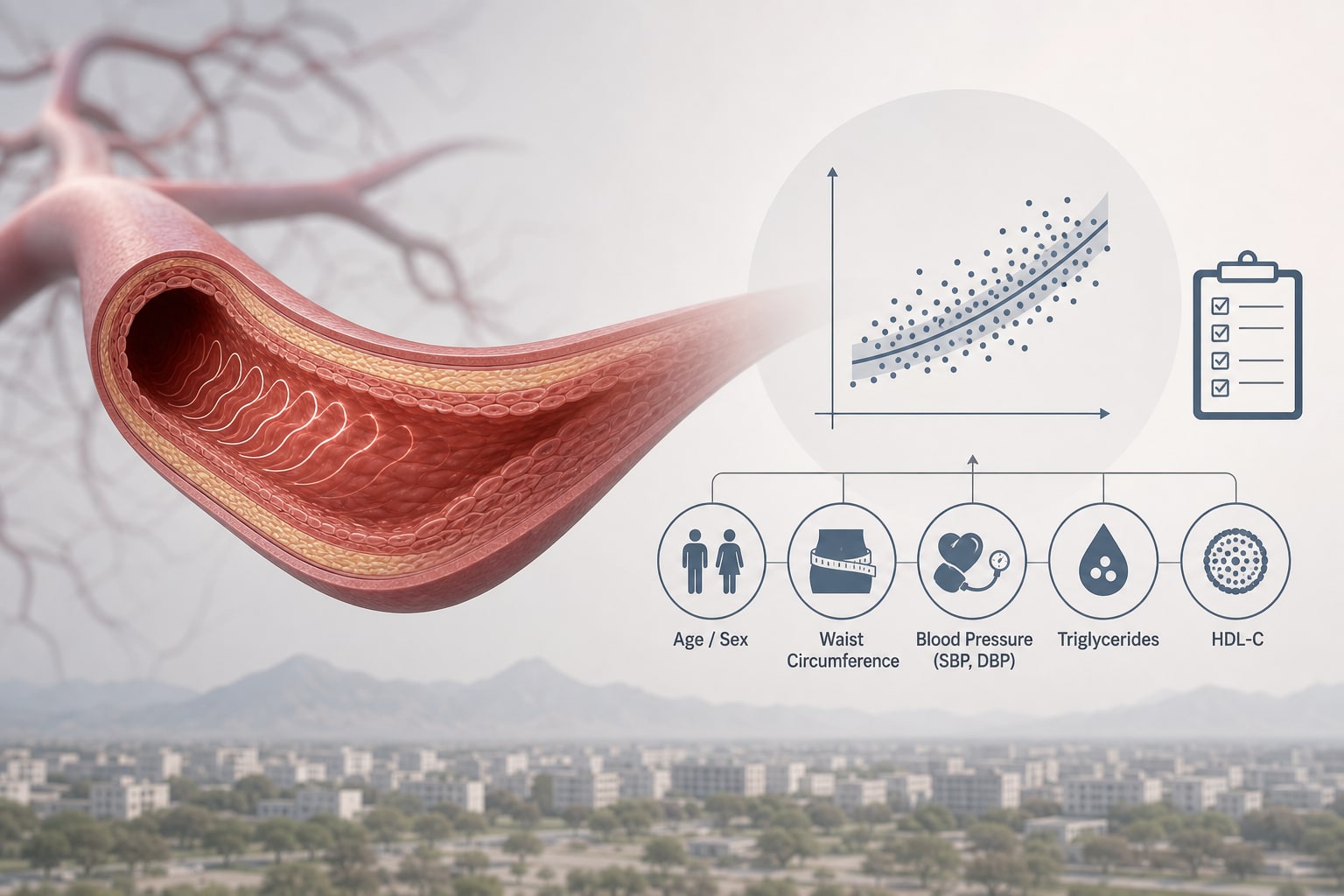
Model Development: Two logistic regression models were developed: Model 1 included sex, age, waist circumference, systolic and diastolic blood pressure; Model 2 added triglycerides and high-density lipoprotein cholesterol.
Performance Assessment: Model performance was evaluated using area under the receiver operating characteristic curve (AUC), calibration curves, bootstrap internal validation, and decision curve analysis.
Key Findings:
Model 1 and Model 2 achieved AUCs of 0.926 and 0.927 in the derivation cohort, and both models had an AUC of 0.916 in the validation cohort.
Both models significantly outperformed five metabolic indices (LAP, WWI, VAI, TyG, TG/HDL-C) with P < 0.001.
Interpretation:
Limitations:
Study limited to two districts in Ningxia, China, which may affect generalizability.
Potential biases inherent in cross-sectional study design.