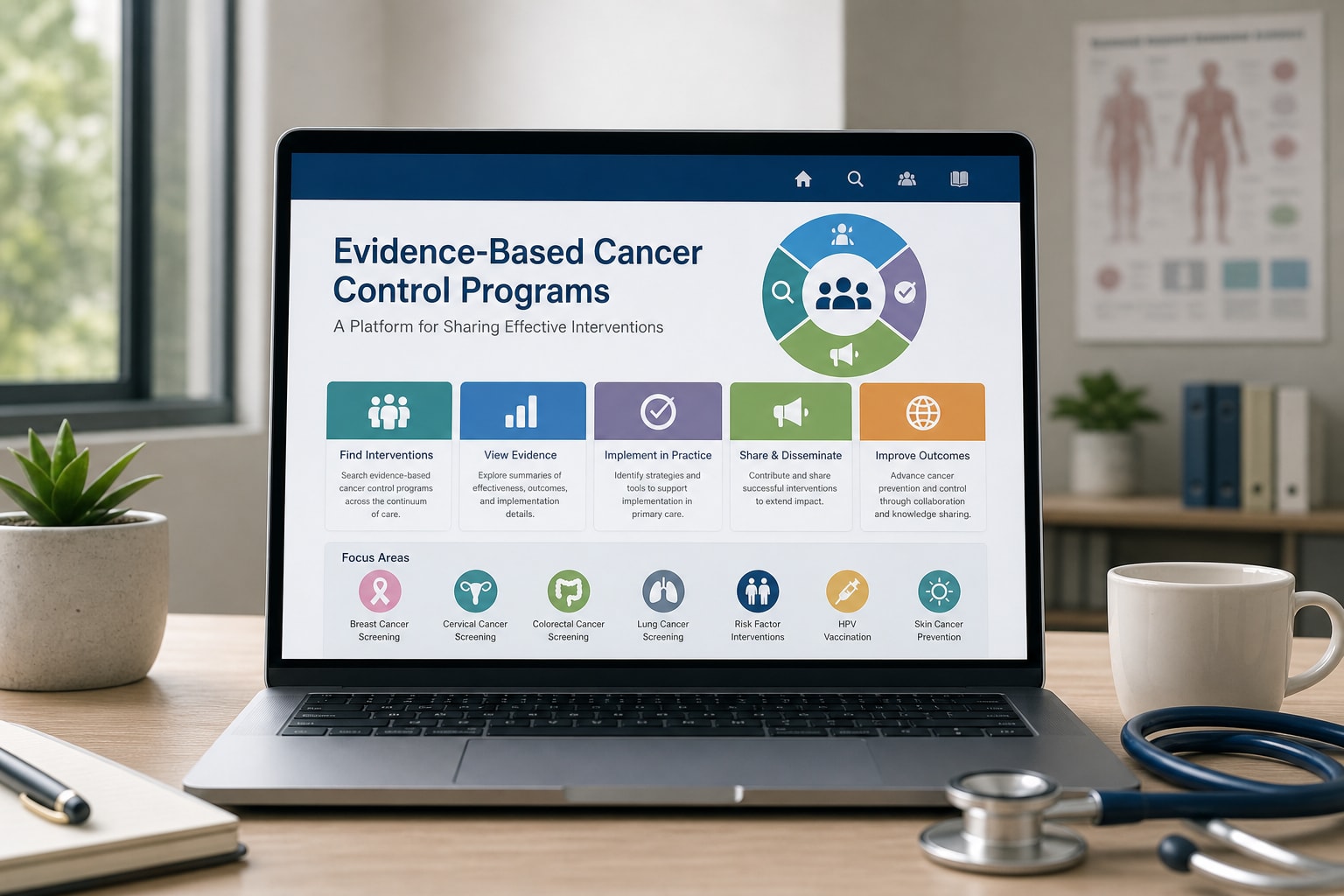
The article describes the Evidence-Based Cancer Control Programs (EBCCP) website, its eligibility and review process, the interventions it lists, and its relevance to cancer prevention and control in primary care.
Approach:
Platform and eligibility: EBCCP is a searchable database of cancer control interventions. Eligible programs must have published, peer-reviewed, statistically significant primary outcomes from an experimental or quasi-experimental study completed within the preceding ten years, and intervention materials suitable for use in a U.S. community or clinical setting.
Review and implementation support: Developers may submit interventions, and NCI also conducts ongoing literature scans to identify newly published interventions. NCI arranges external review of research integrity, intervention impact, dissemination capability, reach, effectiveness, adoption, implementation, and written-material readability. Before posting, NCI works with the study team to prepare a summary that includes implementation guidance.
Primary care context: The article describes primary care as a setting for cancer prevention and screening because of its accessibility, continuity of care, clinician communication, and existing care teams.
Key Findings:
As of September 2026, EBCCP listed 177 active and 61 archived interventions across 15 topic areas.
Among 79 interventions assessed in health care facilities, 28 (35%) were developed for primary care, 8 (10%) used hybrid clinic and community approaches, and 43 (54%) were designed for specialty, survivorship, dental, or tertiary hospital settings.
All interventions were available in English. Materials were also available in Spanish for 26 interventions, Vietnamese for 5, Arabic for 1, Swahili for 1, and other languages for 13.
The number of interventions in each topic area varied in part according to when the topic was added to RTIPs or EBCCP.
Interpretation:
The article describes EBCCP as an NCI-supported searchable resource for reviewed cancer control interventions, with summaries that include implementation guidance. It also discusses primary care as a setting for delivering cancer prevention and screening interventions.
Limitations:
Because EBCCP is a government website, detailed information about its users is limited.
The number of interventions available in each topic area is influenced by when that topic was added to the database.
Conclusion:
By September 2026, EBCCP listed 177 active and 61 archived interventions across 15 topic areas. The article describes the website’s eligibility and review processes and identifies primary care as one setting for cancer prevention and screening interventions.