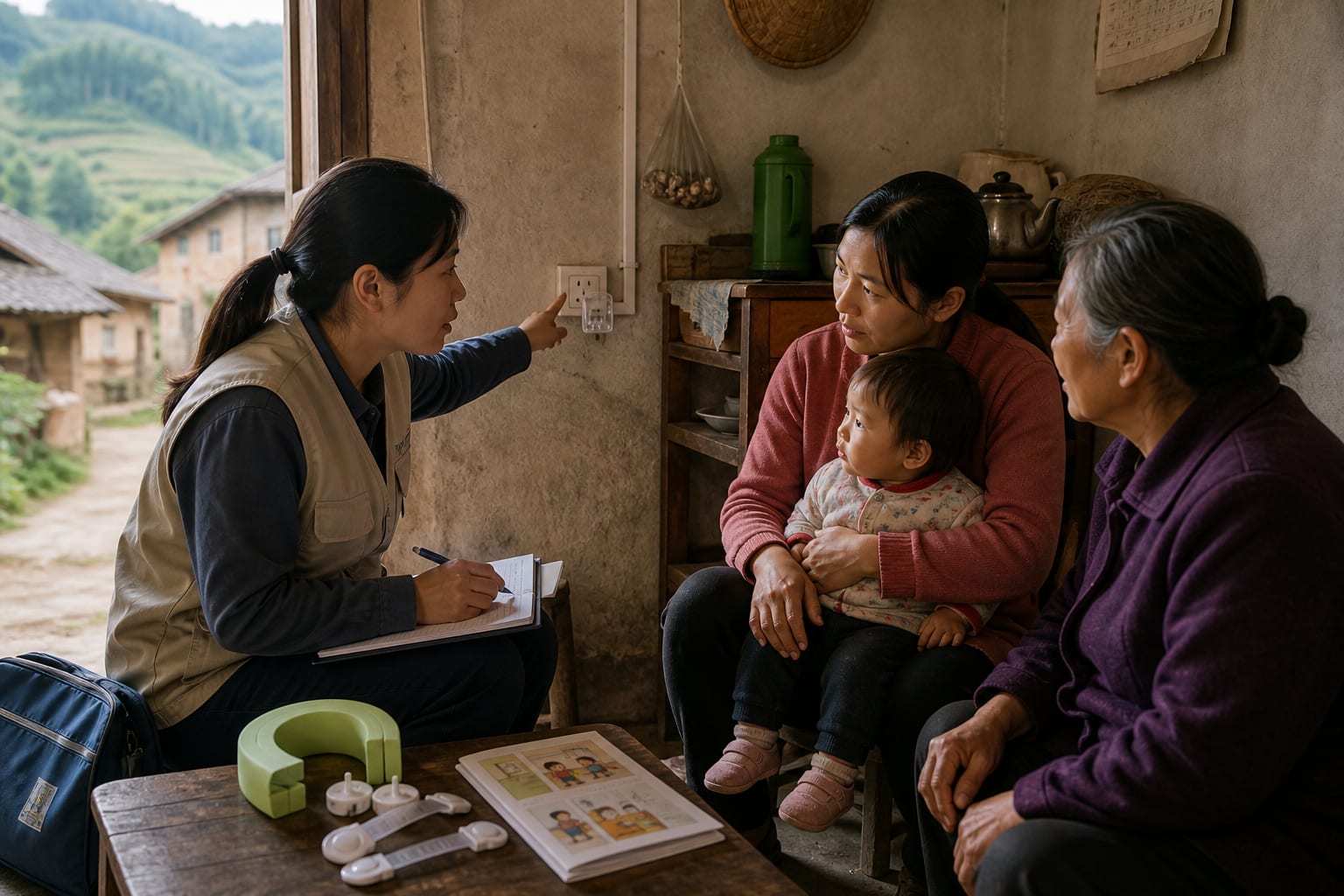
To assess whether structured, community-delivered home visits can reduce child injuries and improve household safety in rural China.
Approach:
Design and setting: Outcome assessor–blinded cluster randomized clinical trial in 24 rural communities in Guizhou and Shaanxi provinces, involving 360 households with children aged 3 to 12 years.
Intervention: Trained civil society organization social workers delivered three monthly structured home visits and a month-4 follow-up, using standardized home safety and first aid tool kits to identify hazards, support remediation, and reinforce safety skills.
Comparator and follow-up: The intervention was compared with routine social worker services; outcomes were assessed over four months.
Key Findings:
Among households with observed outcomes, cumulative injury incidence was 11.8% in the intervention group and 19.1% in the control group.
In the intention-to-treat analysis, intervention exposure was associated with lower odds of injury (adjusted odds ratio, 0.36; 95% CI, 0.18-0.73).
After adjustment, caregiver supervisory behavior scores at month 4 were 17.08 points higher and household environmental hazard scores were 36.66 points lower in the intervention group.
Improvements were more pronounced for supervision and household safety than for caregiver knowledge and attitudes.
Interpretation:
The trial provides proof of concept for delivering structured child injury prevention through a community-based social work platform. The authors describe the approach as complementary to school-based prevention and primary care.
Limitations:
Follow-up ended at month 4, while the intervention was ongoing; persistence of benefits after visits stop is unknown.
The primary outcome relied on caregiver reports from participants aware of group assignment, so reporting bias cannot be ruled out.
The trial could not identify which intervention components produced the observed changes.
Broader implementation requires further assessment of delivery resources and costs, and replication depends on comparable community infrastructure and workforce support.
Conclusion:
The authors call for extended follow-up and further evaluation of implementation resources, costs, and fidelity before broader implementation.
A modeling study projects 83% more childhood chronic hepatitis B infections and 1.8 million susceptible young adults under a shared decision-making vaccination strategy.