Deep learning model to generate patient-specific pulmonary vein isolation lines from successful atrial fibrillation ablation cases: a proof-of-concept study - Summary - MDSpire

Deep learning model to generate patient-specific pulmonary vein isolation lines from successful atrial fibrillation ablation cases: a proof-of-concept study

  • By

  • Kazuo Sakamoto

  • Takeshi Tohyama

  • Hirotake Yokoyama

  • Tsukasa Watanabe

  • Tomomi Nagayama

  • Yasushi Mukai

  • Shunsuke Kawai

  • Daisuke Yakabe

  • Hiroshi Mannoji

  • Kazuhiro Nagaoka

  • Atsushi Tanaka

  • Mitsutaka Yamamoto

  • Kiyohiro Ogawa

  • Takeshi Mikami

  • Shujiro Inoue

  • Susumu Takase

  • Kei Inoue

  • Kazuya Hosokawa

  • Koji Todaka

  • Hiroyuki Tsutsui

  • Kohtaro Abe

  • July 6, 2026

  • 0 min

Share

Objective:

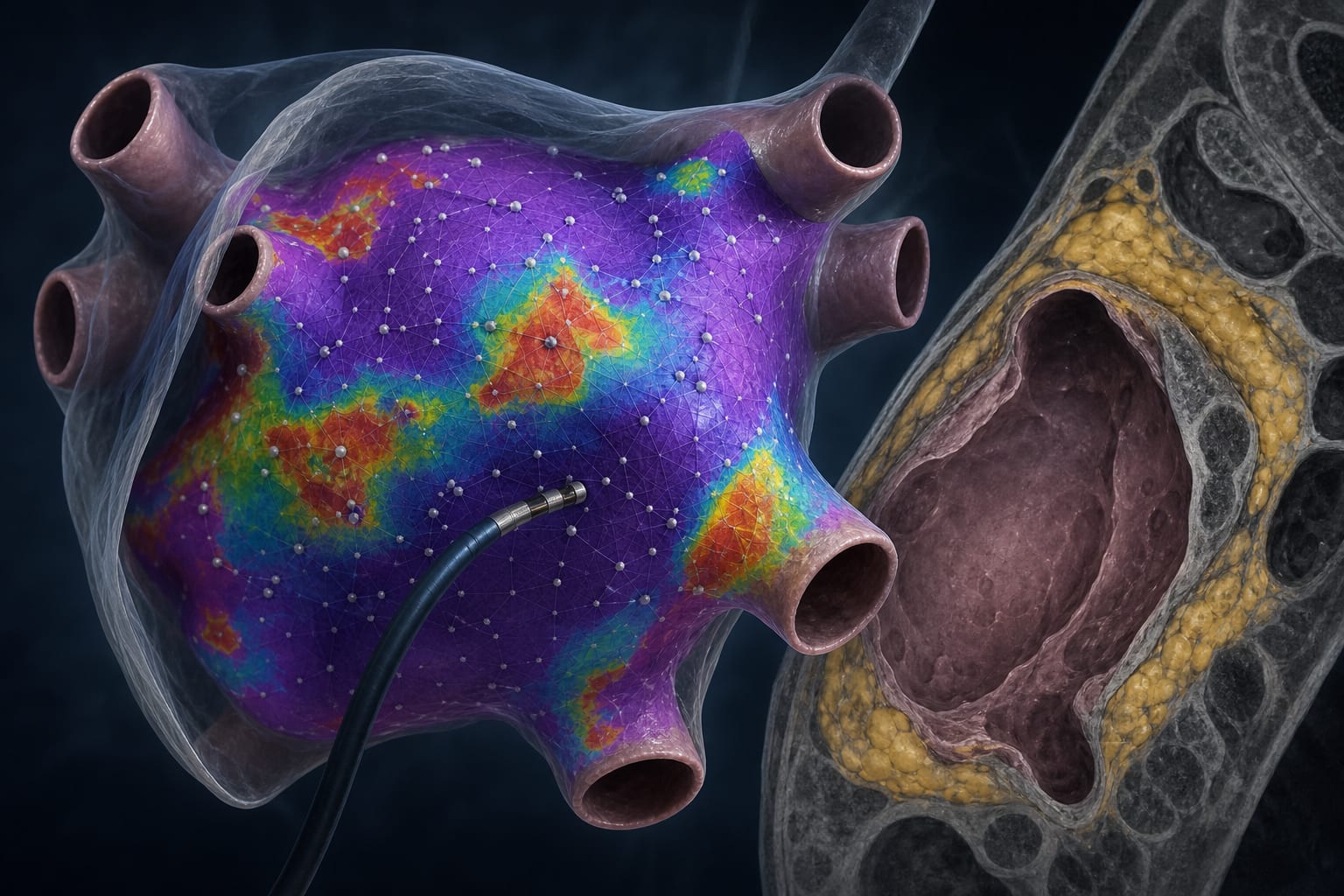
To develop a deep learning model that generates patient-specific pulmonary vein isolation (PVI) lines from pre-ablation 3D voltage maps based on successful atrial fibrillation (AF) ablation cases.

Approach:
  • Study Design: A retrospective, multicenter study involving 1,969 patients who underwent catheter ablation for AF, with data collected from April 2016 to March 2023.
  • Model Development: A U-Net-based deep learning model was trained on 513 3D voltage maps from 171 patients with documented freedom from AF recurrence for over one year.
  • Performance Metrics: The model's performance was evaluated using mean Intersection over Union (IoU) and Dice score, achieving 0.87 and 0.93, respectively.
Key Findings:
  • The deep learning model successfully reproduced anatomical and electrophysiological features of PVI lesion sets.
  • The model achieved a mean Intersection over Union of 0.87 and a Dice score of 0.93 on the test set.
Interpretation:

Limitations:
  • The study is a proof-of-concept without external validation.
  • Inter-operator variability in ground-truth annotations was not quantitatively assessed.
Conclusion:

The study demonstrates the feasibility of using deep learning to create individualized PVI lines, warranting further investigation for clinical application.

Sources:

Original Source(s)

Related Content