Tumor-associated macrophages and lineage plasticity in prostate cancer: from established myeloid programs to emerging spatial hypotheses - Summary - MDSpire
Advertisement
Tumor-associated macrophages and lineage plasticity in prostate cancer: from established myeloid programs to emerging spatial hypotheses
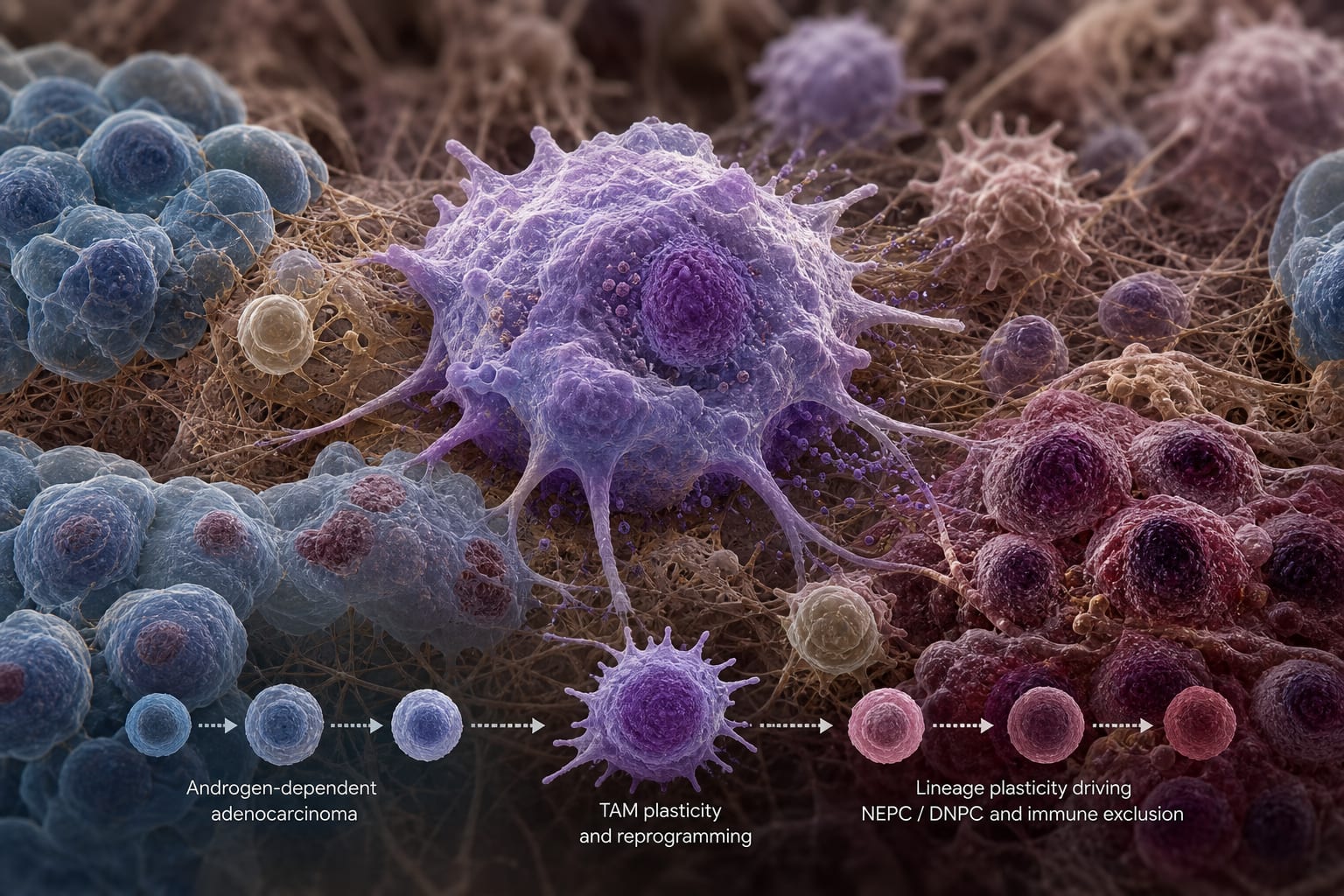
To synthesize evidence linking tumor-associated macrophage (TAM) heterogeneity to lineage plasticity in prostate cancer and to propose a framework for understanding their role in therapeutic resistance, particularly in the context of AR signaling inhibitors.
Approach:
Literature Review: The review summarizes established and emerging evidence regarding TAMs and their influence on prostate cancer lineage plasticity, including specific pathways such as IL-6/STAT3 and TGF-beta.
Framework Development: It discusses established myeloid programs and introduces new spatial theories related to TAMs, including emerging states like PLAC8+ TAMs and their interactions with tumor cells.
Key Findings:
TAMs are heterogeneous and play a significant role in shaping tumor-cell fate through various mechanisms, including paracrine signaling and immune selection.
Established myeloid programs include SPP1+/TREM2+ states and pathways such as IL-6/STAT3 and TGF-beta.
Emerging TAM states like PLAC8+ TAMs may be associated with ARSI-induced DNPC-like remodeling.
Single-cell and spatial transcriptomic studies reveal extensive TAM heterogeneity linked to clinical outcomes, emphasizing the need for independent validation.
Interpretation:
The review emphasizes the need to distinguish between established findings supported by multiple independent studies and emerging hypotheses regarding TAMs in prostate cancer.
Limitations:
The proposed models require direct biochemical, genetic, and in vivo validation, particularly for emerging observations based on limited cohorts.
Emerging observations are based on limited cohorts and need further independent validation.
Conclusion:
The review outlines a translational roadmap for TAM-directed therapy, focusing on the need for validation, functional testing, and biomarker-guided clinical testing.