Influencing factors of peripheral blood indicators on 30-day mortality risk in children with hemophagocytic lymphohistiocytosis based on weighted quantile sum regression: a single-center retrospective cohort study - Summary - MDSpire
Advertisement
Influencing factors of peripheral blood indicators on 30-day mortality risk in children with hemophagocytic lymphohistiocytosis based on weighted quantile sum regression: a single-center retrospective cohort study
To investigate the joint effect of peripheral blood parameters on the 30-day mortality risk in children with hemophagocytic lymphohistiocytosis (HLH) using weighted quantile sum (WQS) regression.
Approach:
Study Design: A retrospective cohort design was adopted involving 133 pediatric HLH patients diagnosed at a single center.
Data Collection: Baseline peripheral blood parameters were collected within 24 hours prior to or on the day of diagnosis.
Statistical Analysis: Univariate logistic regression was used for preliminary screening, followed by WQS regression to evaluate joint effects and extract empirical weights.
Additional Analysis: Restricted cubic spline (RCS) analysis explored the dose-response relationship between core parameters and mortality risk.
Key Findings:
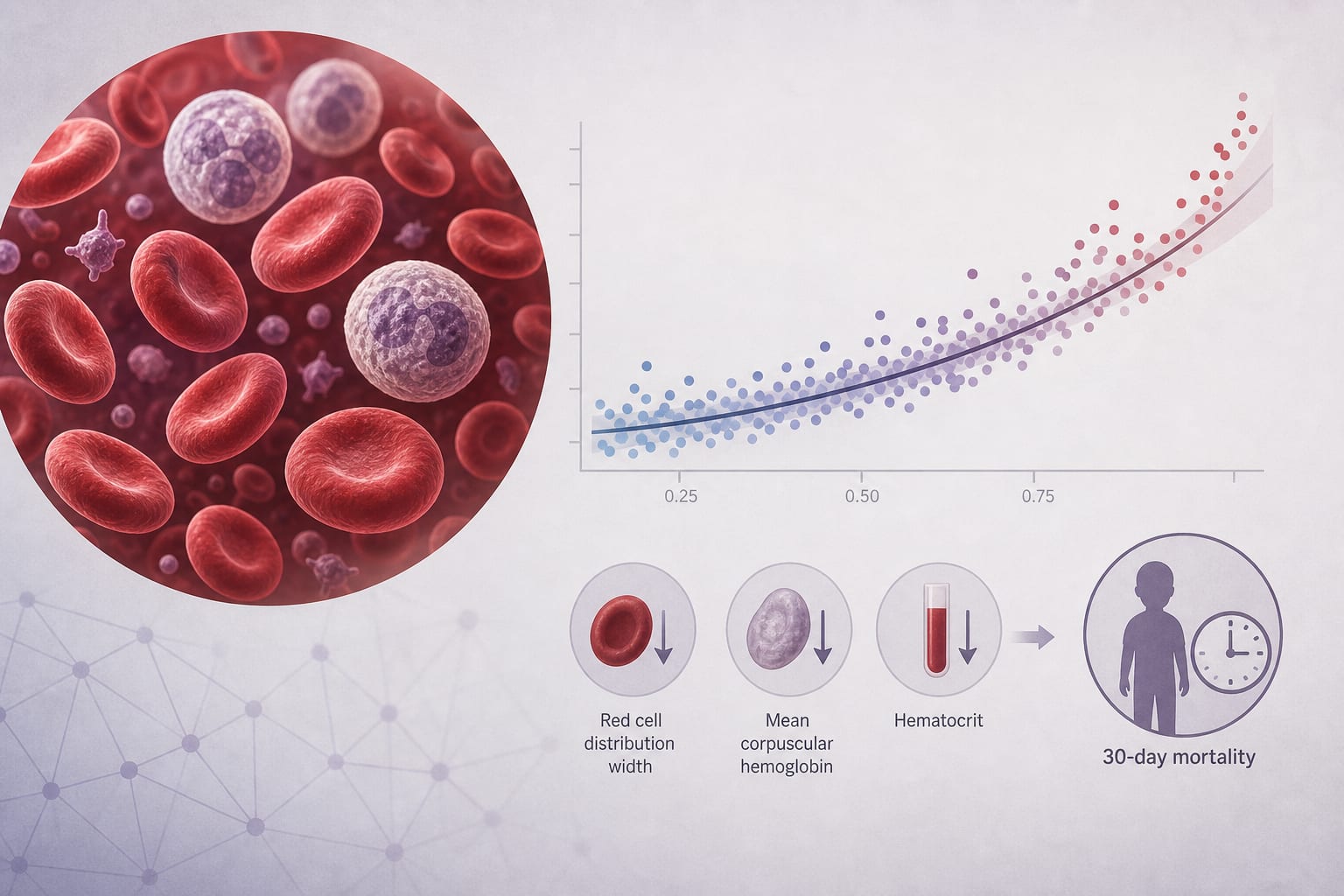
Red blood cell distribution width (RDW), mean corpuscular hemoglobin (MCH), hematocrit (HCT), and hemoglobin (Hb) were significantly associated with early mortality risk.
The WQS regression model indicated a significant joint protective effect against 30-day mortality risk (β = −0.936, P = 0.012).
MCH (weight 62.6%) and HCT (weight 29.8%) had the highest relative weights in the evaluated mixture.
The combined predictive model of MCH and HCT improved the area under the curve (AUC) to 0.728.
Decision curve analysis confirmed that the combined model provided a favorable clinical net benefit across a range of threshold probabilities.
Interpretation:
Abnormalities in peripheral blood parameters, particularly HCT and MCH, serve as composite indicators for predicting early fatal outcomes in pediatric HLH.
Limitations:
The study is based on a single-center retrospective cohort, which may limit generalizability.
Potential confounding factors not accounted for in the analysis.
Conclusion:
The WQS regression model effectively mitigates collinearity interference among clinical variables, providing insights into early mortality risk in pediatric HLH.