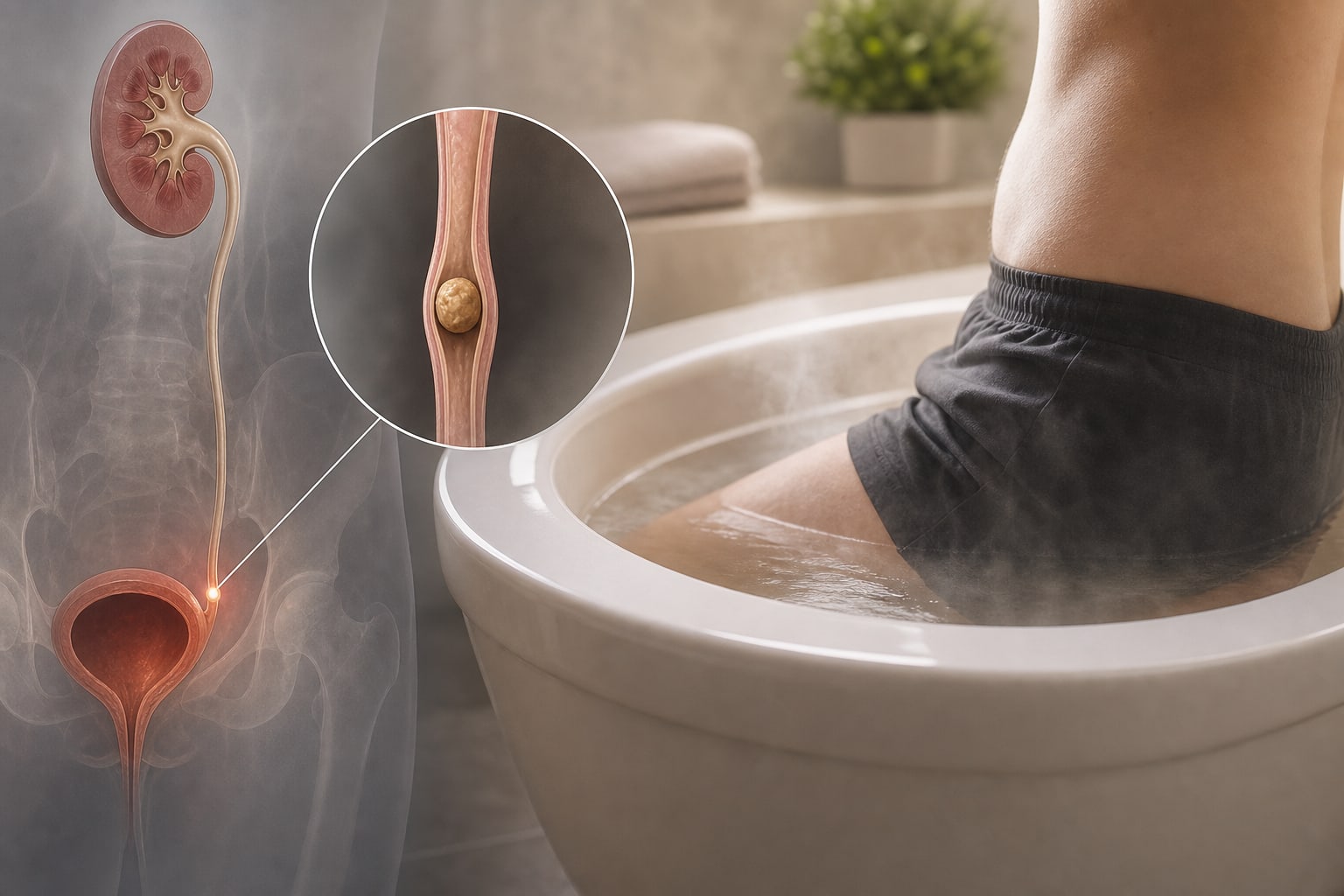
To evaluate the efficacy of warm sitz bath (WSB) as an adjunctive conservative therapy for patients with distal ureteral calculi (DUC) ≤5 mm.
Approach:
Study Design: A total of 131 eligible patients with DUC ≤5 mm were prospectively randomized into the WSB group or the control group.
Intervention: Patients in the WSB group received standardized WSB (40–42 °C, 15–20 min, once daily), while the control group received no expulsive intervention.
Follow-up: All patients were required to complete a 4-week follow-up after enrollment.
Key Findings:
The WSB group demonstrated significantly shorter stone expulsion time compared to the control group (9.3 ± 2.9 days vs. 14.3 ± 4.2 days, P < 0.001).
Stone expulsion rates at week 1 (40.7% vs. 21.0%, P = 0.019) and week 2 (81.4% vs. 61.3%, P = 0.015) were significantly higher in the WSB group.
No significant difference was observed in the 4-week stone expulsion rate (93.2% vs. 87.1%, P = 0.260).
The WSB group showed significantly fewer daily pain episodes (0.8 ± 0.3 vs. 1.3 ± 0.4, P < 0.001) and lower post-treatment VAS scores (3.1 ± 1.0 vs. 4.2 ± 1.7, P < 0.001).
Lower analgesic requirements were noted in the WSB group (4.1 ± 1.5 vs. 8.4 ± 3.1, P < 0.001).
Interpretation:
WSB may shorten the expulsion time of DUC ≤5 mm and reduce pain burden and analgesic requirements; however, it does not significantly improve the overall 4-week stone expulsion rate.
Limitations:
The study did not include a blinding procedure due to the nature of the intervention.
The sample size may limit the generalizability of the findings.
Conclusion:
WSB may be beneficial in reducing pain and expulsion time for DUC ≤5 mm, but does not significantly affect the overall stone expulsion rate over 4 weeks.
These 10 metropolitan areas reported population gains and active federal shortage area designations identified in census and health care workforce data.