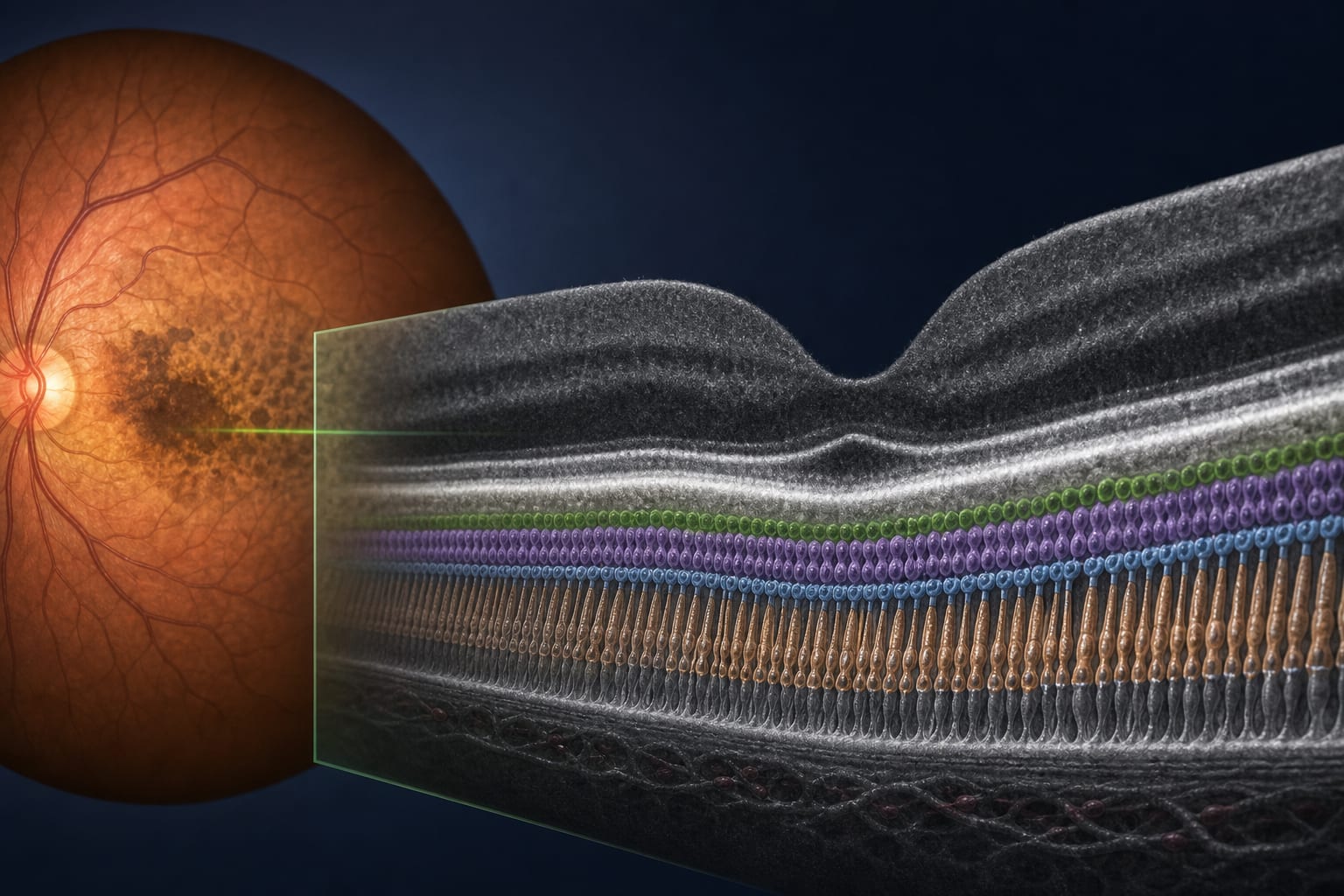
CLEAR report 1: a scoping review and meta-analysis for definitions, imaging metrics, and functional correlates of photoreceptor integrity in AMD - Summary - MDSpire
Advertisement
CLEAR report 1: a scoping review and meta-analysis for definitions, imaging metrics, and functional correlates of photoreceptor integrity in AMD
To map how axial photoreceptor biomarkers are operationalized, segmented, validated, and related to functional and multimodal endpoints in age-related macular degeneration (AMD).
Approach:
Study Selection: MEDLINE, Embase, and Scopus were searched from January 2015 to December 2025 following PRISMA-ScR guidelines for studies reporting OCT-based photoreceptor biomarkers in AMD populations.
Data Extraction: Data captured included boundary definitions, imaging platforms, segmentation approaches, analytic domains, ROI strategies, reliability statistics, structure–function correlations, and OCT–FAF agreement.
Key Findings:
Ninety-four studies met inclusion criteria, showing variability in boundary definitions, measurement strategies, and spatial sampling.
High reliability for EZ and ONL metrics was observed when segmentation boundaries were clearly defined (ICC > 0.90).
Moderate-to-strong correlations were found between photoreceptor loss and microperimetry sensitivity (r = 0.50–0.80) and best-corrected visual acuity (r = 0.40–0.70).
OCT–FAF agreement for geographic atrophy detection was high (κ > 0.80), though early atrophic features showed greater definitional variability.
Interpretation:
OCT-derived photoreceptor biomarkers demonstrate high analytical reliability and clinically meaningful structure–function associations when reporting conventions are consistently applied.
Limitations:
Substantial construct heterogeneity complicates cross-study comparability and endpoint interpretation.
Inconsistent documentation of phenotypic stratification and topographic reporting.
Conclusion:
Adoption of consensus boundary definitions, minimum reporting standards, and harmonized validation frameworks is necessary for reproducibility and regulatory evaluation.
Frank Brodie, MD, MBA, presents the surgical technique for subretinal placement of the PRIMA implant, an investigational therapy for advanced geographic atrophy.