A transfer learning-based multimodal model for early prediction of 90-day respiratory failure in dermatomyositis-associated interstitial lung disease - Summary - MDSpire
Advertisement
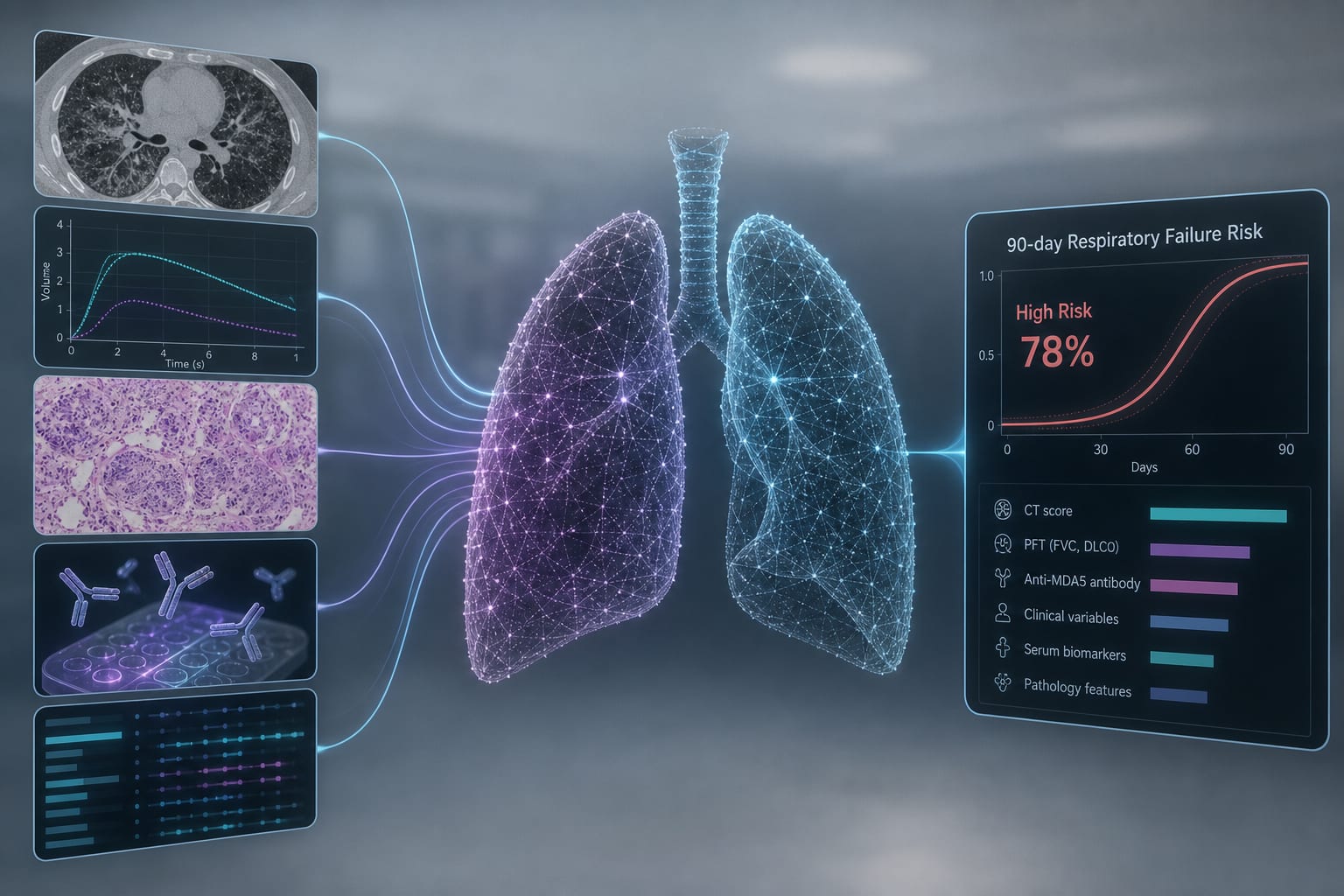
A transfer learning-based multimodal model for early prediction of 90-day respiratory failure in dermatomyositis-associated interstitial lung disease
To develop and internally test a multimodal model for predicting 90-day respiratory failure in patients with dermatomyositis-associated interstitial lung disease (DM-ILD) when anti-MDA5 antibody status is unavailable at admission, addressing the need for timely risk assessment.
Approach:
Model Development: A multimodal random forest model was developed using demographic characteristics, clinical features, laboratory results, pulmonary function indices, and latent CT features.
Key Findings:
The early-fusion random forest model incorporating PCA showed the best performance with an AUC of 0.967 and a PR-AUC of 0.879.
Influential predictors included arthritis, pulmonary function indices, laboratory markers, and several latent CT features identified through the model.
Interpretation:
The admission-based multimodal model demonstrated strong performance in predicting 90-day respiratory failure risk in patients with DM-ILD.
Limitations:
The study was conducted at a single center, which may limit generalizability to broader populations.
No formal sample-size calculation was performed, which may affect the robustness of the findings.
Conclusion:
The model may assist in stratifying respiratory failure risk in DM-ILD patients when anti-MDA5 antibody results are delayed.