Freely accessible large language models for parent education in pediatric immune thrombocytopenia: an expert-rated cross-sectional study of safety, readability, and guideline concordance - Summary - MDSpire
Advertisement
Freely accessible large language models for parent education in pediatric immune thrombocytopenia: an expert-rated cross-sectional study of safety, readability, and guideline concordance
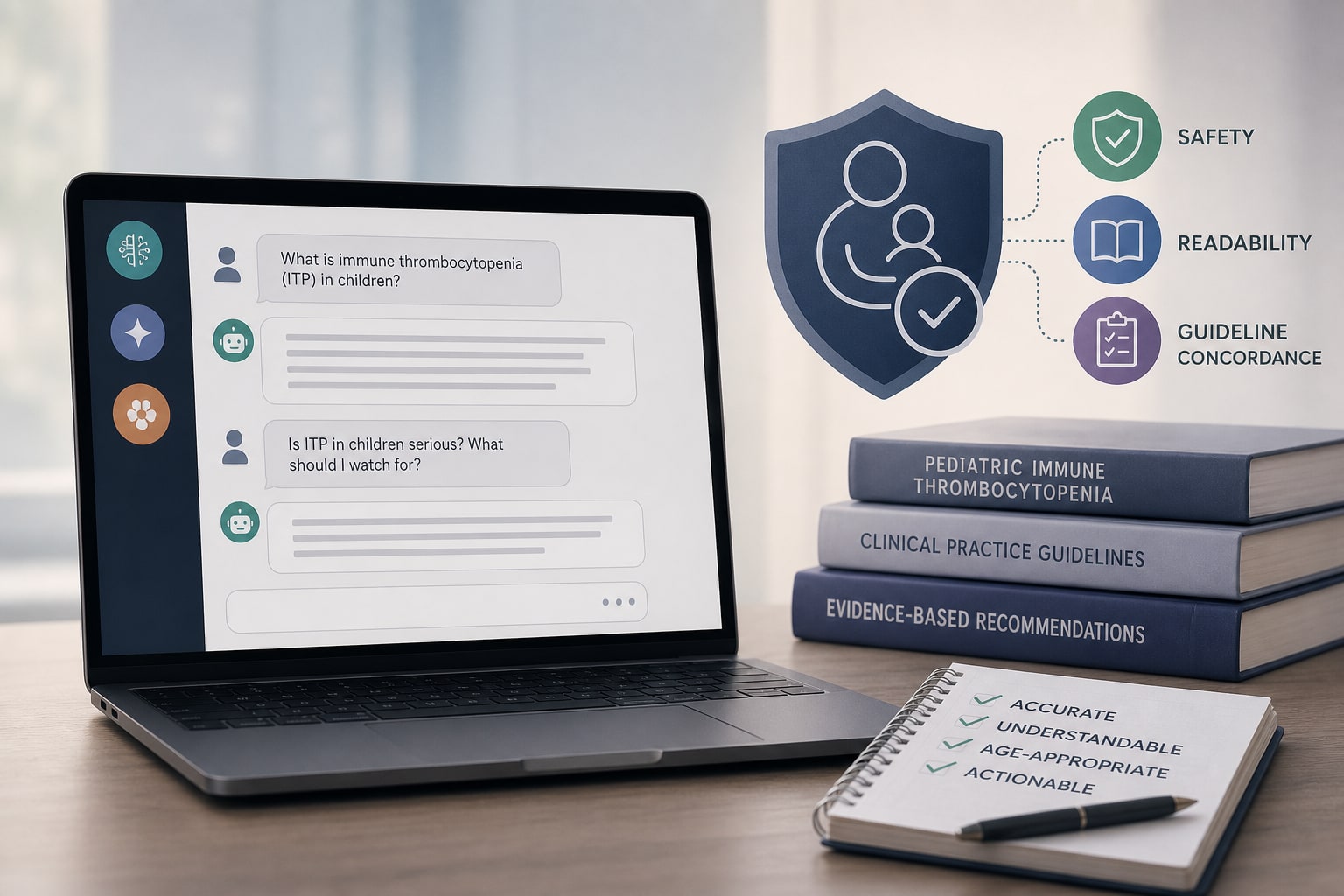
To assess the quality, safety, readability, and guideline/reference concordance of freely accessible LLM responses to parent-oriented questions about childhood ITP.
Approach:
Study Design: Cross-sectional analysis of LLM-generated responses to standardized parent-oriented questions about childhood ITP.
Evaluation Method: Responses were rated by clinical reviewers using the AI-ITP Parent Response Score (AI-ITP-PRS) and assessed for unsafe content and readability based on predefined criteria.
Key Findings:
Gemini 3 Flash had the highest mean composite score (32.78), followed by Claude Sonnet 4.6 (30.60) and GPT-5.3-mini (29.98).
Medical accuracy, guideline/reference concordance, and safety were largely similar across models.
Two instances of unsafe content were detected in responses generated by Gemini 3 Flash.
Interpretation:
Freely accessible LLMs can produce supportive explanations about childhood ITP, but the highest scores reflect communication performance rather than definitive safety superiority.
Limitations:
The study cannot precisely estimate true safety-event rates.
It does not establish robust rare-event safety differences between models.
Model behavior across repeated generations is not defined, and the matched categorical comparison for safety events was not statistically significant.
Conclusion:
Freely accessible LLMs can provide educational content for parents regarding childhood ITP, but caution is needed regarding safety and accuracy.
Boston magazine has named more than 145 physicians affiliated with Dana-Farber Cancer Institute to its annual "Top Doctors" guide. Drawing from a Castle Connolly Medical Ltd. physician database, the Boston magazine Top Doctors™ list draws from hundreds of Boston-area physicians in many medical specialties