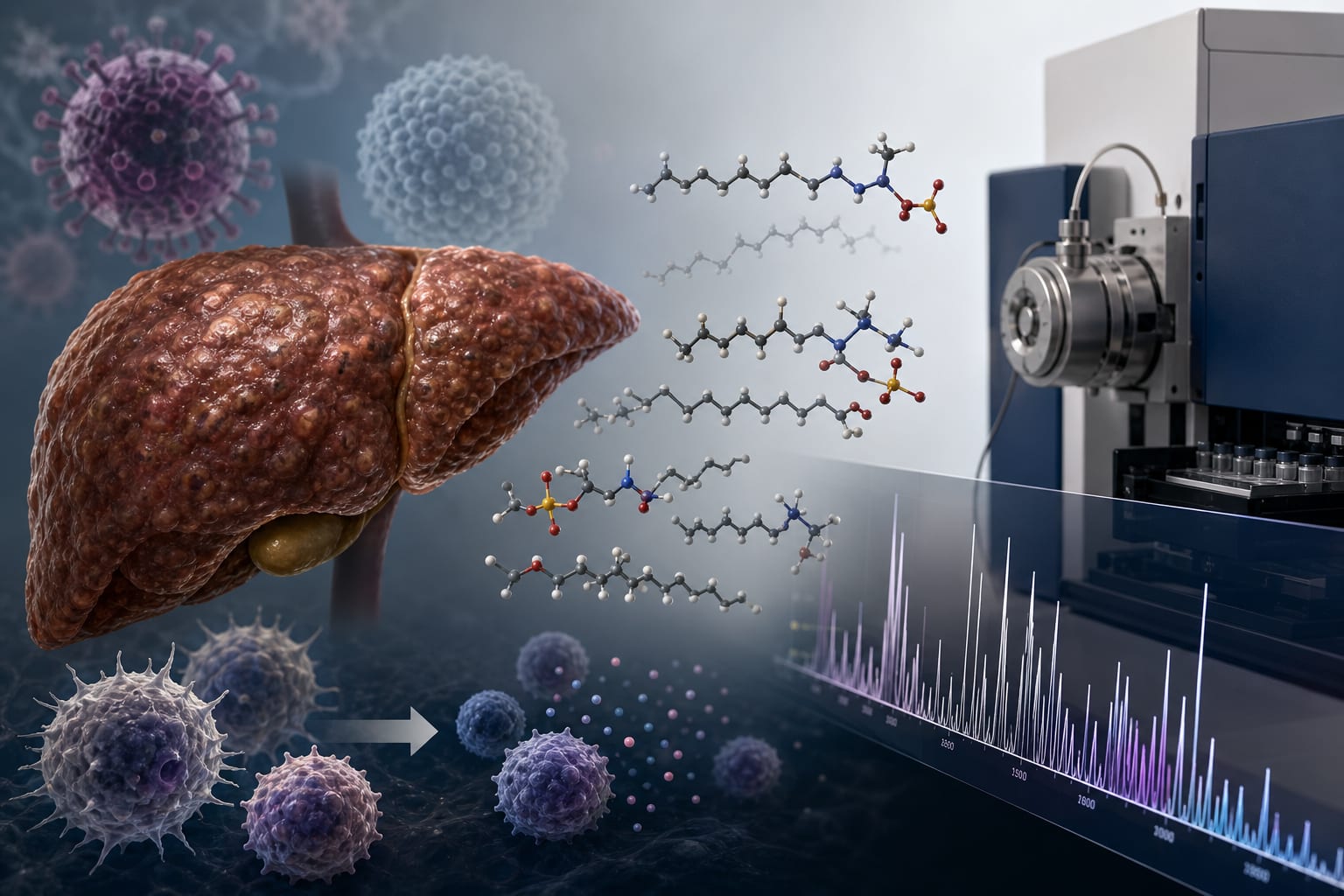
To characterize the plasma lipidomic profile that differentiates decompensated advanced chronic liver disease (dACLD) from compensated advanced chronic liver disease (cACLD) in HIV/HCV-coinfected patients and investigate its links to systemic inflammation and immune dysregulation.
Approach:
Study Design: Cross-sectional study involving 58 HIV/HCV-coinfected patients with advanced chronic liver disease, utilizing untargeted liquid chromatography-mass spectrometry for lipidomic analysis.
Statistical Analysis: Multivariate (OPLS-DA) and univariate (GLM) statistical models were employed to identify lipid species associated with disease severity.
Key Findings:
A signature of 28 lipids—predominantly phosphatidylcholines, phosphatidylethanolamines, and triglycerides—was significantly depleted in patients with dACLD (17.2% of the cohort).
This systemic lipid depletion showed relevant correlations with the pro-inflammatory chemokine IP-10 and soluble immune checkpoint proteins.
Interpretation:
The findings suggest that dACLD in HIV/HCV-coinfection is characterized by significant plasma lipid depletion, which correlates with markers of inflammation and immune activation.
Limitations:
The study is cross-sectional, limiting causal inferences.
The sample size of 58 patients may not fully represent the broader population.
Conclusion:
Lipid dysregulation may play a critical role in the pathogenesis of liver decompensation in HIV/HCV-coinfected patients.
by Raquel Behar-Lagares, Belen Requena, Juan Berenguer, Ana Virseda-Berdices, Juan Gónzalez-García, Carolina Gonzalez-Riano, Cristina Díez, Victor Hontañón, Aida Vaquero-Rey, Coral Barbas, Salvador Resino, Rubén Martín-Escolano, María Ángeles Jiménez-Sousa